

Commentary
Judy Dempsey
{
  "authors": [
    "Judy Dempsey"
  ],
  "type": "commentary",
  "blog": "Strategic Europe",
  "centerAffiliationAll": "",
  "centers": [
    "Carnegie Endowment for International Peace",
    "Carnegie Europe"
  ],
  "collections": [
    "EU Integration and Enlargement"
  ],
  "englishNewsletterAll": "",
  "nonEnglishNewsletterAll": "",
  "primaryCenter": "Carnegie Europe",
  "programAffiliation": "",
  "programs": [],
  "projects": [],
  "regions": [
    "Europe"
  ],
  "topics": [
    "EU"
  ]
}
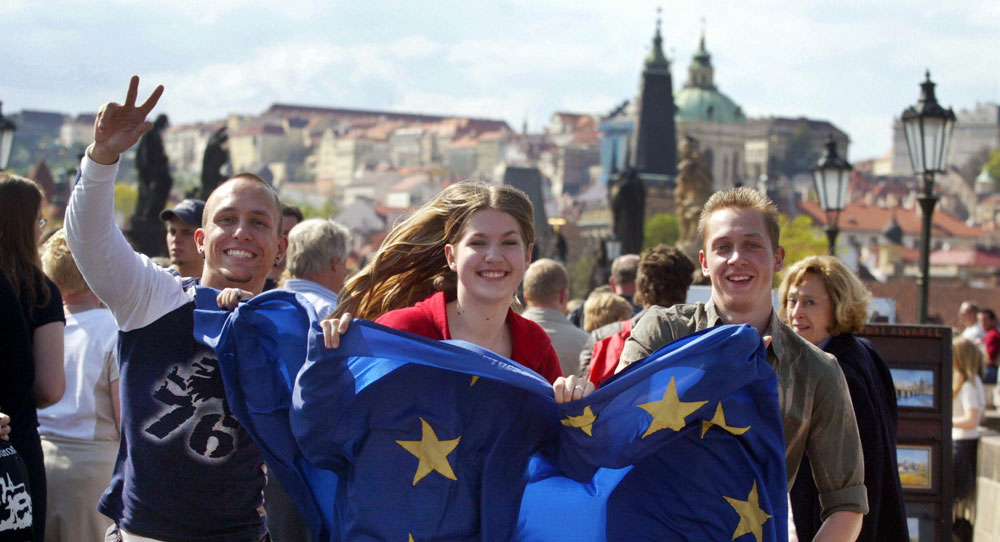
Source: Getty
Despite Brexit, the rise of populist movements, and lack of a strategic outlook, countries still queue to join the European Union.
It was the finches.
These birds nearly scuppered Malta’s chances of joining the European Union fifteen years ago. The Maltese negotiators wanted a derogation that would allow their citizens continue to trap finches during the migration season and keep them in cages. For some observers it was a puzzling request. For environmentalists, it was unacceptable. But what the finch controversy revealed was the special, different, and largely unknown cultural traditions in other parts of Europe.
Malta’s request was just one of the many exceptions requested by the ten countries about to continue the EU’s policy of stabilizing and uniting Europe. Unifying—but not necessarily integrating—Europe was what the big bang enlargement was about.Eight countries from the Baltics and Central and Eastern Europe—which for decades had been under the Soviet yoke—joined the EU along with Cyprus and Malta on May 1, 2004, ending most of the divisions of post-1945 Europe. That unification of the continent will be complete when the Western Balkans joins the bloc. Then comes the big question about where Europe’s borders end. Brexiteers have no doubts about that answer.
Those heady days of the 2004 enlargement were memorable both in Brussels and in the capitals of the new member states. There was a tremendous sense of relief. Eastern Europe had returned home.
It’s easy to wax nostalgic about those times. But the excitement about being part of the European project was genuine. Now, as the 28-member bloc prepares for elections to the European Parliament, the idea of Europe’s direction is being challenged by the increasing number of populist movements across the continent.
Europe, however, is also being defended—not just by the established parties that sometimes seem tired but by grassroots and civil society activists who believe Europe is worth standing up for. But here is the nub of Europe’s current predicament. Euroskeptics and pro-Europeans alike lack any strategic compass.
The Euroskeptics and the populists—whether from far-right or far-left wing parties, be they in Poland or Hungary, Italy, Finland, or France—protest against what they see as the creeping interference of Brussels and the undermining of their national sovereignty. Yet corrupt elites in Romania, Bulgaria, and elsewhere do everything possible to undermine the independence of the judiciary, the courts, and the independent media. It’s hard to know what these elites really stand for, except to protect the status quo and talk about “taking back control.”
As for the pro-Europeans—and this includes the Remain camp in Britain—they want to defend what Europe stands for. But when it comes to the crunch, the defenders of the European project are not prepared to match their support for the bloc’s four freedoms with strategy.
Strategy means identifying interests, identifying threats, and identifying the means of upholding the democratic institutions of the post-1945 era in Western Europe—and the post-1989 era of Central and Eastern Europe.
Relying on soft power, which has been an intrinsic part of the EU’s enlargement policy, is no substitute for strategy. The Europe of 2019 is radically different from the Europe of 2004. Cybersecurity, artificial intelligence, and digitization, as well as disinformation campaigns and fake news, have the enormous potential to chisel away at Europe’s democratic institutions. And leaving aside the refugee issue, which has damaged Europe so much, there is no consensus about how to deal with the future of the transatlantic relationship, let alone China’s or Russia’s ambitions to divide the West.
Yet neither the leaders of the EU’s institutions nor national governments are pulling together to deal with these threats that have a long-term and corrosive, if not destabilizing, affect on the European project itself.
That is where the finches come home to roost (if they are allowed to).
During the big bang negotiations, the countries that were about to join the EU were pulled in two directions: between being “communautaire” or pro-Commission in outlook and wanting to defend their national interests. They all signed up to the acqui communuataire, the tens of thousands of pages of EU legislation that they agreed to implement. Forget about lacking the capacity to absorb such laws, or allocate development and structural funds, or having a civil service to see everything through.
Yet during the first several years after the big bang enlargement, most of these countries were communuataire in spirit. Today, it is almost the opposite. The member states hold sway. That puts integration on the backburner. It begs the question if the big bang enlargement is incomplete because it did not lead to more integration, or if widening the EU is incompatible with more integration.
One thing is certain: enlargement has not fostered a strategic culture in Europe. Until that happens, the European project will be incomplete. Its leaders will also be unprepared to redefine or rebuild the West, if it is not already too late.

Nonresident Senior Fellow, Carnegie Europe
Judy Dempsey is a nonresident senior fellow at Carnegie Europe
Recent Work
Judy Dempsey
Judy Dempsey
The EU had to compromise to adopt a twenty-first sanctions package against Russia, exposing growing cracks in the union’s resolve. Is this latest, weaker round worth it to keep pressure on Moscow?

Rym Momtaz, ed.
Trump is distracted and Ukraine wants Europe to step up. The continent’s leaders must find their voice and assert it in talks with Russia.

Alissa de Carbonnel

Mounting economic strain and battlefield losses will not necessarily make the Kremlin less dangerous. They could instead push Moscow toward a more aggressive hybrid campaign designed to test NATO’s Eastern flank, exploit allied hesitation, and fracture European resolve.

Maksym Beznosiuk
Over the past ten years, NATO has held almost as many summits as it did during the entirety of the Cold War. Are they still useful, or is it time to stop holding annual meetings?
Rym Momtaz, ed.
Nearly a year and a half after Europeans leaned into sucking up to Trump, the strategy has produced some benefits when it comes to Ukraine.
Rym Momtaz