

Commentary
Gwendolyn Sasse
{
  "authors": [
    "Gwendolyn Sasse"
  ],
  "type": "commentary",
  "blog": "Strategic Europe",
  "centerAffiliationAll": "",
  "centers": [
    "Carnegie Endowment for International Peace",
    "Carnegie Europe"
  ],
  "collections": [
    "Europe’s Eastern Neighborhood"
  ],
  "englishNewsletterAll": "",
  "nonEnglishNewsletterAll": "",
  "primaryCenter": "Carnegie Europe",
  "programAffiliation": "",
  "programs": [],
  "projects": [],
  "regions": [
    "Europe",
    "Eastern Europe",
    "Ukraine"
  ],
  "topics": [
    "Political Reform",
    "EU"
  ]
}
Source: Getty
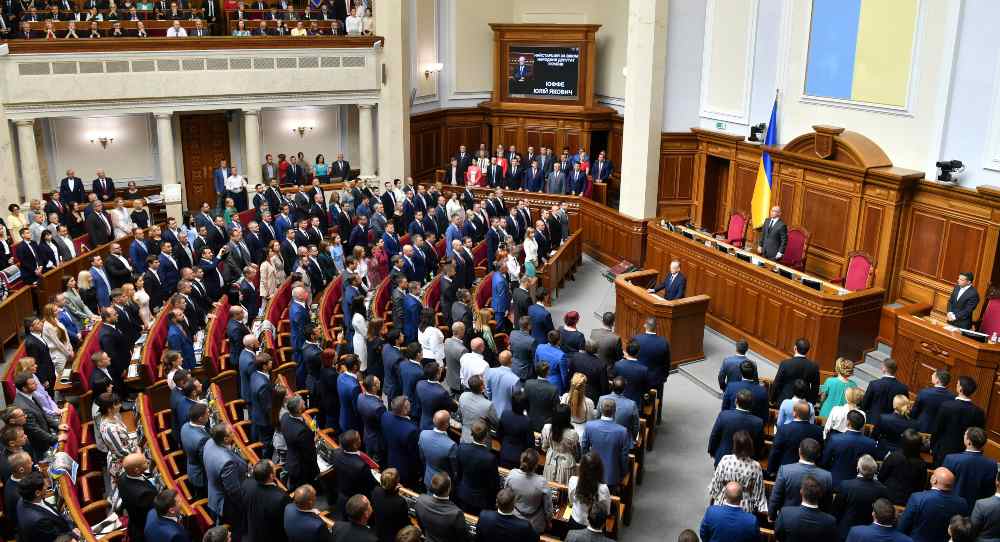
Government and parliament are accepting President Zelenskiy’s proposals and orders too readily, thereby turning the Ukrainian political system into much more of a presidential system than it has ever been.
Since the parliamentary elections in Ukraine in July 2019, which led to a large-scale turnover of parliamentarians, many commentators have focused on the lack of political experience characterizing the new Verkhovna Rada.
Almost 80 percent of the current members of parliament (MPs) have never held a Rada mandate before; only 83 deputies managed to get reelected from the previous parliament and 13 deputies from earlier ones.For the moment, the Ukrainian public sees the work of parliament positively—a big change from before the elections. According to a poll by the Razumkov Centre in early September, 44 percent positively evaluate the work of the new parliament (compared to 70 percent positively evaluating the president’s performance to date).
Elite turnover can facilitate structural reforms, as old interests and networks are disrupted, but it also carries risks, as reforms require commitment and expertise that can only be built gradually.
Relying on an unprecedented majority in parliament that enables him to get potentially uncomfortable laws passed, Ukrainian President Volodymyr Zelenskiy enjoys a privilege his predecessors lacked. However, the one-party majority could also play an active part in further diminishing the constitutional role of the parliament as the key institution scrutinizing, debating, and amending legislative initiatives.
In its first month, the Rada has uncritically waved through the initiatives of the executive. These worrying signs and the overall uncertainty about Zelenskiy’s ability to deliver on reforms necessitate a closer look at the MPs.
New research at the Centre for East European and International Studies (ZOiS) puts these various claims about the new Rada in perspective.
Overall, Zelenskiy’s faction controls 254 of the currently 423 mandates in parliament. Each of the other four parties controls no more than 25-55 seats, and they are too divided among themselves to make for a coherent parliamentary opposition.
The deputies new to the Rada include all 254 MPs of Zelenskiy’s party, Servant of the People; nineteen MPs of Voice; twenty-three MPs of the Opposition Platform—For Life, one of the successors to the Yanukovych-era Party of Regions; six MPs from Fatherland; and another six MPs from former president Petro Poroshenko’s European Solidarity.
Compared to the previous Rada, the average age of all MPs has dropped from forty-eight to forty-one, with the average age of the new MPs being thirty-nine. Female representation has increased from about 13 to 21 percent, though primarily thanks to MPs from Voice and European Solidarity rather than from Servant of the People.
97 percent of all deputies have a higher education record, mostly in law (31 percent) and economics or management (27 percent). 21 percent of all MPs (and 17 percent of the new MPs) have a PhD or similar academic qualification, while 10 percent of the Rada were at least partially educated abroad.
Before being elected to the current Rada, 42 percent of the MPs held a business-related position; 27 percent held a political position (compared to only 8 percent of the new MPs); and 7 percent held a position in civil society (compared to 9 percent if only counting new MPs).
61 percent of the new MPs have not had any prior first-hand experience in politics.
Of the MPs with political experience in the current Rada, about a third held parliamentary mandates before, a third have been assistants to former MPs, about 38 percent have been regional or local council deputies in the past, and 12 percent have worked in ministries.
By comparison, 38 percent of all MPs have civil society experience. Of these, 48 percent were members or founders of NGOs, while 17 percent worked for charitable funds (organizations tasked with supporting specific constituencies).
In light of the high number of MPs with civil society experience, cooperation with civil society actors should be possible.
Some of the characteristics of the parliamentarians directly map onto the first decisions taken by parliament. In particular, the unusual move of parliamentarians to remove their own immunity was facilitated by their lack of previous political ties and privileges.
It cannot be ruled out that the new MPs will find themselves divided by economic or other interests in due course, but for the moment, Zelenskiy’s agenda is not curtailed by this. This structural advantage is balanced by the risk that government and parliament are accepting Zelenskiy’s proposals and orders too readily, thereby turning the Ukrainian political system into much more of a presidential system than it has ever been.
Time is of the essence in Ukraine’s reform process, in particular in the area of judicial reforms, but this should not come at the cost of sacrificing the democratic credentials of the system.
Gwendolyn Sasse is a nonresident senior fellow at Carnegie Europe and director of the Centre for East European and International Studies (ZOiS) in Berlin.
The author gratefully acknowledges the research assistance of Viktoriia Omelianenko, student at the Institute of International Relations at the Taras Shevchenko National University of Kyiv.
Nonresident Senior Fellow, Carnegie Europe
Gwendolyn Sasse is a nonresident senior fellow at Carnegie Europe. Her research focuses on Eastern Europe, with a particular focus on Ukrainian politics and society, EU enlargement, and comparative democratization.
Recent Work
Gwendolyn Sasse
Gwendolyn Sasse
Carnegie does not take institutional positions on public policy issues; the views represented herein are those of the author(s) and do not necessarily reflect the views of Carnegie, its staff, or its trustees.

The aftermath of the Ceuta crisis shows Europe has drawn the wrong lessons. Rather than doubling down on failed migration policies, the EU needs to address the underlying roots of such episodes.

Richard Youngs

An overwhelming victory by a far-right-wing party in a small state in eastern Germany will have major repercussions for Chancellor Friedrich Merz’s coalition.

Judy Dempsey

Canadian Prime Minister Mark Carney has twice inspired praise for standing up to U.S. President Donald Trump: at the 2026 World Economic Forum in Davos and on Canada-U.S. trade negotiations. Is Carney showing a third way better than the EU has in dealing with the Trump administration?

Rym Momtaz, ed.

The EU’s responses to two recent incidents expose the gulf between European perceptions and capabilities. Unless the union can bridge that gap, it will never become a real geostrategic power.
Rym Momtaz

In supporting Europe’s far-right, MAGA and Russia both want the same thing: a weaker EU. Europe must defend itself without abandoning the openness these forces exploit.

Armida van Rij