

Commentary
Judy Dempsey
{
  "authors": [
    "Judy Dempsey"
  ],
  "type": "commentary",
  "blog": "Strategic Europe",
  "centerAffiliationAll": "",
  "centers": [
    "Carnegie Endowment for International Peace",
    "Carnegie Europe"
  ],
  "collections": [
    "Transatlantic Cooperation"
  ],
  "englishNewsletterAll": "",
  "nonEnglishNewsletterAll": "",
  "primaryCenter": "Carnegie Europe",
  "programAffiliation": "",
  "programs": [],
  "projects": [],
  "regions": [
    "Europe",
    "North America",
    "United States",
    "Western Europe"
  ],
  "topics": [
    "Security"
  ]
}
Source: Getty
A selection of experts answer a new question from Judy Dempsey on the foreign and security policy challenges shaping Europe’s role in the world.
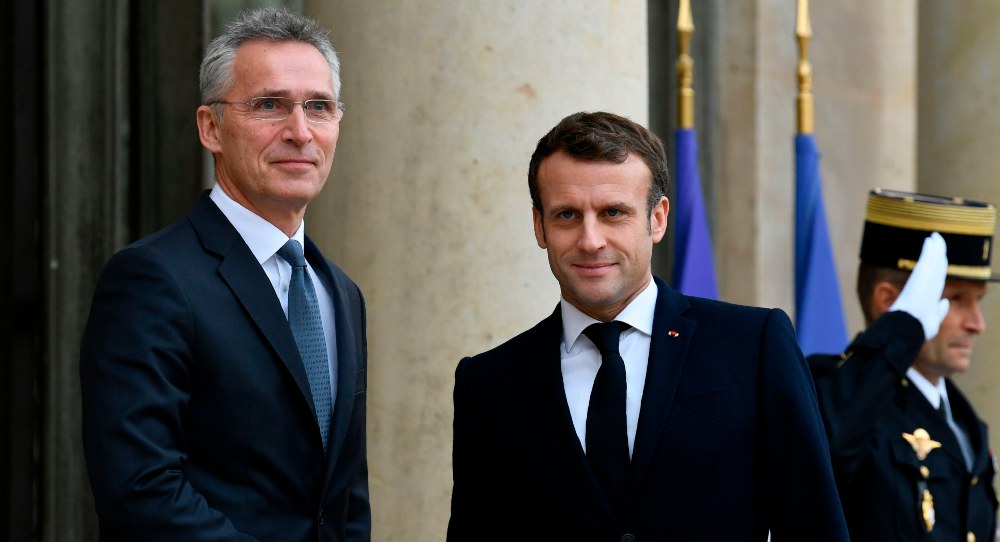
French President Emmanuel Macron’s interview with the Economist will be remembered for his criticisms of NATO and not for his views about Europe’s future. During the annual Berlin Foreign Policy Forum, I asked several participants if they thought NATO was brain-dead. Here are their responses.
Yes. NATO needs to be reinvented for the twenty-first century.
There is no way to know whether NATO is brain-dead or not. The response will be given by the U.S. president and the U.S. electorate in 2020. As Europeans, we should do everything in our power to strengthen NATO as much as possible and to be ready for the day that it ceases to exist.
I agree particularly with Macron that we need a more open political dialogue. Several countries have to do their homework—especially when it comes to capabilities. The pressure from the United States is good, but it needs to be much more constructive.
2019 was supposed to be a big birthday party for NATO. Unfortunately, the celebrations did not exactly go as planned. In fact, at every party you have two main groups: those who come to have a good time, and those who join mainly to criticize the host.
Yet, 2019 confirmed the politico-military substance, which is the true glue of NATO. On numerous occasions, this has proven to be more important than fiery speeches and digital rhetoric. In 2019, NATO did deliver.
The list of concrete decisions remains robust and includes, among others: adoption of the Black Sea package; speeding up of the military adaptation in response to the Russian violation of the INF Treaty; update of the baseline requirement for civilian telecommunications to cover 5G; recognition of space as an operational domain; full operationalization of the counter-hybrid support teams as a dedicated instrument to help allies respond to a hybrid attack; adoption of the first roadmap to deal with disruptive and emerging technologies.
NATO is alive and kicking. If Émile Zola was to write his famous article today (“J’Accuse…!”), it surely wouldn’t be about NATO and its idleness.
Actually, I think Emmanuel Macron is both right and wrong. He is right that Turkish behavior and American behavior have been uncoordinated—without consultations among allies. There is a need for a more political, coordinating role. Where he is wrong is in using this term (brain-dead), which overshadowed his very interesting interview, because it essentially muted the great ideas it contained.
No. Militarily, NATO works. In fact, rather well. Politically, it is difficult due to the U.S. factor and Turkey. There’s a real challenge in keeping Europeans united. The question for me is: How are we going to organize European defense in ten or fifteen years?
No. We have a broad agreement in the transatlantic alliance to deter Russia and defend NATO territory, especially on its eastern flank. The debates taking place were operational. There is no need for a broad strategic debate, because there is an agreement between NATO countries about the mission.
I don’t think it’s brain dead. But we need to make the European Union more significant as a military and political actor.
No. It was a hyperbolic comment. You can’t say it’s brain dead when its forces are still in Afghanistan and in the Balkans. I understand it as a positive provocation to generate discussion about European security and beyond.

Nonresident Senior Fellow, Carnegie Europe
Judy Dempsey is a nonresident senior fellow at Carnegie Europe
Recent Work
Judy Dempsey
Judy Dempsey
Carnegie does not take institutional positions on public policy issues; the views represented herein are those of the author(s) and do not necessarily reflect the views of Carnegie, its staff, or its trustees.

Are Germany’s economic, industrial, and political struggles becoming a liability for the EU’s ability to rise to the geopolitical moment?

Rym Momtaz, ed.

European Commission President Ursula von der Leyen is about to give her annual address on the state of the EU. Here’s what she won’t—but should—say.
Rym Momtaz

The aftermath of the Ceuta crisis shows Europe has drawn the wrong lessons. Rather than doubling down on failed migration policies, the EU needs to address the underlying roots of such episodes.

Richard Youngs

An overwhelming victory by a far-right-wing party in a small state in eastern Germany will have major repercussions for Chancellor Friedrich Merz’s coalition.
Judy Dempsey

Canadian Prime Minister Mark Carney has twice inspired praise for standing up to U.S. President Donald Trump: at the 2026 World Economic Forum in Davos and on Canada-U.S. trade negotiations. Is Carney showing a third way better than the EU has in dealing with the Trump administration?
Rym Momtaz, ed.