
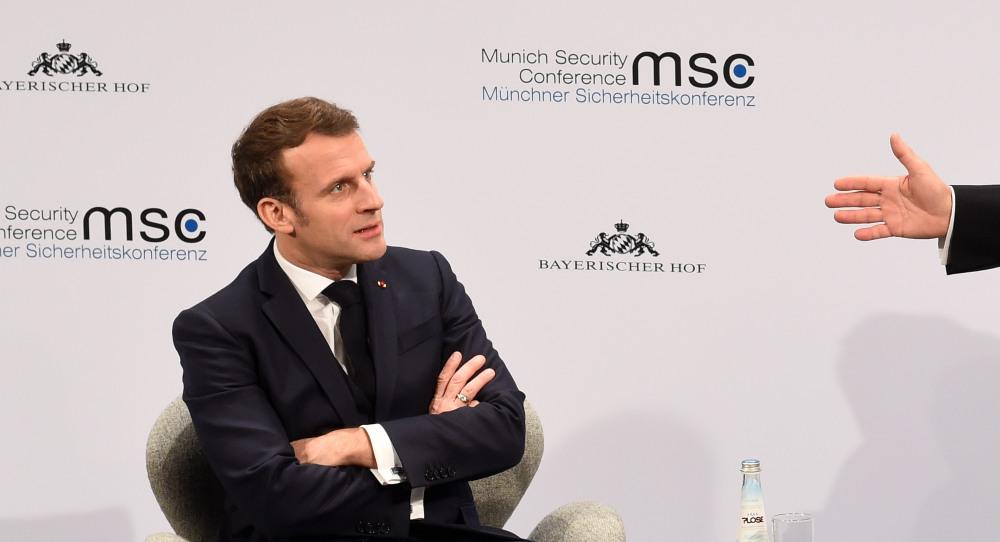
French President Emmanuel Macron is leading the charge in Europe to set out a new strategy with Russia. His goal is to end Russia’s sense of isolation and alienation, as he explained during the 2020 Munich Security Conference, which took place on February 14–16.
Macron believes Russia is essential for Europe’s security. Without engaging its big neighbor, Europe will not be safe. This is why Europe must create some kind of security architecture that includes Russia.
This is something the Kremlin—and Germany—has long advocated only to be rebuffed by most EU and NATO countries. They simply perceive those calls as attempts by Moscow to create such a construction at the expense of the transatlantic alliance. Seeking to divide NATO and weaken Europe’s ties with the United States has been the Kremlin’s consistent policy.
U.S. President Donald Trump’s “America First” policy, in which the EU is repeatedly criticized by Washington for its trade and competition practices, could be exploited by Russian President Vladimir Putin.Under the Trump administration, Macron believes Europe can no longer take for granted that the United States will continue to defend Europe. That actually doesn’t seem to hold water given how much the Pentagon is investing in terms of personnel and spending in the security and defense of the Baltic states.
And despite Macron’s criticism of NATO as a military and political organization—its “brain-death,” in Macroniste shorthand—publics have a different view about the alliance.
According to a recent Pew Research Center report on attitudes toward NATO, publics in member states are convinced that the United States would use military force to defend a NATO ally from Russia. An average of 60 percent believe the United States would defend an ally, while just 29 percent believe it would not.
So the United States continues to be seen as a reliable ally.
But just consider how European allies would react if one of its NATO allies was attacked by Russia. A median of 50 percent across sixteen NATO member states say their country should not defend an ally against a Russian attack, compared with only 38 percent who say their country should defend an ally, according to the survey. The vast majority of publics against defending an ally are European.
In other words, European publics are more likely to believe the United States would defend a NATO ally from a Russian attack than to think their own country should do the same. What does the Kremlin think about that then?
Despite those findings, Macron believes Europe must be prepared to become sovereign, more autonomous, and more capable of taking care of its own security and defense. Reaching out to Russia would enhance Europe’s security.
Macron’s overtures to Russia, however, are a one-way street for several reasons.
First, he has never spelled out the conditions for such a strategic partnership between Russia and Europe. The EU is supposed to place much emphasis on values, but human rights, media freedom, intimidation of investigative journalists, attacks on the rule of law, and the territorial integrity of countries are not part of Macron’s “conversation” about Russia.
Furthermore, if values were that important to Macron’s policies, he could openly criticize how Russia, apart from continuing to prop up the brutal regime of President Bashar al-Assad, has been bombing civilians, hospitals, and schools in Syria—more recently in the northwestern city of Idlib. The suffering is appalling. In a statement on Monday, the head of the UN’s humanitarian affairs office, Mark Lowcock, called it “the biggest humanitarian horror story of the 21st Century.”
And if security is so important for Macron, he knows full well how the war in Syria has created a political and security problem for Europe. The flow of refugees has fueled the rise of far-right, populist parties—not to mention the terrorist threats and attacks. It’s as if European leaders and publics have become inured to the war in Syria.
Second, his support of the principle of sovereignty, which he advocates for Europe, seems to be selectively used. Macron only has to look toward Ukraine, which Russia invaded in 2014 before illegally annexing the Crimean Peninsula. Since then, over 10,000 civilians have been killed in the war and over 1.5 million people have been internally displaced.
Sovereignty, it seems, is an exclusive right or aspiration for Europe. And given the competing players in Syria, it’s hard to see how that country’s sovereignty can be regained—an issue Russian Foreign Minister Sergei Lavrov blithely dismissed when asked about at the Munich Security Conference.
This suggests that Macron’s overtures to Russia are based not on values but on interests. But even the latter doesn’t add up. What Russia is doing in Ukraine and Syria is against Europe’s interests. And even if his overtures are based on realpolitik, Macron can only win support from other Europeans if Moscow were to give something in return. And so far, it won’t.
Macron’s way is a cul-de-sac.


