

Commentary
Judy Dempsey
{
  "authors": [
    "Judy Dempsey"
  ],
  "type": "commentary",
  "blog": "Strategic Europe",
  "centerAffiliationAll": "",
  "centers": [
    "Carnegie Endowment for International Peace",
    "Carnegie Europe"
  ],
  "collections": [
    "Coronavirus"
  ],
  "englishNewsletterAll": "",
  "nonEnglishNewsletterAll": "",
  "primaryCenter": "Carnegie Europe",
  "programAffiliation": "",
  "programs": [],
  "projects": [],
  "regions": [
    "Asia",
    "Europe",
    "East Asia",
    "China",
    "Western Europe"
  ],
  "topics": [
    "Foreign Policy",
    "EU",
    "Security",
    "Technology"
  ]
}
Source: Getty
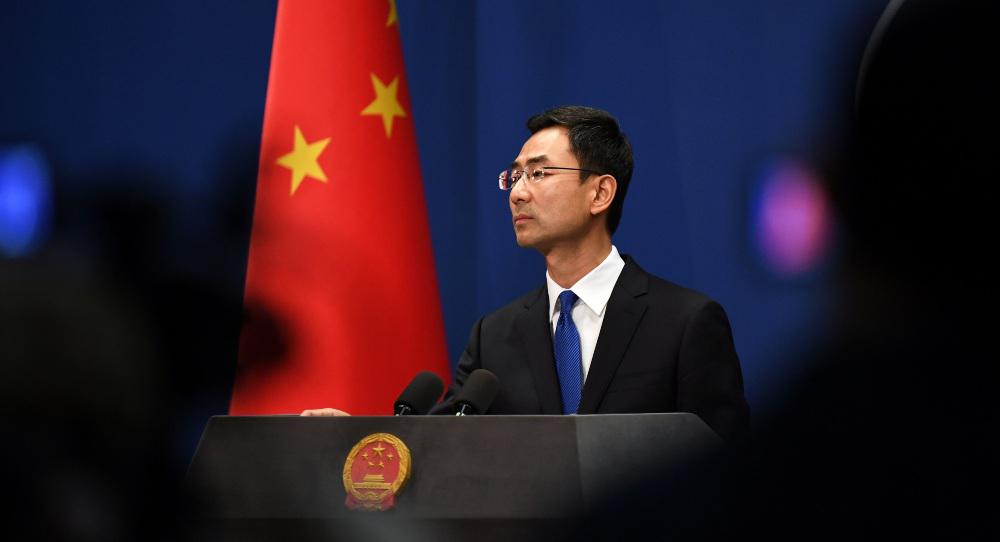
Overcoming the coronavirus pandemic is also about the EU defending its own principles of transparency and truthfulness, both of which China is aggressively challenging.
It’s not easy being a Western diplomat in Beijing these days. It’s not just because of the restrictions imposed by the Chinese communist authorities to contain the coronavirus pandemic.
Ever since the virus broke out in Wuhan back in December 2019—which for some weeks was covered up by the authorities—Beijing has gone on a massive campaign of disinformation and intimidation.It is targeting Western embassies based in China. It is targeting any democratic government that dares call for an independent inquiry into the origins of the new coronavirus. It is targeting any organization that dares to challenge China’s narrative about a virus that has already killed over 211,000 people worldwide as of April 28, 2020.
When Australia’s foreign minister, Marise Payne, recently called for such an investigation, China threatened to retaliate by banning the import of wine and other products.
When the European External Action Service (EEAS) was putting the finishing touches to a report about how Russia and China are stepping up their disinformation campaigns throughout Europe, Beijing piled on the pressure on some of its diplomats. The report was released but watered down in parts, according to Politico Europe, which broke the story.
The report—on “narratives and disinformation” around the coronavirus pandemic—was finally published on April 24 with heavily toned-down language on China.
According to Politico Europe, references to Beijing running a “global disinformation” campaign and to Chinese criticism of France’s handling of the pandemic were removed. The final version of the report stated that “official and state-backed sources from various governments, including Russia and—to a lesser extent—China, have continued to widely target conspiracy narratives and disinformation.”
The New York Times reported that an EU official who disagreed with the changes accused the EEAS of “self-censoring to appease the Chinese Communist Party.”
Why the self-censorship? Why the timidity of the EU not to speak openly about how China is making every effort to disseminate its own nationalist narrative about the origins of the new coronavirus?
As for Russia, its insidious campaigns of spreading false information about the virus and about how European governments are so badly prepared to deal with it are attempts to sow distrust and panic.
All this is happening at a time when people are dying from COVID-19, the disease caused by the virus, or are subject to severe restrictions in order to contain its spread.
China’s aggressive attempts to have its narrative accepted have not gone unchallenged in several EU countries.
Sweden, for one, which has criticized Beijing’s handling of the pandemic and the silencing of critics and human rights activists, has been subject to a barrage of intimidation by the Chinese ambassador in Stockholm. But other countries, particularly Hungary, never criticize Beijing because of the extremely close economic ties.
As for the EEAS’s rather timid criticism, if there is an element of self-censorship at play, then the EU is playing China’s game. In doing so, it is undercutting its own principles of transparency and truthfulness at a time when the need to understand how the new virus appeared is becoming more important by the day. Cover-up and self-censorship are not panaceas.
No doubt some EU countries fear that China will retaliate by threatening to ban certain imports. The EU and China are already two of the biggest traders in the world. China is now the EU’s second-biggest trading partner and the EU is China’s biggest trading partner.
But given the state of China’s economy—and Europe’s—Beijing is going to need all the economic support it can muster to bring back the high levels of growth needed for its stability and global influence.
More importantly, its tactics of intimidation and its attempts to silence critics could backfire in Europe and other democracies.
“China is shooting itself in the foot,” said Reinhard Bütikofer, a leading German Greens party member of the European Parliament. “All the kind of goodwill it tried to build up over the past thirty years since Tiananmen Square has gone down the drain in the past three months,” he told Carnegie Europe.
Huawei, China’s giant electronics company, may be the first casualty.
Before the pandemic broke out, European governments were divided about integrating Huawei into their 5G networks. That may be changing.
Norbert Röttgen, chairman of the German parliament’s foreign affairs committee warned against signing up to it. “Corona should teach us that we must not be dependent on China for critical infrastructure—not for masks and certainly not for 5G.” he tweeted. (Shipments of masks and testing equipment sent by China to several EU countries were found to be faulty.)
Indeed, if Germany opted for a European network it would be a massive setback for Huawei and a signal for other EU countries to follow Berlin’s line.
The European Commission is also becoming more aware of China’s attempts to establish a strong and influential presence in Europe’s infrastructure. Margrethe Vestager, the EU’s competition commissioner, has proposed that European countries should buy stakes in certain companies instead of succumbing to Chinese takeovers.
“It’s clear what Europe should do with regard to China,” Bütikofer said. “There should be pushback. We have the instruments to do so, especially with the commission’s strategy paper on China.”
If only the EU member states were united, even over their own principles. Whether the coronavirus could make that happen is a big “if.”

Nonresident Senior Fellow, Carnegie Europe
Judy Dempsey is a nonresident senior fellow at Carnegie Europe
Recent Work
Judy Dempsey
Judy Dempsey
Carnegie does not take institutional positions on public policy issues; the views represented herein are those of the author(s) and do not necessarily reflect the views of Carnegie, its staff, or its trustees.

A summer of escalation in the Black Sea has hurt Ukraine economically and is exacerbating world food security. A truce is needed—as is a broader reframing of Europe’s Ukraine strategy.

Thomas de Waal

Are Germany’s economic, industrial, and political struggles becoming a liability for the EU’s ability to rise to the geopolitical moment?

Rym Momtaz, ed.

European Commission President Ursula von der Leyen is about to give her annual address on the state of the EU. Here’s what she won’t—but should—say.
Rym Momtaz

The aftermath of the Ceuta crisis shows Europe has drawn the wrong lessons. Rather than doubling down on failed migration policies, the EU needs to address the underlying roots of such episodes.

Richard Youngs

An overwhelming victory by a far-right-wing party in a small state in eastern Germany will have major repercussions for Chancellor Friedrich Merz’s coalition.
Judy Dempsey