

Commentary
Judy Dempsey
{
  "authors": [
    "Judy Dempsey"
  ],
  "type": "commentary",
  "blog": "Strategic Europe",
  "centerAffiliationAll": "",
  "centers": [
    "Carnegie Endowment for International Peace",
    "Carnegie Europe"
  ],
  "collections": [
    "Europe’s Eastern Neighborhood",
    "Transatlantic Cooperation"
  ],
  "englishNewsletterAll": "",
  "nonEnglishNewsletterAll": "",
  "primaryCenter": "Carnegie Europe",
  "programAffiliation": "",
  "programs": [],
  "projects": [],
  "regions": [
    "Russia",
    "Europe",
    "North America",
    "Eastern Europe",
    "Belarus"
  ],
  "topics": [
    "Foreign Policy",
    "Democracy",
    "EU"
  ]
}
Source: Getty
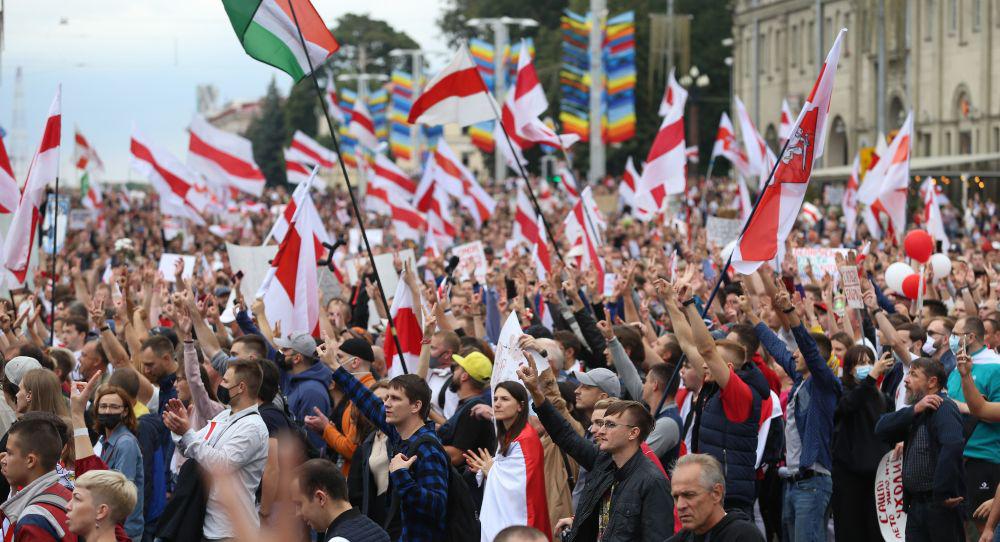
The people of Belarus are peacefully demonstrating for their freedom. The EU’s member states, along with the United States, should do much more to support them.
The offices are basic. The space is cramped. But no matter. What’s important is getting the news out to neighboring Belarus. And that’s what Belsat has been doing since 2006: broadcasting into Belarus from its headquarters in downtown Warsaw.
The satellite TV network that provides independent news in Belarusian and Russian is working around the clock ever since demonstrators across Belarus took to the streets on August 9, 2020, when President Alexander Lukashenko claimed victory for a consecutive sixth term.“It hasn’t been easy for our staff on the ground,” Agnieszka Romaszewska-Guzy, Belsat’s director, told me. “Of the ninety of so journalists detained by the regime, over a third work for Belsat.”
Belarus’s opposition, the European Union, and the United States have no doubts that the results were rigged and that the elections were neither fair nor free. But their criticism has not been matched by introducing tough measures against the regime in Minsk.
Lukashenko, relying on the security forces and implicit support from Russia, has reacted to the demonstrations by cracking down, violently.
Yet the huge demonstrations have continued each Sunday. Whatever the outcome of these peaceful protests, Romaszewska-Guzy—herself imprisoned for five months in Poland when the communist regime imposed martial law in 1981—said there was no going back to the status quo ante. “Lukashenko has lost all legitimacy. The Europeans should recognize that.”
Leading members of Belarus’s 600-strong Coordination Council—established by the opposition after the August 9 election to hold new elections and ensure the transfer of power—have either been kidnapped, disappeared, or been kicked out of the country. On September 7, one of its leaders, Maria Kolesnikova, was picked up and pushed into a minivan by masked, plainclothes people.
“Instead of talking to the people of Belarus, the outgoing leadership is trying cynically [to] eliminate [them] one by one. The kidnapping of M. Kalesnikava [sic] in downtown . . . Minsk is a disgrace. Stalinist NKVD methods are being applied in 21st century’s Europe. She must be released immediately,” Lithuanian Foreign Minister Linas Linkevicius said on Twitter.
Lithuania, along with Poland, has thrown its unequivocal support behind the opposition.
“We learned from our own history about the fight for freedom but also about the disappointment with Western reaction,” said Žygimantas Pavilionis, a Lithuanian conservative member of parliament and former ambassador to the United States.
“The big member states should say clearly that Lukashenko stole the elections and is killing people and that new elections should be organized,” he said.
“But neither France nor Germany is speaking out clearly enough. It’s as if they see Belarus through the prism of Russia. It’s just like in 1989 when we were warned not to rock the boat in case it would destabilize [then Soviet leader Mikhail] Gorbachev.”
Germany, which currently holds the EU’s six-month rotating presidency, is unwilling to impose sanctions on Lukashenko and is instead considering targeting some in the regime’s top leadership. Berlin still believes dialogue is possible.
“EU sanctions against a few people at the top mean nothing,” said Romaszewska-Guzy. “The sanctions have to hit the security people on the lower levels who are using violence, who are torturing.”
Lithuania and Poland, supported by the other Baltic states, know time is of the essence. Lukashenko is planning his inauguration ceremony and a trip to Moscow very soon, said both Pavilionis and Romaszewska-Guzy.
They believe that Lukashenko will ask Russian President Vladimir Putin for support. Russia, they added, will extract a high price. “It’s quite likely that Lukashenko will sell Belarus to Putin, and that means economically annexing Belarus,” Pavilionis said. That would give Russia more political control over its western neighbor.
It’s hard to see the Belarusian opposition accepting that move, even as the crackdown continues. Although the Eastern and Western EU member states hold different views on Belarus, they should all act together in the following ways.
First, they need to speak out and support new, fair, and free elections. This means helping the Coordination Council pave the way—through constitutional changes—for a peaceful transition. That should be in the interests of Belarus and the EU—and Russia, for that matter.
Second, the EU leaders have to explain to their own publics why Belarus matters. It’s about citizens living along the EU’s border who are demonstrating for basic freedoms and an end to violence and torture.
Third, the EU, but particularly Germany, should provide assistance to those Belarusians detained, tortured, or expelled from their country—something which Lithuania is already providing.
Fourth, Europe must provide financial support for Belarus’s independent media. Belsat has an annual budget of €10 million, with the Polish foreign ministry providing 90 percent of it. “The EU gives us nothing,” said Romaszewska-Guzy.
Fifth, Europe needs the United States to put pressure on Lukashenko—and Putin. So far, Washington’s support has been lukewarm. “I don’t hear a very clear position from the United States. We need a clear, united position from the West,” Pavilionis said.
The fear is that Lukashenko and Putin will use the distraction of the American presidential campaign to continue the crackdown and European dithering and disunity to bring Belarus politically and economically under Russia’s control.
“The people of Belarus will not take that [development] for granted,” Romaszewska-Guzy said. Will Europe?

Nonresident Senior Fellow, Carnegie Europe
Judy Dempsey is a nonresident senior fellow at Carnegie Europe
Recent Work
Judy Dempsey
Judy Dempsey
Carnegie does not take institutional positions on public policy issues; the views represented herein are those of the author(s) and do not necessarily reflect the views of Carnegie, its staff, or its trustees.

The European Commissioner for Trade is headed to China. But after President Xi’s bridge-building visit to Washington, can a more isolated EU overcome Beijing’s stranglehold on critical raw materials? Who will blink first?

Rym Momtaz, ed.

The domestic impacts of how long it is taking to end the war in Ukraine have pushed the French electorate to the political extremes and compromised the country’s diplomatic capacity.
Rym Momtaz

Before the next wave of EU enlargement takes place, the union needs to grapple with thorny questions of how power is distributed among its members.


Emil Sondaj Hansen, Ditte Brasso Sørensen

A summer of escalation in the Black Sea has hurt Ukraine economically and is exacerbating world food security. A truce is needed—as is a broader reframing of Europe’s Ukraine strategy.

Thomas de Waal

Are Germany’s economic, industrial, and political struggles becoming a liability for the EU’s ability to rise to the geopolitical moment?
Rym Momtaz, ed.