

Commentary
Peter Kellner
{
  "authors": [
    "Peter Kellner"
  ],
  "type": "commentary",
  "blog": "Strategic Europe",
  "centerAffiliationAll": "",
  "centers": [
    "Carnegie Endowment for International Peace",
    "Carnegie Europe"
  ],
  "collections": [
    "EU Integration and Enlargement",
    "Brexit and UK Politics"
  ],
  "englishNewsletterAll": "",
  "nonEnglishNewsletterAll": "",
  "primaryCenter": "Carnegie Europe",
  "programAffiliation": "",
  "programs": [],
  "projects": [],
  "regions": [
    "Europe",
    "Western Europe",
    "United Kingdom"
  ],
  "topics": [
    "EU",
    "Political Reform"
  ]
}
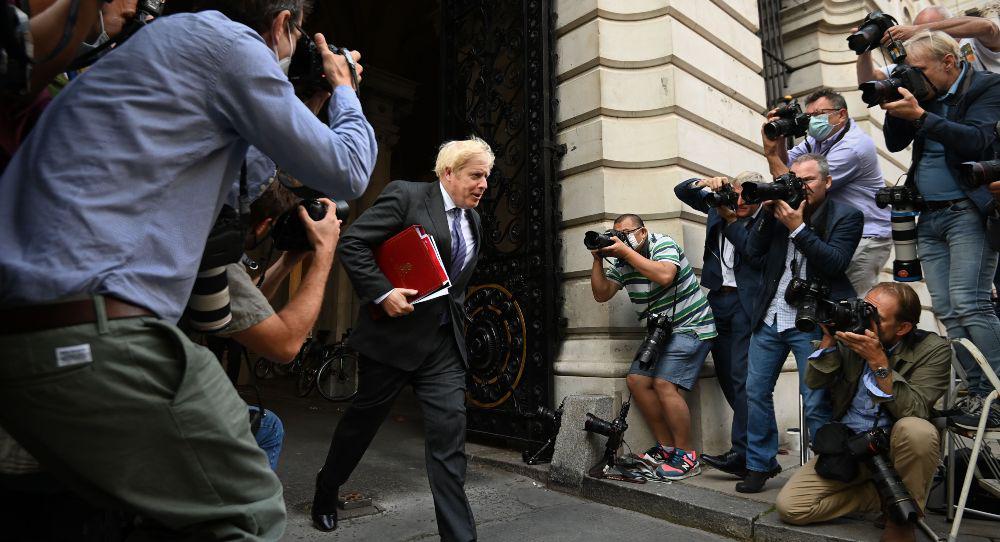
Source: Getty
With the UK government’s proposal of an internal market bill that could breach international law and derail negotiations with the EU, Britain is in the first stages of a profound and potentially dangerous upheaval.
Insults, however unfair, are apt to stick.
In the early 1790s, as the French Revolution descended into terror, the sympathy it had enjoyed in Britain drained away. Augustin Louis de Ximénès, a French writer who defended Robespierre’s excesses, reacted with a poem in which he declared: “Let us attack perfidious Albion in her waters.”
The insult has seldom been more appropriate than it is today. In its dealings with the European Union, Albion has indeed been perfidious.However, before we dissect what has happened in recent days, let me reassure readers in Europe and beyond: unlike many members of his party, UK Prime Minister Boris Johnson does not have any particular animus toward foreigners. He has betrayed pretty well everyone in his various lives as philanderer, journalist, and politician: wives, mistresses, editors, readers, party colleagues, Parliament, and the wider public. EU negotiators are merely the latest victims of his boundless treachery.
Nor should his latest initiative come as a great surprise. On September 14–22, the House of Commons is debating an internal market bill that government ministers accept will breach international law. If it becomes law, it will allow Britain to ignore key provisions in the withdrawal agreement that it agreed with the EU less than a year ago, in January 2020.
This is not the first time the prime minister has tried to wriggle out of commitments he made during the winter of 2019–2020.
In April, UK ministers told the EU they wanted to water down Britain’s commitment to geographical indications (GIs)—rules that protect the names and regional origins of products ranging from champagne to Parma ham. In the withdrawal agreement, the UK agreed to continue to observe all 3,000 GIs in the EU. Now, it wants to reopen an issue that the EU believed was settled.
Moreover, Johnson has never wanted to uphold the principle—contained in the political declaration on the future relationship that accompanied the withdrawal agreement—that British businesses should observe the EU’s level-playing-field rules.
His lead Brexit negotiator, David Frost, has made clear that Britain wanted to decide its own rules, especially on state aid. Technically, the UK would be within its rights: the political declaration is not a formal treaty and so has no legal force. But Johnson was certainly guilty of acting in bad faith.
Johnson’s latest move, then, fits a pattern. Whether viewed in terms of his personal behavior over four decades or, more recently, his cavalier attitudes to the formal undertakings he has given to the EU, his record shouts out: do not trust this man.
This is not all.
What we are witnessing are not just the defects of a man with no principles, but a huge shift in the nature of right-of-center politics in Britain.
The governing party is called the Conservative Party for a reason. Historically, it sought to protect the best of the past from the desire for change. It has always acknowledged what various Conservatives down the years have called “the authority of tradition.”
On the other side of British politics have been the reformers who want to get rid of old, and often deep, injustices. For the past hundred years, this has been the central purpose of the Labour Party; before that, the torch was held by the Liberal Party.
The never-ending contest between tradition and reform has provided the central tension at the heart of British politics for two centuries.
No longer. Not only does Johnson lack respect for almost everyone who enters his life; he lacks respect for the traditions which, until now, have dominated the outlook of his party. Instead, he is a revolutionary insurgent, far closer in political style to Vladimir Lenin than to Winston Churchill.
Naturally, he does not put it that way himself, but Dominic Cummings, his senior adviser and the architect of his political strategy, does. Earlier this year, a long analysis of Cummings’s career by a respected BBC journalist reported the influence of Lenin and, in particular, Lenin’s view that “you cannot make a revolution in white gloves.”
To take just one example, Cummings explicitly wants to convert the UK civil service from a repository of wisdom and experience into a battering ram for radical change. In June, he told officials that a “hard rain is coming” for Britain’s mandarin class.
Already, six permanent secretaries—the top rank of Britain’s civil servants—have been sacked or forced to resign, essentially for political reasons, defying the basic deal that officials should be politically neutral and that, in return, their independence and neutrality should be expected. In recent times, Johnson and Cummings have also targeted the BBC, the judiciary, and virtually anyone who opposes Brexit. The EU is in eminent company.
True, a growing minority of Conservatives fear that this will all end in tears. In the past few days, Johnson has fallen out with three former party leaders: Theresa May, Michael Howard, and John Major. And just as the insult “perfidious Albion” can be traced back to the age of Robespierre, so can the warnings of defying tradition. Edmund Burke is widely regarded as the father of British conservatism. In Reflections on the Revolution in France, he wrote:
Plausible schemes with pleasing commencements often have shameful and lamentable conclusions. . . . a man should be infinitely cautious about pulling down an edifice that has for ages satisfied the common purposes of society to some tolerable degree . . . When it [respect for tradition] is extinct in the minds of men, plots and assassinations will be anticipated by preventive murder and preventive confiscation… Kings will be tyrants from policy when subjects are rebels from principle.
Twenty-first-century Britain is not eighteenth-century France; Johnson is no Robespierre. But democrats have reason to be concerned, even without the specific terror of the guillotine.
If Johnson gets his way with this new bill—and he has a big majority in the House of Commons—Britain is in the first stages of a profound and potentially dangerous upheaval, of which the current spat with the EU is just one element. You—we—have been warned.

Former Nonresident Scholar, Carnegie Europe
Kellner was a nonresident scholar at Carnegie Europe, where his research focused on Brexit, populism, and electoral democracy.
Recent Work
Peter Kellner
Peter Kellner
Carnegie does not take institutional positions on public policy issues; the views represented herein are those of the author(s) and do not necessarily reflect the views of Carnegie, its staff, or its trustees.

With its public finances in shambles, the far right polling at 35 percent ahead of the 2027 presidential election, and a growing protest movement, is France’s crisis a threat to the EU’s geopolitical awakening?

Rym Momtaz, ed.

Ahead of a tough winter for Ukraine, Donald Trump’s swing back toward Russia bodes ill. But instead of panicking, Kyiv’s European allies are focusing on action.
Rym Momtaz

While the EU and European governments are embracing the much-lauded middle-power moment, this entails three difficult conundrums.

Richard Youngs

Much has been said of the changes Brussels is trying to make to the EU enlargement process. Here’s why gradual integration might—or might not—be the answer.

Dimitar Bechev

The European Commissioner for Trade is headed to China. But after President Xi’s bridge-building visit to Washington, can a more isolated EU overcome Beijing’s stranglehold on critical raw materials? Who will blink first?
Rym Momtaz, ed.