

Commentary
Judy Dempsey
{
  "authors": [
    "Judy Dempsey"
  ],
  "type": "commentary",
  "blog": "Strategic Europe",
  "centerAffiliationAll": "",
  "centers": [
    "Carnegie Endowment for International Peace",
    "Carnegie Europe"
  ],
  "collections": [],
  "englishNewsletterAll": "",
  "nonEnglishNewsletterAll": "",
  "primaryCenter": "Carnegie Europe",
  "programAffiliation": "",
  "programs": [],
  "projects": [],
  "regions": [
    "Europe",
    "Western Europe",
    "Germany"
  ],
  "topics": [
    "Security",
    "Military",
    "EU"
  ]
}
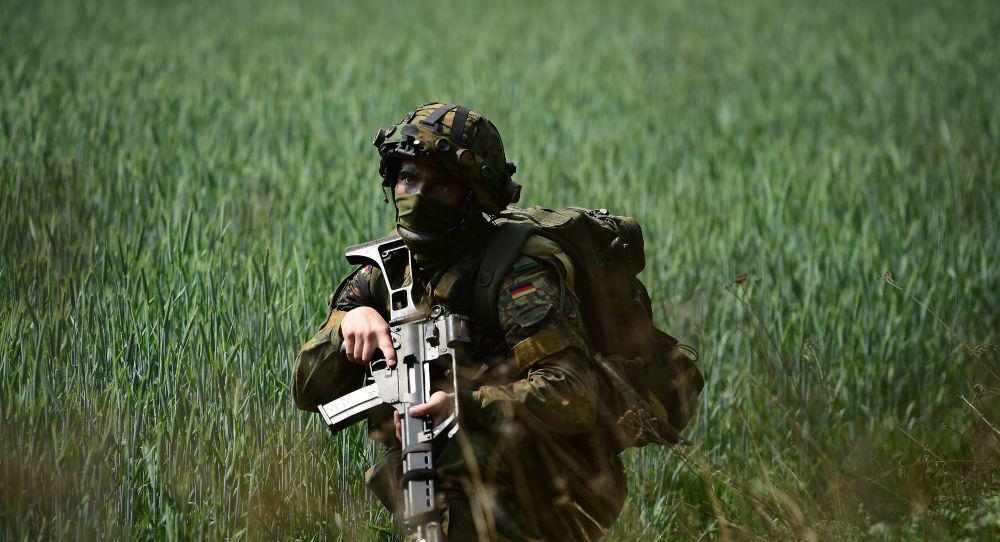
Source: Getty
The German Social Democrats are undermining both the safety of Germany’s armed forces abroad and Berlin’s reputation among allies by picking a fight over armed drones.
That’s all Annegret Kramp-Karrenbauer needed.
The German defense minister, who at one stage was tipped to succeed Angela Merkel as leader of the Christian Democratic Union (CDU) and potentially as Germany’s chancellor, has had ambitious plans to modernize the country’s armed forces.
One of them included giving the almost 3,200 soldiers serving in missions abroad, particularly in Afghanistan and Mali, more protection.
The idea was that five new Heron TP drones leased from Israel would be armed. Nothing radical about that. Except that just before Christmas, Merkel’s coalition partner, the Social Democratic Party (SPD), blocked the plan. Kramp-Karrenbauer was furious.“We are negligently putting soldiers’ lives at risk, and I want to change that,” she said. It was, she added, “a bitter day for our Bundeswehr and especially for the men and women on active service.”
She could have added that the decision to prevent drones from being armed does little to convince Germany’s allies both in NATO and the EU that Berlin is serious about defense, about protecting its allies, and even about resorting to this aspect of hard power in general.
Roderich Kiesewetter, a CDU member of the German parliament’s foreign affairs committee, bemoaned the fact that the decision by the Social Democrats was an “admission of complete failure on security policy.”
He’s right. Despite attempts by Kramp-Karrenbauer—but also by more pragmatic SPD parliamentarians—to act strategically and modernize the armed forces, defense is one of those issues that is repeatedly used by the German left to win votes. That is what’s happening in the run-up to the federal election in autumn 2021.
Merkel, now in her fourth term, is not going to run again. At the moment, her standing in the polls is at a record high. In contrast, the Social Democrats are floundering, to say the least. That is why its leadership has picked a fight over the drone issue; the same thing happened before the 2013 election.
It’s about playing the pacifist card—but it comes at a time when the security challenges facing NATO and the EU are increasingly complex. It’s about preventing supporters and voters from drifting to the Left party, which has taken a hard line against armed drones. And it’s about pandering to anti-American sentiment in Germany, in particularly related to how the Pentagon has used drones as offensive weapons and often killed civilians, for example in Afghanistan.
Norbert Walter-Borjans, co-leader of the Social Democrats, justified his party’s decision. “The line between defending the lives of our soldiers and killing with a joystick is extremely thin,” he argued. He added that the issue had not debated enough in the parliament.
Nothing could be further from the truth, said Claudia Major, security expert at the German Institute for International and Security Affairs.
For several years the German parliament has been discussing the use of drones for surveillance. The defense ministry wanted them also to protect troops serving in Afghanistan. Since 2003, fifty-four German soldiers have been killed there. The debate about their security increased in 2007, when three were killed in a suicide bombing in the city of Kunduz.
Yet after all this time, German troops are still not adequately protected—let alone adequately equipped with proper clothing and weaponry.
“Command and control of the drones in the area of operation, usage exclusively to protect troops against armed attacks—it would be that simple,” Kiesewetter said. As for the reference to joysticks, it was, he added, “unbelievable.”
Fritz Felgentreu, defense spokesperson for the SPD parliamentary group, had supported arming the drones and resigned from his post in protest of what is effectively the Social Democrats’ leftward shift.
It would be easy write off this debate as simple electioneering tactics by the SPD. Except that the party’s leadership is ideologically moving to the left.
The Social Democratic leadership is against the NATO agreement on member states spending 2 percent of their GDP on defense. It could become wobbly over maintaining the sanctions imposed on Russia after its annexation of Crimea in early 2014. And some in the leadership would support the removal of American nuclear weapons from Germany.
Merkel, already saddled with containing a huge second wave of the coronavirus pandemic, has been her customary self over the drone debate. Silent. She consistently ducks security and defense issues, just as she talks little—if ever—about NATO and Germany’s defense responsibilities.
Yet the growing instability in Afghanistan and the Sahel—not to mention the many other conflicts in Europe’s neighborhood—demand that Germany’s armed forces can respond. On top of that, there’s the uncertainty about America’s commitment to European security and the debate about the EU’s “strategic autonomy.”
Strong language by Merkel about drones and the need for Germany to protect the country’s armed forces and its allies abroad would be more than welcome. Don’t hold your breath, though.

Nonresident Senior Fellow, Carnegie Europe
Judy Dempsey is a nonresident senior fellow at Carnegie Europe
Recent Work
Judy Dempsey
Judy Dempsey
Five countries staged the biggest political boycott in Eurovision history over Israel’s participation. With the FIFA World Cup and other sporting or cultural touchstones on the horizon, are boycotts effective?

Rym Momtaz, ed.
The full list of humiliations Europe has endured since Donald Trump returned to the White House makes for grim reading. But Washington’s adversarial approach to its allies undermines its own power base.
Rym Momtaz
The closure of the Strait of Hormuz has triggered a global energy crisis, but Europe is stuck in reaction mode. Without more strategic foresight, the EU will remain dependent on fossil fuels and will never be truly secure.


Milo McBride, Pauline Gerard
After spending much of 2025 trying to placate Donald Trump, some European leaders are starting to change posture. But is even a hostile Washington still so important to Europe that the U.S. president’s outbursts are worth putting up with?
Rym Momtaz, ed.
European leaders have now not only lost faith in Donald Trump’s U.S. presidency, but also in America’s hegemony as a whole. But short-term challenges make an immediate divorce unwise.
Rym Momtaz