

Commentary
Thomas de Waal
{
  "authors": [
    "Thomas de Waal"
  ],
  "type": "commentary",
  "blog": "Strategic Europe",
  "centerAffiliationAll": "",
  "centers": [
    "Carnegie Endowment for International Peace",
    "Carnegie Europe"
  ],
  "collections": [
    "Europe’s Eastern Neighborhood"
  ],
  "englishNewsletterAll": "",
  "nonEnglishNewsletterAll": "",
  "primaryCenter": "Carnegie Europe",
  "programAffiliation": "",
  "programs": [],
  "projects": [],
  "regions": [
    "Russia",
    "Eastern Europe",
    "Caucasus",
    "Georgia",
    "Europe"
  ],
  "topics": [
    "Foreign Policy",
    "Democracy",
    "EU"
  ]
}
Source: Getty
When it should be dealing with issues of global importance, Georgia’s government seems intent on shredding the country’s democratic credentials and waging an acrimonious political civil war on its domestic opponents.
Arrogant. Dangerous. Stupid. These are just a few of the adjectives being used to describe the Georgian government’s behavior in having Nika Melia, the leader of the main opposition party, arrested in a violent police operation. As if from nowhere, Georgia faces its worst political crisis in years.
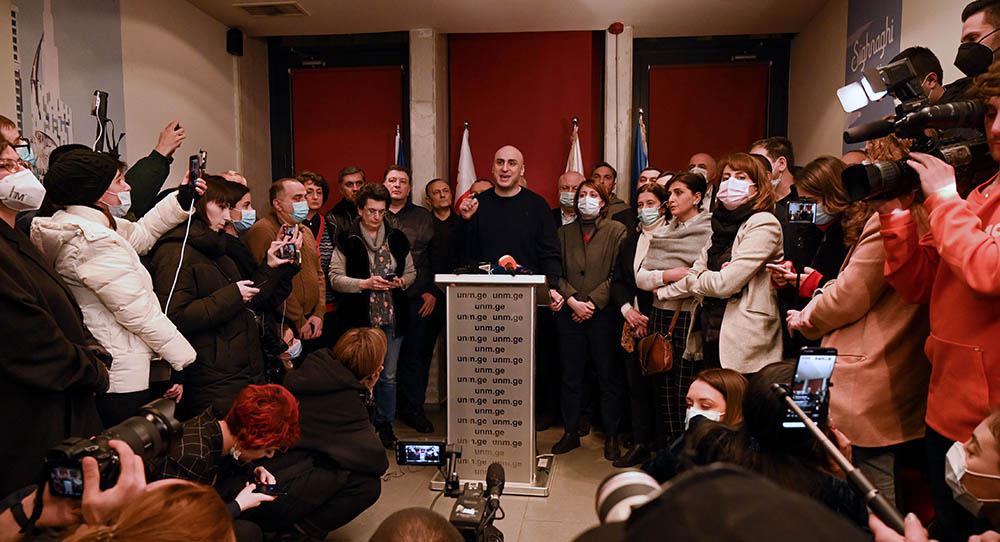
Melia was detained on February 23 by riot police, who used tear gas to enter the building where he was sheltering. He is charged with inciting violence in 2019, when the opposition protested against the invitation of a Russian parliamentarian to the Georgian legislature. Yet the legal case against Melia is full of holes. His arrest looks like a purely political decision.
This is the latest act in the decade-old mutual vendetta between Bidzina Ivanishvili, the founder of the Georgian Dream party, which has governed Georgia since 2012, and Mikheil Saakashvili, a former president of the country and the de facto leader of the United National Movement (UNM), Melia’s party.
It’s worth saying that this is not a tale of an authoritarian government cracking down on a liberal opposition. Saakashvili’s democratic record was patchy, and the nearest parallel to recent events was a violent crackdown by his government in 2007. This state of affairs is the work of more than one government.
Melia’s arrest, which comes on the back of a series of abuses of the rule of law, was an especially outrageous act and bodes ill for the country’s political future. So much so that Georgia’s prime minister, Giorgi Gakharia, resigned on February 18, saying that he disagreed with plans to detain Melia. Formally, Gakharia was the most powerful politician in Georgia, having been reconfirmed in his post by Georgian Dream after it won the 2020 parliamentary election. But that Gakharia had to announce he disagreed with his own government’s policy makes it painfully clear that he was not really in charge. Instead, Ivanishvili, the godfather of Georgian Dream, and an unaccountable inner circle around him are still running the show from behind the scenes.
Condemnation of Georgian Dream’s actions has been universal—and justified. There have been political arrests in Georgia before, but never of someone so prominent. The violent scenes were more reminiscent of Russia or Turkey than of a country frequently referred to as a “beacon of democracy.”
The U.S. Embassy and the British ambassador to Georgia swiftly condemned what they said was a retreat from democracy. The European Union (EU) was more cautious, only deploring the “escalation” of the crisis. One can only hope the EU is putting pressure on the Georgian government behind the scenes.
More striking were the strong words of two former pillars of Georgian Dream. Former Georgian president Giorgi Margvelashvili said that the government “utilizes violence as the tool of governance.” Giorgi Kvirikashvili, the longest-serving and most successful of recent Georgian prime ministers, described the arrest as a dangerous development and called for Melia’s release.
For such a small country, Georgia is terribly wasteful of good politicians. Margvelashvili, Kvirikashvili, and half a dozen other retired politicians of recent years were decent and competent officials who could still provide good service to their country, but there is no place for them in the current Georgian political configuration.
Instead, Georgian Dream picked former prime minister Irakli Gharibashvili to return to the position after Gakharia’s resignation. Aged only thirty-eight, Gharibashvili has little to recommend him but loyalty to Ivanishvili and a willingness to crack heads if the job demands it. In a speech to the Georgian parliament before being confirmed as prime minister on February 22, Gharibashvili called the UNM “a refuge of criminals and terrorists.”
The political calculus behind this episode is puzzling and suggests a government that lives in a small and rather paranoid bubble. Last October, Georgian Dream won an unprecedented third term in Georgia’s parliamentary election and was looking quite comfortable. Despite irregularities, the party easily beat the UNM. Unhappy with the outcome, all opposition parties boycotted the new parliament.
That did not impress Georgia’s Western partners, who called on the parties to take up their seats—and nor did it satisfy most of the Georgian public. In a December 2020 poll for the National Democratic Institute, 76 percent of respondents agreed with the statement, “In order for the new parliament to represent the interests of people like me, it is important that all elected political parties participate in the parliament.”
The UNM is still Georgia’s biggest opposition party, but its chances of returning to power are virtually zero. It is badly hobbled by the leadership from exile of the wayward Saakashvili, who has been calling for “acts of disobedience.”
Georgia now has a crisis it does not need. The country badly needs Western support at the moment, and a conspicuous authoritarian turn will do it no favors. The second wave of the coronavirus pandemic has been far more destructive than the first, and the economy has been severely hit. In the aftermath of last year’s Armenia-Azerbaijan conflict, Russia sent troops to the region as peacekeepers and unveiled plans for new regional transportation schemes that bypass Georgia.
In short, when it should be dealing with much bigger issues of global importance, Georgia’s government seems intent on shredding the country’s democratic credentials and waging an acrimonious political civil war against its domestic opponents. The best answer to the crisis would probably be to hold an early election, but the outside pressure to do so would have to be overwhelming for this stubborn and secretive government to yield. It will be an intense year in Georgia.

Senior Fellow, Carnegie Europe
Thomas de Waal is a senior fellow at Carnegie Europe, specializing in Eastern Europe and the Caucasus.
Recent Work
Thomas de Waal


Thomas de Waal, Areg Kochinyan, Zaur Shiriyev
Carnegie does not take institutional positions on public policy issues; the views represented herein are those of the author(s) and do not necessarily reflect the views of Carnegie, its staff, or its trustees.

The EU’s new migration policy is not suited to today’s realities. With climate change increasingly becoming a driver of displacement, Europe needs to rethink its deterrence-focused approach.

Shana Tabak
The battle over free speech has taken center stage since U.S. Vice President JD Vance accused Europe of censorship. From travel bans to social media regulation, especially around the Israel-Palestine conflict, are liberal democratic governments weaponizing free speech?

Rym Momtaz, ed.
Europe seems to have accepted its sidelining in the Middle East. The EU must reassert its support for the international rules-based order and step up engagement.
Rym Momtaz
Amid uncertainty caused by the Iran war, the global drive for nonproliferation has stalled. With Europe diplomatically marginalized and countries reassessing their nuclear options, efforts to curb the spread of nuclear weapons risk becoming irrelevant.
Jane Darby Menton
Preparing candidate countries for EU membership is no longer enough. As the enlargement process becomes a reality, the union must also prepare its own societies.

Iliriana Gjoni