

Commentary
Judy Dempsey
{
  "authors": [
    "Judy Dempsey"
  ],
  "type": "commentary",
  "blog": "Strategic Europe",
  "centerAffiliationAll": "",
  "centers": [
    "Carnegie Endowment for International Peace",
    "Carnegie Europe"
  ],
  "collections": [],
  "englishNewsletterAll": "",
  "nonEnglishNewsletterAll": "",
  "primaryCenter": "Carnegie Europe",
  "programAffiliation": "",
  "programs": [],
  "projects": [],
  "regions": [
    "Europe",
    "Eastern Europe"
  ],
  "topics": [
    "EU",
    "Democracy"
  ]
}
Source: Getty
Jan Litynski, a leading dissident under Poland’s communist regime and later a passionate defender of the rule of law, will be buried on March 10 in Warsaw. The values and principles he fought for are now under threat more than ever before.
It was a tiny kitchen. But how Helena Łuczywo could make space to seat at least six people around her small table! It was the early summer of 1980. Apart from the enduring smell of black tobacco cigarettes, the next-door living room was full to bursting with publications that Łuczywo had to edit and quickly distribute to the underground movement.
Here, in this apartment in a Warsaw suburb, Łuczywo introduced me to so many special people. One of them was Jan Lityński. This feisty, funny, and warm intellectual was—like his dissident friends—indefatigable. In the late 1970s, with Jacek Kuron, he founded the Workers’ Defense Committee. This was, in some ways, the precursor to the independent Solidarity trade union movement, which was established in August 1980 in Gdańsk.
Poland’s dissidents paid a very heavy price for activities aimed at challenging the communist regime’s monopoly. In March 1968, during student protests at Warsaw University, Lityński, then twenty-two years old, and many others were expelled. He was given a two-year jail sentence. At the same time, the regime unleashed a vicious anti-Semitic campaign, forcing many intellectuals to emigrate to Paris, London, or Stockholm.
In exile, they continued to support the underground movement, smuggling in xeroxing machines, carbon paper (remember those flimsy sheets?), newsletters, journals, paper, and printing ink (which weighed down my baggage allowance).
Those who remained continued their opposition activities. They were undeterred by the repression. They expanded the underground, which leaped into the open in the summer of 1980 with Solidarity. The fear, punctured by the historic visit in 1979 of the Polish-born Pope John Paul II to his homeland, was gone.
It’s hard to forget those euphoric, unpredictable months of Solidarity. By December 1981, Poland’s communist party—and, of course, the Kremlin—had had enough. Martial law was imposed. Lityński was interned until September 1982, then imprisoned. On his release, he returned to the underground, paving the way for 1989, when the communists and the opposition agreed on a peaceful transition to democracy. Over the next two decades, he remained engaged.
Lityński, who drowned in February while trying to rescue his dog, will be buried on March 10 beside Kuron and other leading dissidents.
I’m writing about Lityński not only because he and his friends taught me about the preciousness of freedom and about life without freedom but also because memories are very short—and selective. And the younger generation often knows little about their parents’ or their country’s immediate past.
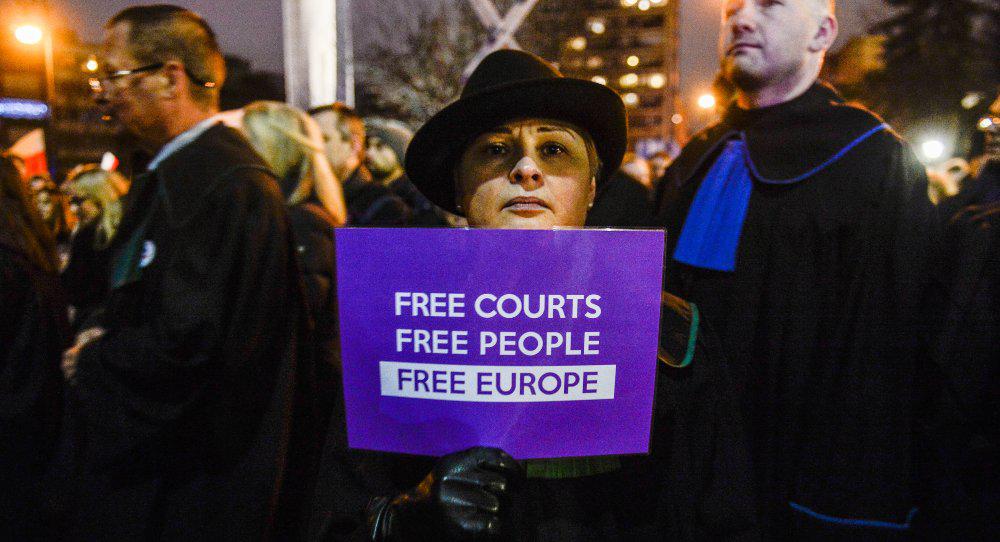
But there’s another, more fundamental reason. What Lityński and the dissidents fought for is now being challenged by Poland’s governing Law and Justice (PiS) party, led by Jarosław Kaczyński.
Kaczyński was a Solidarity supporter and a member of the 1989 roundtable negotiations. But since taking power in 2015—after a brief stint in 2005–2007—PiS has done everything to demonize Poland’s dissidents, attack its intellectual elites, and, above all, undermine the rule of law and the checks and balances that form the cornerstone of the Polish constitution.
PiS has often justified its attack on the judiciary on the grounds that communist-era judges were not sacked after 1989. Nearly thirty-two years since the roundtable negotiations, that claim hardly holds water. In reality, PiS’s assault on the judiciary, which amounts to a consistent vendetta and smear campaigns against independent-minded judges, is because checks and balances designed to protect Poland’s democratic institutions stand in the way of PiS’s agenda.
PiS set out this agenda in its party program back in 2009, when it was in opposition. Kaczyński referred to “legal impossibilism” and “the over-idealistic understanding of division and balance of power among the branches of governments.” He criticized judges who ruled contrary to PiS’s vision of the Polish national interest as harboring a hatred of their native country.
The attack on the judiciary is nonstop. Here is a tweet written on March 6 by Wojciech Sadurski, a leading Polish constitutional lawyer who is PiS’s bête noir and now lives outside his country:
Important! A judge who handed down an acquittal in my case earlier today, a few hrs later became target of vicious assault by TVP: a state body, and an unsuccessful prosecutor. Their official statement is offensive and threatening. I will keep you informed if persecutions follow. https://t.co/UKnIC8EJc6
— Wojciech Sadurski (@WojSadurski) March 6, 2021
The EU has more than enough information and evidence to know that Poland’s rule of law is being systematically stripped of its independence. But somehow, the bloc is unwilling to protect something as vital as an independent judiciary and the constitutional principles that underpin democracy. That is what Lityński fought for before and after 1989. Does the EU want to bury that legacy?

Nonresident Senior Fellow, Carnegie Europe
Judy Dempsey is a nonresident senior fellow at Carnegie Europe
Recent Work
Judy Dempsey
Judy Dempsey
Carnegie does not take institutional positions on public policy issues; the views represented herein are those of the author(s) and do not necessarily reflect the views of Carnegie, its staff, or its trustees.

The EU can impose sanctions but struggles to enforce them without the United States. With Washington increasingly disinterested in backing European interests, the bloc must now fend for itself.


Nicu Popescu, Tiago Antunes

Russia is testing the waters of NATO’s mutual defense clause. What do strikes in Romanian territorial waters mean for the alliance’s posture toward Moscow?

Dimitar Bechev

With its public finances in shambles, the far right polling at 35 percent ahead of the 2027 presidential election, and a growing protest movement, is France’s crisis a threat to the EU’s geopolitical awakening?

Rym Momtaz, ed.

Ahead of a tough winter for Ukraine, Donald Trump’s swing back toward Russia bodes ill. But instead of panicking, Kyiv’s European allies are focusing on action.
Rym Momtaz

While the EU and European governments are embracing the much-lauded middle-power moment, this entails three difficult conundrums.

Richard Youngs