

Commentary
Peter Kellner
{
  "authors": [
    "Peter Kellner"
  ],
  "type": "commentary",
  "blog": "Strategic Europe",
  "centerAffiliationAll": "",
  "centers": [
    "Carnegie Endowment for International Peace",
    "Carnegie Europe"
  ],
  "collections": [
    "Brexit and UK Politics"
  ],
  "englishNewsletterAll": "",
  "nonEnglishNewsletterAll": "",
  "primaryCenter": "Carnegie Europe",
  "programAffiliation": "",
  "programs": [],
  "projects": [],
  "regions": [
    "Europe",
    "Western Europe",
    "United Kingdom"
  ],
  "topics": [
    "Foreign Policy",
    "Economy",
    "EU",
    "Climate Change"
  ]
}
Source: Getty
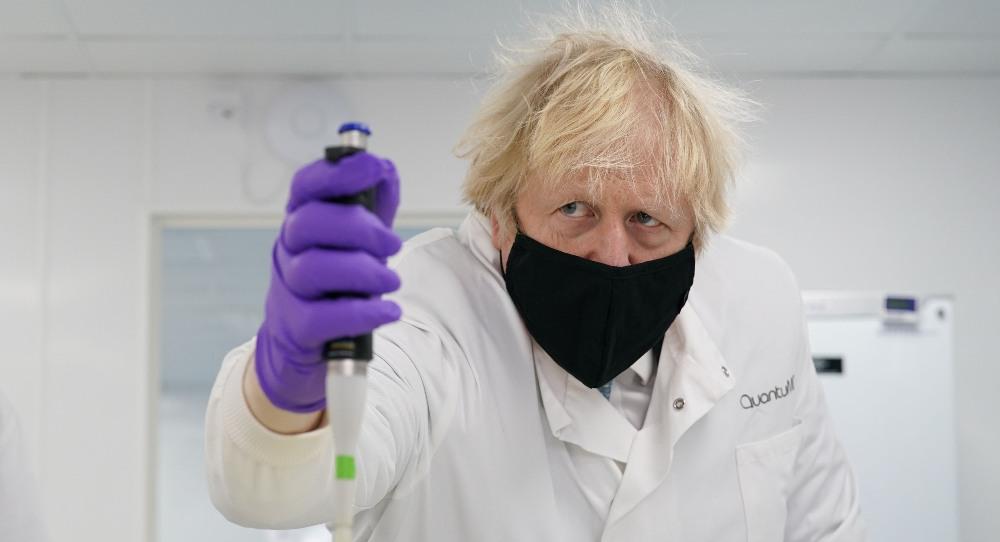
The loud boasts of defiance by the British government toward the EU have given way to the quieter language of negotiation. The outcome will determine just how much post-Brexit sovereignty London will have.
As Winston Churchill famously said, jaw-jaw is better than war-war. However, jaw-jaw is less exciting, which is why the latest news about relations between Britain and the EU has passed most people by.
In three separate areas, confidential discussions have been proposed to resolve tricky issues. Any or all may yet founder. Even if the talks all conclude in agreement, awkward questions will remain about long-term EU-UK relations. But for the moment, a new tone has been set for the next few months.
First, vaccines. This issue has provoked the biggest recent frenzy. In January, European Commission President Ursula von der Leyen announced that the EU would ban the export of coronavirus vaccines across the Ireland-UK border. The immediate uproar, not least from Dublin, forced the commission president to reverse her decision two hours later. However, the UK’s Brexiters lost no time in denouncing von der Leyen as someone who could not be trusted to stick by formal agreements.
The wider issue—of Britons receiving their vaccines far faster than EU citizens—has added to a palpable sense that Brexit Britain has triumphed over bungling Brussels. Less remarked is that by late March, the EU had exported 77 million vaccine doses to thirty-three countries, including 21 million doses to the UK, while Britain had exported precisely none. Global Britain? Protectionist Europe? The figures tell a different story.
Privately, both sides knew that grandstanding was doing them no favors—not least because of the practical matter of making the vaccines in a cross-border world.
For example, EU-made Pfizer-BioNTech vaccines depend on the supply of lipid nanoparticles from Britain. So talks are under way to dial down the rhetoric and design practical arrangements to keep everyone happy. Significantly, the UK’s negotiator is Sir Tim Barrow, a former UK ambassador to the EU who is well liked in Brussels, not the abrasive Lord Frost, a minister and formally the UK’s chief negotiator, who seems to regard the EU as an enemy, not a partner.
The second source of friction has been the Northern Ireland Protocol to the Brexit withdrawal agreement. To keep the border between Northern Ireland and the Republic of Ireland fully open—and it’s the only land border between the UK and the EU—Northern Ireland has acquired a unique status through the protocol. Politically, the province is part of the UK; commercially, it applies EU regulations so that its businesses can trade freely with Ireland and, by extension, the rest of the EU.
To achieve this, the UK has agreed to a commercial border between Great Britain and Northern Ireland. This has caused traders all kinds of problems already, even before all the protocol’s rules come fully into force. This is supposed to happen on April 1. In early March, the UK government said it would unilaterally extend the grace period that applies to some of the new rules and not introduce full food controls for a further six months. Maroš Šefčovič, a vice president of the European Commission, responded by threatening legal action against the UK.
In late March, the EU sought to reduce the tension by offering talks on the issue. Irish Foreign Minister Simon Coveney has led the way: Ireland has an obvious and massive interest in preventing anything that might undermine the 1998 Good Friday Agreement, which has delivered two decades of peace to Northern Ireland. At the time of writing, further progress has yet to be made. However, British ministers have gone quiet on this issue. This looks like a prelude to proper engagement with the EU and a desire to do a deal.
The third subject on which talks might break a deadlock is financial services. Brexit has been bad for the City of London, the capital’s financial district. Thousands of jobs and billions of euros’ worth of financial assets have left London. This is because the Brexit withdrawal agreement preserves free trade between the EU and the UK for goods but not for services.
UK Prime Minister Boris Johnson has always said that he wanted Britain to “have its cake and eat it” too over Brexit. That is, he wanted the UK to be free to set its own rules—but not suffer any penalty for ignoring the EU’s rule book. Not surprisingly, the EU rejected this approach, which has been described as “cakeism.” To come to a deal on UK access to EU financial markets, a common framework would be needed for the rules and professional qualifications that both sides would obey.
On March 26, an agreement was announced—not on what the rules should be, but on how to start the process of cooperation in this area. A joint UK-EU Financial Regulatory Forum has been set up. Technical discussions have already taken place; the forum will explore the trickier political issues that need to be resolved.
Standing back and looking at the three issues together—vaccines, the Northern Ireland Protocol, and financial services—one can see a distinct change in the mood music. The loud boasts of defiance have given way to the quieter language of negotiation.
How this process will play out is far from certain. The fundamental challenge of Brexit remains. Johnson won a big election victory in December 2019 after promising to “get Brexit done.” The three sets of talks now in progress or in prospect will test how far Johnson is prepared to compromise on UK sovereignty after all—and how flexible the EU is prepared to be in interpreting and enforcing its rules.
Any agreement is likely to upset someone: Britain’s most passionate Brexiters, the EU’s most fervent federalists, or both. Complaints of surrender are likely. Agreement, no agreement, or partial agreement: the long-term consequences of this delicate process for relations between London and Brussels could be massive.
Peter Kellner
Former Nonresident Scholar, Carnegie Europe
Kellner was a nonresident scholar at Carnegie Europe, where his research focused on Brexit, populism, and electoral democracy.
Recent Work
Peter Kellner
Peter Kellner
Carnegie does not take institutional positions on public policy issues; the views represented herein are those of the author(s) and do not necessarily reflect the views of Carnegie, its staff, or its trustees.
European reactions to the war in Iran have lost sight of wider political dynamics. The EU must position itself for the next phase of the crisis without giving up on its principles.

Richard Youngs
Europe isn’t as weak in the new geopolitics of power as many would believe. But to leverage its assets and claim a sphere of influence, Brussels must stop undercutting itself.

Dimitar Bechev

Europe’s reaction to the war in Iran has been disunited and meek, a far cry from its previously leading role in diplomacy with Tehran. To avoid being condemned to the sidelines while escalation continues, Brussels needs to stand up for international law.

Pierre Vimont
France and Germany’s failure to agree on the Future Combat Air System (FCAS) raises questions about European defense. Amid industrial rivalries and competing strategic cultures, what does the future of European military industrial projects look like?

Rym Momtaz, ed.
France has stopped clinging to notions of being a great power and is embracing the middle power moment. But Emmanuel Macron has his work cut out if he is to secure his country’s global standing before his term in office ends.
Rym Momtaz