

Commentary
Judy Dempsey
{
  "authors": [
    "Judy Dempsey"
  ],
  "type": "commentary",
  "blog": "Strategic Europe",
  "centerAffiliationAll": "",
  "centers": [
    "Carnegie Endowment for International Peace",
    "Carnegie Europe"
  ],
  "collections": [
    "Transatlantic Cooperation"
  ],
  "englishNewsletterAll": "",
  "nonEnglishNewsletterAll": "",
  "primaryCenter": "Carnegie Europe",
  "programAffiliation": "",
  "programs": [],
  "projects": [],
  "regions": [
    "Asia",
    "Russia",
    "Europe",
    "North America",
    "Middle East",
    "East Asia",
    "China",
    "Eastern Europe",
    "Western Europe"
  ],
  "topics": [
    "Foreign Policy",
    "Democracy",
    "EU"
  ]
}
Source: Getty
The Biden administration is making the defense of human rights one of its foreign policy priorities. Other democracies, particularly in Europe, should actively support this shift.
U.S. President Joe Biden has hit the ground running. His mantra “America is back” is a much-needed boost for democracies. The Europeans, in particular, are consumed by self-doubt, a lack of confidence, and, to make matters worse, mismanagement of coronavirus vaccinations. Looking for scapegoats for Europe’s slow rollout of vaccines is a daily preoccupation.
Biden doesn’t believe in the blame game. It would have been easy for him to lash out at former U.S. president Donald Trump at every opportunity, from dealing with the pandemic to restoring America’s standing in the world. That blame game would have played into the hands of die-hard Trump supporters and other Republicans, who could have accused Biden of using his office to seek revenge.
Instead, Biden wants the United States to move on. The Europeans should emulate—indeed, capitalize on—that energy and zeal by working to push the transatlantic relationship and other democracies to embrace an agenda that can marry values with interests. This could be a strategic first for the EU—if it chooses to seize the opportunity.
Apart from the blitz-like way in which Americans (and the British) are now getting vaccinated, which, in turn, generates an element of self-confidence, Biden is homing in on human rights. Whether it’s China or Russia, Saudi Arabia or Belarus, the Biden team has not minced words.
Even better news: U.S. Secretary of State Antony Blinken, who is attending a NATO foreign ministers’ meeting in Brussels on March 23, has announced that the administration will “seek election to a seat on the UN Human Rights Council starting in January 2022.”
In 2018, Trump withdrew the United States from the council, which does itself no favors with the opaque way in which it repeatedly elects nondemocratic countries with often appalling human rights records to sit among its forty-seven members. That has given a free hand to council members such as China, Cuba, Egypt, Russia, and Venezuela to block as much criticism as possible of their own policies and those of their often authoritarian allies who elected them.
“The United States has long been a champion of human rights,” Blinken said. “If elected to the Human Rights Council, we will use the opportunity to be a leading voice within the Council for promoting respect for human rights.” In other words, contrary to Trump’s policies of disengaging from multilateral institutions, Biden’s team believes that it is better to engage in—and, possibly, reform—institutions than to remain outside them.
But what does “engage” mean? Here’s what Britain’s Foreign Secretary Dominic Raab told staff in a leaked video call. Referring to the European Convention on Human Rights (ECHR), he said, “If we restrict [trade] to countries with ECHR-level standards of human rights, we’re not going to do many trade deals with the growth markets of the future.” That says a lot about the state of human rights in those countries. He continued, “I think we’re in a much better position to do that if we’re willing to engage.”
But on what terms, and in what ways that reconcile universal human rights with interests?
London has been extremely critical of human rights violations in China, Beijing’s clampdown on democracy in Hong Kong, and events in Russia. The EU’s reactions have been weak. Yes, the union imposed limited sanctions on a group of officials implicated in the poisoning of Russian opposition leader Alexei Navalny and announced on March 22 it would impose sanctions on China for its detentions of members of the Uighur community. But these measures are probably ineffective as policy changers. Also, several EU member states are uncomfortable with them. They fear retaliation.
Take the case of Australia. It is being heavily penalized by China after it called for an investigation into the how the coronavirus originated in the Chinese city of Wuhan. Other democracies are helping compensate Australia for the decline in its trade revenues. Democracies can and should pull together. It’s one way of standing up to regimes that use trade as blackmail.
There’s another way to reconcile values with interests. Many countries want to forge trade accords with Brussels. Look at the EU-China investment deal that was clinched at the end of December 2020 just before Germany ended its six-month rotating presidency of the EU Council. This was surely the ideal opportunity to link trade with values such as the rule of law, transparency, clear procurement procedures, and human rights—for instance, through something as basic as how employees are treated. The point is that the EU, as a big, wealthy market, has leverage. When it comes to human rights, it should use that clout.
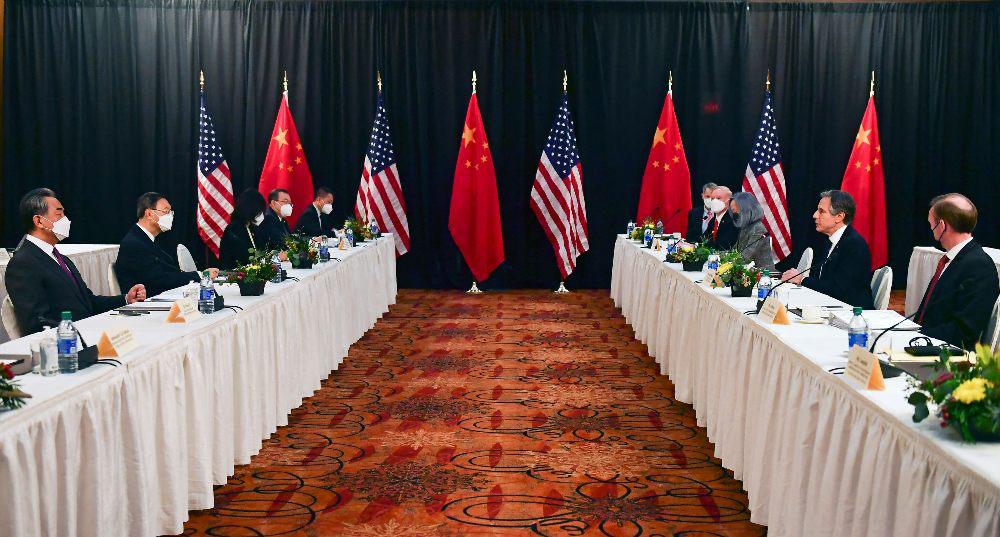
However, democracies won’t get that traction if they don’t deal with human rights in their own countries. Operating with double standards is a nonstarter when it comes to democracies aiming to project influence. So when Blinken criticized China’s human rights violations, he sure got a rebuke from his Chinese interlocutor over the racism and police violence that sparked the Black Lives Matter movement. All Blinken had to say was, “Yes. There’s a big problem. We’re dealing with it. And what about your human rights issues?”

Nonresident Senior Fellow, Carnegie Europe
Judy Dempsey is a nonresident senior fellow at Carnegie Europe
Recent Work
Judy Dempsey
Judy Dempsey
Carnegie does not take institutional positions on public policy issues; the views represented herein are those of the author(s) and do not necessarily reflect the views of Carnegie, its staff, or its trustees.

The European Commissioner for Trade is headed to China. But after President Xi’s bridge-building visit to Washington, can a more isolated EU overcome Beijing’s stranglehold on critical raw materials? Who will blink first?

Rym Momtaz, ed.

The domestic impacts of how long it is taking to end the war in Ukraine have pushed the French electorate to the political extremes and compromised the country’s diplomatic capacity.
Rym Momtaz

Before the next wave of EU enlargement takes place, the union needs to grapple with thorny questions of how power is distributed among its members.


Emil Sondaj Hansen, Ditte Brasso Sørensen

A summer of escalation in the Black Sea has hurt Ukraine economically and is exacerbating world food security. A truce is needed—as is a broader reframing of Europe’s Ukraine strategy.

Thomas de Waal

Are Germany’s economic, industrial, and political struggles becoming a liability for the EU’s ability to rise to the geopolitical moment?
Rym Momtaz, ed.