

Commentary
Judy Dempsey
{
  "authors": [
    "Judy Dempsey"
  ],
  "type": "commentary",
  "blog": "Strategic Europe",
  "centerAffiliationAll": "",
  "centers": [
    "Carnegie Endowment for International Peace",
    "Carnegie Europe"
  ],
  "collections": [
    "EU Integration and Enlargement"
  ],
  "englishNewsletterAll": "",
  "nonEnglishNewsletterAll": "",
  "primaryCenter": "Carnegie Europe",
  "programAffiliation": "",
  "programs": [],
  "projects": [],
  "regions": [
    "Europe",
    "Eastern Europe"
  ],
  "topics": [
    "EU",
    "Democracy",
    "Political Reform"
  ]
}
Source: Getty
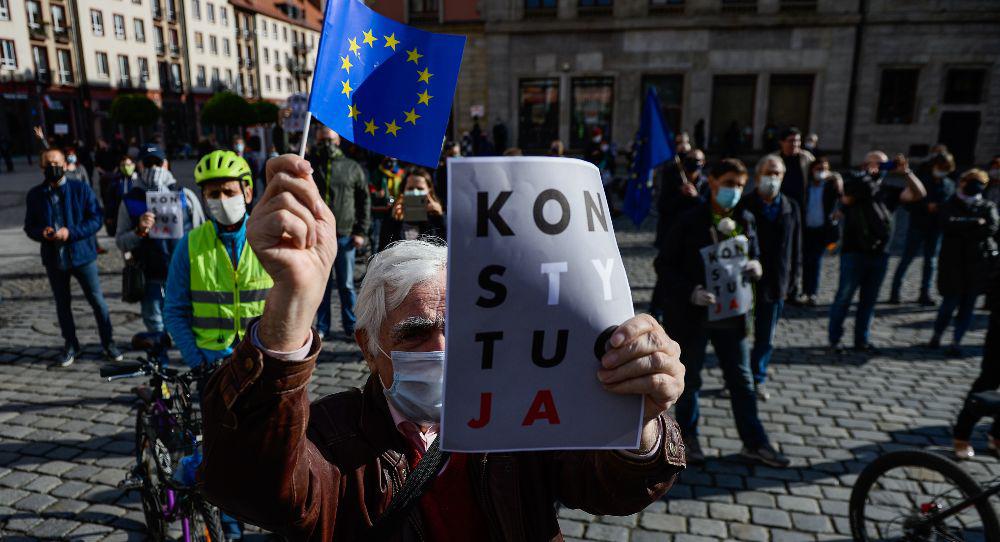
Poland and the EU are locked in a bitter battle over the rule of law. At stake is something so fundamental to both sides: the meaning and exercise of sovereignty.
It was a remarkable document for its time.
230 years ago, the Polish-Lithuanian Sejm rushed through a hastily drawn-up bill. It was radical in its content, political in its goal, and emotional in its execution. The bill in question was the Constitution of the Third of May 1791.
Norman Davis, in his monumental history of Poland “God’s Playground,” wrote that for later generations, the constitution “assumed a symbolic importance… It was the Bill of Rights of the Polish tradition, the embodiment of all that was enlightened and progressive in Poland’s past, a permanent reproach to the tyranny of the partitioning powers.”
In practical terms, the constitution was about the Polish-Lithuanian nobility struggling to establish strong institutions after the Commonwealth was first partitioned by Austria, Prussia, and Russia in 1772.
The constitution treated the Polish-Lithuanian nobility as a single political union. It did away with unanimity in parliamentary voting. Citizens of towns were given the same rights and privileges as the nobility. The peasantry was protected by the law. Religious toleration was enshrined in the constitution as was the separation of powers.
As Timothy Snyder wrote in his marvellous book “The Reconstruction of Nations,” the constitution “sought to create a modern, centralized republic.” It was hardly surprising that it provoked Russia.
Empress Catherine the Great and Prussia moved quickly to partition the Commonwealth. It was, Snyder added, “removed from the map of Europe.” Poland had to wait until 1918 to regain its independence, only to be later invaded by Nazi Germany and Russia. In 1989, it regained its independence. A new constitution was promulgated in 1997.
No wonder that Poland used the 1791 anniversary to celebrate. President Andrzej Duda invited his counterparts from Ukraine, Estonia, Latvia, and Lithuania, countries that had at one stage been linked to Poland. There was much pomp and ceremony, despite a scaled-down event because of the coronavirus that has rapidly spread throughout the country.
Yet the aspirations and content of the Third of May Constitution sit uncomfortably with what is taking place in Poland today. Some constitutional lawyers say the current constitution is under siege to the extent that the democratic institutions themselves are being threatened.
Others say the governing Law and Justice (PiS) party is not only by-passing the constitution. It is challenging European Union law and the bloc’s treaty that Poland signed up to on May 1, 2004, when it joined the EU.
Since its election in 2015, PiS has moved to effectively emasculate the independence of the Constitutional Tribunal. Judges have been replaced by those hand-picked by PiS. Duda has helped PiS by signing into law new bills that undermine the independence of the judiciary.
The Disciplinary Chamber of the Supreme Court has been politicized so much so that some judges have been suspended from their judicial duties. There is also an intense debate taking place about who will replace Adam Bodnar, Poland’s ombudsman who has taken a consistently strong stance when it comes to defending human rights.
Bodnar was ordered last month by the Constitutional Tribunal to leave his post. PiS, he told AFP, “marginalizes the role of parliament, has in large part brought to heel the Constitutional Court, the prosecutor’s office, public media as well as other certain judicial institutions.”
Bodnar has little praise for the European Commission. Even though the commission has threatened Poland and Hungary with financial sanctions, Bodnar insists Brussels has been dragging its feet when it comes to protecting the rule of law.
“What is the EU supposed to be?” he asked. “A community based on democratic values—or just a loose confederation of states that will include both democratic and authoritarian states?” If the latter, it could “spell the breakup of the EU.”
PiS supporters say the party’s de facto leader Jarosław Kaczyński is simply making up for what wasn’t done during the 1989 roundtable talks. Held between the independent Solidarity opposition movement and Poland’s communist party—and attended by Kaczyński—they led to the peaceful transfer of power.
PiS’s assault on the judiciary is based on the belief that after 1989 the judiciary was never cleansed of communists and that it was never reformed. The fact that most judges who served before 1989 are now mostly retired or dead doesn’t add much weight to the first argument.
As for the reform of the judiciary and courts, changes to the functioning of the court were needed. But that is a separate issue from politically controlling appointments and influencing legal decisions.
There’s another reason why PiS is assaulting the courts. It is about a contest between EU legalism and Polish legalism and independence.
In theory, there should be no contest because Poland agreed to adopt EU legislation and the acquis communautaire back in 2004. In practice, PiS and its supporters are attempting to give Poland legal jurisdiction over EU law. It’s as if Poland wants to regain the legal sovereignty it ceded to the union.
That is why this month, the Constitutional Tribunal will challenge the European Court of Justice. The latter has opposed a crucial element of the government’s judicial reforms. The case is immensely important.
It is about the sovereignty and primacy of EU law versus that of Polish law—and the latter’s independence, which PiS is fighting for. The outcome could determine Poland’s role in the EU just as the 1791 constitution determined Poland’s fate.

Nonresident Senior Fellow, Carnegie Europe
Judy Dempsey is a nonresident senior fellow at Carnegie Europe
Recent Work
Judy Dempsey
Judy Dempsey
Carnegie does not take institutional positions on public policy issues; the views represented herein are those of the author(s) and do not necessarily reflect the views of Carnegie, its staff, or its trustees.

Before the next wave of EU enlargement takes place, the union needs to grapple with thorny questions of how power is distributed among its members.


Emil Sondaj Hansen, Ditte Brasso Sørensen

A summer of escalation in the Black Sea has hurt Ukraine economically and is exacerbating world food security. A truce is needed—as is a broader reframing of Europe’s Ukraine strategy.

Thomas de Waal

Are Germany’s economic, industrial, and political struggles becoming a liability for the EU’s ability to rise to the geopolitical moment?

Rym Momtaz, ed.

European Commission President Ursula von der Leyen is about to give her annual address on the state of the EU. Here’s what she won’t—but should—say.
Rym Momtaz

The aftermath of the Ceuta crisis shows Europe has drawn the wrong lessons. Rather than doubling down on failed migration policies, the EU needs to address the underlying roots of such episodes.

Richard Youngs