

Commentary
Thomas de Waal
{
  "authors": [
    "Thomas de Waal"
  ],
  "type": "commentary",
  "blog": "Strategic Europe",
  "centerAffiliationAll": "",
  "centers": [
    "Carnegie Endowment for International Peace",
    "Carnegie Europe"
  ],
  "collections": [
    "Europe’s Eastern Neighborhood",
    "Aso Tavitian Initiative"
  ],
  "englishNewsletterAll": "",
  "nonEnglishNewsletterAll": "",
  "primaryCenter": "Carnegie Europe",
  "programAffiliation": "",
  "programs": [],
  "projects": [],
  "regions": [
    "Russia",
    "Europe",
    "Eastern Europe",
    "Caucasus",
    "Georgia"
  ],
  "topics": [
    "Democracy",
    "Political Reform",
    "EU"
  ]
}
Source: Getty
For Georgia’s ruling party, regime survival seems to trump all other considerations. Georgian Dream’s fight with Western partners and persistent political polarization risk undoing the country’s democratic progress.
The long-running political crisis in Georgia has not attracted the attention it deserves in Europe and the United States. It is neither the human tragedy of the Armenian-Azerbaijani conflict nor the nightmare of Belarus. But Georgia’s long-accumulated achievements in building something approaching a democratic state are in danger of suffering death by a thousand cuts.
The Georgian Dream ruling party is in an unprecedented fight with the EU and the United States. In July it quit an EU-brokered deal to resolve the standoff with the opposition over last year’s elections. In September, openly defying its commitment not to press ahead with politicized appointments to the judiciary, the government forfeited the second half of an EU loan package due to be disbursed worth €75 million ($89 million).
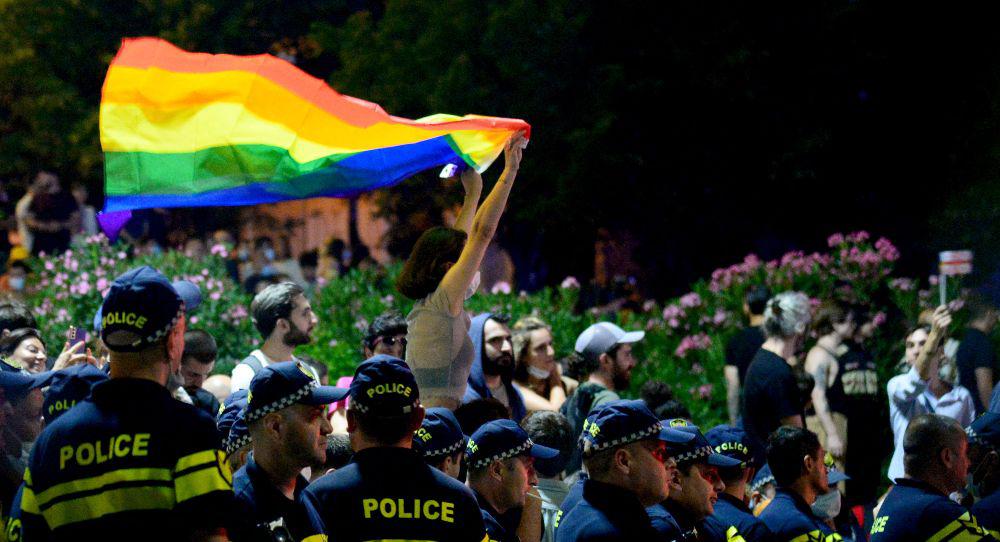
The country’s leaders have also picked a fight with Western partners over the Tbilisi Pride march in July. On July 5, they failed to protect journalists from violence by anti-LGBTQ extremists, who tore down the EU flag from the parliament building twice in two days. Later the pugnacious Prime Minister Irakli Garibashvili called the event a “propagandistic parade,” implicitly casting the EU in the role of a liberal hegemon imposing its values on the unwilling Georgian nation.
As Nino Lejava has written in an essay for Carnegie Europe’s Future of Georgia project looking at divisions in Georgian society, Georgian elites’ pro-European platform is generally more about geopolitical protection than signing up to common values.
Georgia’s systemic crisis is the work of more than just Georgian Dream. It is a joint venture with the country’s main opposition grouping, and former ruling party, the United National Movement (UNM), still led from exile by ex-president Mikheil Saakashvili. While in office, Saakashvili also indulged in many of the same undemocratic practices of which his party now accuses Georgian Dream—politicizing the judiciary, suppressing independent media, harassing opposition candidates.
In October 2020 Georgian Dream won a third term in office in parliamentary elections—something unprecedented in modern Georgian history. Saakashvili instantly called for a boycott of the new parliament, even though most international observers, while saying the vote had many flaws, affirmed the result.
In April, once again it took an international mediator to negotiate a compromise between these irreconcilable political forces. European Council president Charles Michel brokered a compromise by which Georgian Dream agreed to hold early parliamentary elections if it received less than 43 percent in the municipal elections which will take place on October 2, 2021.
Smaller opposition parties signed the agreement, but the UNM did not, leading the ruling party to complain it was making unilateral concessions and getting little in return. Sure enough, heightening the impression of a political circus, Georgian Dream abandoned the agreement in July, allowing the UNM to announce a few weeks later that it was signing up.
Some commentators still frame Georgian politics in geopolitical terms, seeing the hand of Moscow in these events. That does not fit the facts. The Georgian Dream government has not changed its declared orientation towards the EU and NATO, which still commands strong public support.
Russia has had no diplomatic relations with Georgia since the 2008 war and that is unlikely to change so long as the perpetual stand-off over Abkhazia and South Ossetia continues.
Of course Russian Foreign Minister Sergei Lavrov could not miss an opportunity to comment on recent events and say that the door was open to Georgia for better relations, but he offered no path to make that a reality.
Georgian Dream founder Bidzina Ivanishvili and Garibashvili are not so much emulating Russia, as the transactional relationship Georgia’s other neighbors, Azerbaijan and Turkey, have with Western countries. One Tbilisi-based Polish commentator sees worrying parallels with Poland, while Hungary offers another example—we should not forget that formerly Saakashvili forged a strong bond with Hungary’s Prime Minister Viktor Orbán and even invited him to campaign with him in Georgia in 2012.
Regime survival seems to trump all other considerations—even substantial macro-financial assistance. In so much as Garibashvili and his masters have strategy, it seems to be the following: exert sufficient control over the media, judiciary, and elections to keep control; court the public with talk of “Georgian values” and fear of Saakashvili to distract them from other issues; preserve reasonably good working relations with both Washington and Brussels, while not burning all bridges with Moscow.
Does the Georgian public buy into this message?
A comprehensive survey by the National Democratic Institute from July makes for sobering reading. Fifty one percent of respondents said that Georgia is not a democracy, the same proportion says that the country is moving in the wrong direction and also that none of the current parties meet their needs. Only 30 percent named a political party they would vote for. Overwhelmingly, respondents named unemployment and poverty as their major concerns—a rebuke to a whole generation of Georgian politicians who have promised but not delivered on these issues.
Voters in Tbilisi, a free-thinking city, have the chance to affirm their faith in something different in the coming mayoral elections. They have an unusually diverse slate of more independent candidates to choose from if they want to express their displeasure with the two main parties.
The incumbent, Georgian Dream’s Kakha Kaladze, is the favorite to win. But if the independents do well, then we can at least say that reports of the death of Georgian democracy are a bit exaggerated.

Senior Fellow, Carnegie Europe
Thomas de Waal is a senior fellow at Carnegie Europe, specializing in Eastern Europe and the Caucasus.
Recent Work
Thomas de Waal
Thomas de Waal
Carnegie does not take institutional positions on public policy issues; the views represented herein are those of the author(s) and do not necessarily reflect the views of Carnegie, its staff, or its trustees.

The European Commissioner for Trade is headed to China. But after President Xi’s bridge-building visit to Washington, can a more isolated EU overcome Beijing’s stranglehold on critical raw materials? Who will blink first?

Rym Momtaz, ed.

The domestic impacts of how long it is taking to end the war in Ukraine have pushed the French electorate to the political extremes and compromised the country’s diplomatic capacity.
Rym Momtaz

Before the next wave of EU enlargement takes place, the union needs to grapple with thorny questions of how power is distributed among its members.


Emil Sondaj Hansen, Ditte Brasso Sørensen

A summer of escalation in the Black Sea has hurt Ukraine economically and is exacerbating world food security. A truce is needed—as is a broader reframing of Europe’s Ukraine strategy.
Thomas de Waal

Are Germany’s economic, industrial, and political struggles becoming a liability for the EU’s ability to rise to the geopolitical moment?
Rym Momtaz, ed.