

Commentary
Peter Kellner
{
  "authors": [
    "Peter Kellner"
  ],
  "type": "commentary",
  "blog": "Strategic Europe",
  "centerAffiliationAll": "",
  "centers": [
    "Carnegie Endowment for International Peace",
    "Carnegie Europe"
  ],
  "collections": [
    "Brexit and UK Politics"
  ],
  "englishNewsletterAll": "",
  "nonEnglishNewsletterAll": "",
  "primaryCenter": "Carnegie Europe",
  "programAffiliation": "",
  "programs": [],
  "projects": [],
  "regions": [
    "Europe",
    "Western Europe",
    "United Kingdom"
  ],
  "topics": [
    "Foreign Policy",
    "Economy",
    "Migration",
    "EU",
    "Climate Change"
  ]
}
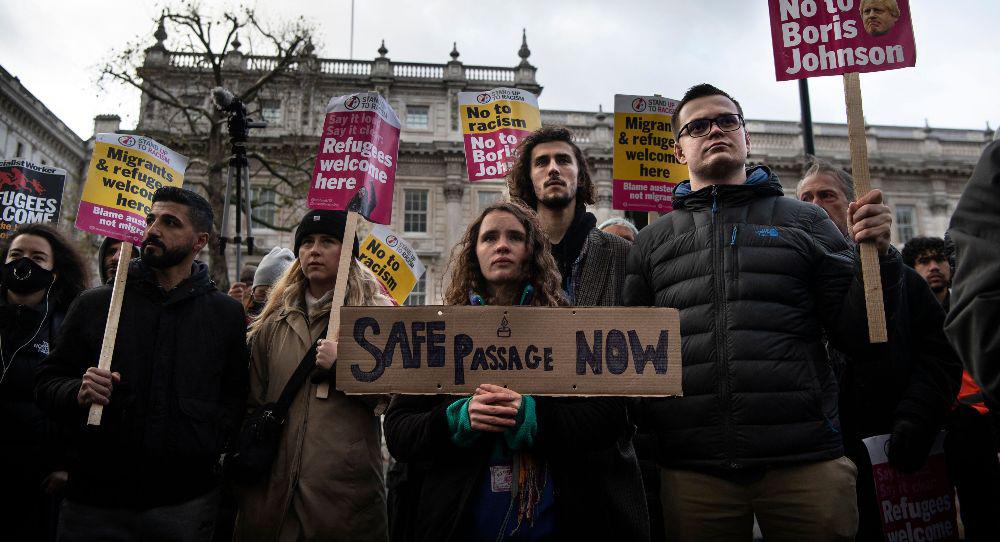
Source: Getty
Boris Johnson ignores the old truth that blaming scapegoats is one way to a run a campaign but no way to run a country. While this lasts, the flame of rational, outward-looking patriotism must be kept alight by Britain’s civil society.
Dear Europe, don’t give up on us. The best of Britain can be found not around Boris Johnson’s cabinet table in London but in the hills of Greece; not snarling at France but helping traumatized Afghan families who have reached the European Union to rebuild their lives.
The Refugee Trauma Initiative (RTI), founded six years ago, is one of many British charities making a difference beyond our borders. Quietly, away from the headlines, they demonstrate daily that the cause of deep, committed cooperation with the rest of Europe lives on.
The news agenda is different. It reports battles with the EU on various fronts. The most notable of these just now are with Brussels over the Northern Ireland Protocol—part of the Brexit deal that Johnson signed two years ago but now wants to ditch—and with France over deadly trade in people paying traffickers to make the hazardous journey across the English Channel to Britain in dinghies.
On November 24, 2021, twenty-seven migrants drowned when their dinghy capsized. This should have been a moment when Britain and France came together to solve a political problem that has now become a human tragedy. However, Johnson defied the accepted norms of what to do in situations that call for delicacy and quiet diplomacy. Seeking to make President Emmanuel Macron a scapegoat, he wrote a provocative letter to France’s leader and released it in time for the next day’s papers. Macron responded by disinviting Priti Patel, Britain’s home secretary, to a meeting that had been planned to tackle the crisis.
Across the board, friction is growing between the UK and the continent. There is a reason for this. Five years ago, the UK voted by 52-48 percent to leave the EU. The campaign that achieved this narrow victory was straightforwardly nationalist: “take back control.” The message was that Britain was being held back by rules and regulations that stymied the country’s economy and prevented it from controlling its borders to keep out immigrants.
The trouble is that the promise of better times has not been kept. Trade with the EU is sharply down. Manufacturers whose exports have to meet EU standards don’t want separate UK rules that will complicate what they do and increase their costs. The government’s own Office for Budget Responsibility has predicted that Brexit will cost Britain’s economy more than COVID-19 and reduce Britain’s potential gross domestic product in the long term by 4 percent.
To this catalogue of failure must now be added the disaster of events in the Channel. Brexit was supposed to increase Britain’s ability to keep out immigrants. Had the UK remained within the EU, it could have employed systems that were being developed to return people who did not qualify for asylum. This had some chance of deterring people from risking their lives to cross the Channel in the first place. Outside the EU, Britain must negotiate afresh. As we have seen, this is not going well.
Following the tragedy on November 24, 2021, one of the normally loyal and fiercely pro-Brexit Conservative members of parliament, Sir John Hayes, addressed the home secretary: “People who voted to take back control have every right to ask the question: ‘If you cannot protect the integrity of the borders, what can you control?’” The minister had no answer.
The Brexit chickens, then, are coming home to roost. There is a fundamental reason for this—indeed, a fundamental reason why the politics of nationalist populism in all countries at all times seldom turn out well. It is that voters are swayed by grievance and the demonization of scapegoats—unwelcome immigrants, greedy bankers, dishonest politicians, interfering foreigners, arrogant elites.
Such campaigns never map out a plausible road to the future once these ne’er-do-wells have been shoved aside. The Leave campaigners conformed to type in the Brexit referendum. They steered well clear of saying what Brexit Britain would be like. It would be a debate they knew they would lose. Events have shown how wise they were.
The need to abandon scapegoat-politics and reengage with the EU is becoming daily more apparent. To be fair, at least parts of the British government know this. Witness the way Alok Sharma, the British minister who chaired the recent COP26 climate conference in Glasgow, worked closely with leaders from around the world, including Frans Timmermans, the EU’s commissioner for climate action, to seek progress on saving the planet.
That, however, is a rare exception. Johnson’s default mode, especially with the EU, is to seek scapegoats rather than solutions. He ignores the old truth that blaming scapegoats is one way to a run a campaign, but no way to run a country. While this lasts, the flame of rational, outward-looking patriotism must be kept alight by civil society. Which brings us back to the Refugee Trauma Initiative.
Three years ago I encountered its founder at event organized by UpRising, a mentoring charity that helps talented youngsters to achieve their potential. Some years earlier, she had served on UpRising’s first program. She went on to start RTI in 2016 after working with refugees in Turkey near the Syrian border. In 2018, we celebrated her selection as one of the first group of twenty community rising stars from around the world to be awarded the Obama Foundation Fellowship, established by Michelle and Barack Obama.
Her name is Zarlasht Halaimzai. She is a refugee from Afghanistan. In the mid-1990s, at the age of eleven, she escaped with her family from the Taliban. After four years without a permanent home, she arrived in the UK, speaking no English. She had to race to catch up, and did.
Zarlasht is just one example of the best of today’s Britain. Dear Europe, don’t give up on us.
Former Nonresident Scholar, Carnegie Europe
Kellner was a nonresident scholar at Carnegie Europe, where his research focused on Brexit, populism, and electoral democracy.
Recent Work
Peter Kellner
Peter Kellner
Carnegie does not take institutional positions on public policy issues; the views represented herein are those of the author(s) and do not necessarily reflect the views of Carnegie, its staff, or its trustees.

Ahead of a tough winter for Ukraine, Donald Trump’s swing back toward Russia bodes ill. But instead of panicking, Kyiv’s European allies are focusing on action.

Rym Momtaz

While the EU and European governments are embracing the much-lauded middle-power moment, this entails three difficult conundrums.

Richard Youngs

Much has been said of the changes Brussels is trying to make to the EU enlargement process. Here’s why gradual integration might—or might not—be the answer.

Dimitar Bechev

The European Commissioner for Trade is headed to China. But after President Xi’s bridge-building visit to Washington, can a more isolated EU overcome Beijing’s stranglehold on critical raw materials? Who will blink first?
Rym Momtaz, ed.

The domestic impacts of how long it is taking to end the war in Ukraine have pushed the French electorate to the political extremes and compromised the country’s diplomatic capacity.
Rym Momtaz