

Commentary
With its public finances in shambles, the far right polling at 35 percent ahead of the 2027 presidential election, and a growing protest movement, is France’s crisis a threat to the EU’s geopolitical awakening?
Rym Momtaz, ed.
{
  "authors": [
    "Olivier de France"
  ],
  "type": "commentary",
  "blog": "Strategic Europe",
  "centerAffiliationAll": "",
  "centers": [
    "Carnegie Endowment for International Peace",
    "Carnegie Europe"
  ],
  "collections": [],
  "englishNewsletterAll": "",
  "nonEnglishNewsletterAll": "",
  "primaryCenter": "Carnegie Europe",
  "programAffiliation": "",
  "programs": [],
  "projects": [],
  "regions": [
    "Europe",
    "Western Europe"
  ],
  "topics": [
    "Foreign Policy",
    "Security",
    "EU"
  ]
}
Source: Getty
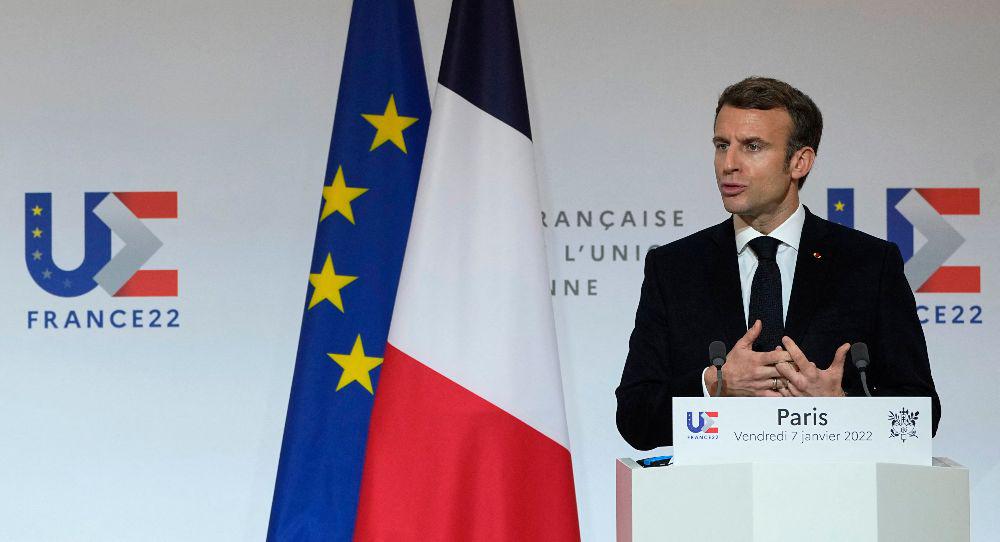
Emmanuel Macron’s bid to build a “Europe that protects” is not misguided; it outflanks both the siege mentality of a defensive continent and the artlessness of a defenseless one. But it will remain a mere ambition if Europe fails to protect itself.
This blog is part of ENGAGE, a project that examines challenges to global governance and EU external action. A consortium of thirteen academic institutions and think tanks seeks to assess the EU’s ability to harness all its foreign policy tools and identify ways to strengthen the EU as a global actor.
***
The idea of a “Europe that protects” has become a totem of the times. It has found favor with many of the continent’s leaders, from former German chancellor Angela Merkel to the European Commission’s former president Jean-Claude Juncker and his successor Ursula von der Leyen, who in 2020 thanked Greece for taking on the dubious role of European “shield” against migration.
The mantra of protection, which many associate with French President Emmanuel’s Macron’s rousing 2017 speech at the Sorbonne University, has logically been raised as a banner for France’s ongoing presidency of the Council of the EU.
For all the present talk about it, the notion is not entirely novel. It has been handed down like a political baton in Paris for the best part of the last three decades. Then president François Mitterrand used it in 1992 to warn against the “wave of mainly Anglo-Saxon free-market ideology in Europe.” In 1996, Jacques Chirac pushed for “a Europe that reassures and protects,” in the face of a disquieting future characterized by an “increasingly globalized economy.”
On the eve of France’s previous EU presidency in 2008, Nicolas Sarkozy argued that “we must not be afraid of the word protection” and pledged to turn Europe into “a means of protecting Europeans in their daily lives.” Not to be outdone, François Hollande stated in 2016 that France was preparing a political initiative to fend off the threat of Brexit: a “Europe that protects.” It required that Brussels focus “on security, the control of its external borders, the fight against terrorism [and] the defence of our continent.”
The foil common to all these presidential pledges is the unruly nature of the outside world. They demonstrate that Paris has never quite bought into the idea of Brussels using the mere power of its markets to convince governments in the near abroad to form an ordered “ring of well governed countries to the East of the European Union and on the borders of the Mediterranean.”
To misquote Radosław Sikorski’s swipe at German foreign policy, France fears European power less than it does European inactivity in this respect—hence why a benign Europe is often cast as a threat to French interests on the global stage, rather than an auxiliary.
The latest of Russia’s military incursions into Ukraine are unlikely to assuage any such fears. Particularly galling for Paris is the reliance of Europeans on U.S. intelligence to track developments in their own backyard. Overall, the old continent has pottered through the crisis as though bent on conjuring up the familiar figure of Titian’s Princess Europa, defenseless in the face of foreign powers.
So what are the alternatives? The first is turning a defenseless power into a defensive continent. Despite their conflicting views of the Kremlin, far-right parties have long used this trope in their attempts to build transnational coalitions of European nationalists. When Hungary’s Prime Minister Viktor Orbán, France’s opposition leader Marine Le Pen, Poland’s Prime Minister Mateusz Morawiecki, and several others met in Madrid at the beginning of 2022, they rallied under the banner of “defending Europe.” Not that the idea of a “fortress Europe” is a strict preserve of the far right: it was Brussels, after all, that appointed an EU Commissioner in 2019 to protect the “European way of life,” and Nicolas Sarkozy who created a ministry of “immigration, integration, national identity and cooperative development” in 2007.
Nor is the perception that Europe is under siege a wholly novel one. If anything, Sebastian Münster’s sixteenth century engravings would indicate that Europe first became a continent in its own eyes by distinguishing itself from an external environment which it identified as hostile. His early modern cosmographies accordingly represent the continent under the guise of Queen Europa, defender of the faith, balancing an orb and scepter.
Defenseless or defensive Europe? Princess Europa or Europa Regina? The difficulty lies in sidestepping the lure of these opposing but mutually sustaining narratives. The Europe that protects is the only palpable alternative at present—but what does it protect, against whom, and with what means? The French president’s proposal for a pan-European debate about the new security order in Europe is one way of framing the question. If the fate of Macron’s Conference for the Future of Europe is anything to go by, however, it hardly guarantees an answer or even a willing public. In effect, Vladimir Putin yesterday rejected Macron’s diplomatic overtures by recognizing the independence of Donetsk and Luhansk.
Yet the French leader’s instincts are not misguided. In the long term, what ultimately weds the continent to the twin narratives of closed and open Europe is a stubborn shortage of political imagination. This is never a fatality. Richard Youngs has developed the idea of protective security, the European Council on Foreign Relations that of protective Europe. Europeans experts have defended cooperative security to protect the basic rules of continental coexistence and others are rethinking global Europe.
Younger voices of the continent are also looking for new totems: replacing toxic narratives with one that reconciles “the protection of the environment, the protection of its citizens and the protection of the European project”—and substituting the ghosts of an imperial, masculine, geopolitical, and colonizing past with a green civilian superpower and a “European Marianne.”
If it hopes to go beyond the sterile dichotomy between defensive and defenseless Europe, the French presidency of the Council of the EU could do worse than following up some of these ideas. In the meanwhile, cold geopolitical realities await. Putin has now effectively withdrawn unilaterally from the Minsk accords and is forcing a response from France and the West. But if a self-styled “geopolitical” Europe is unable to protect itself, what chance does it stand of crafting a Europe that protects?
Olivier de France is a senior research fellow at The French Institute for International and Strategic Affairs.

Olivier de France
IRIS
Olivier de France is a senior research fellow at The French Institute for International and Strategic Affairs.
Carnegie does not take institutional positions on public policy issues; the views represented herein are those of the author(s) and do not necessarily reflect the views of Carnegie, its staff, or its trustees.

With its public finances in shambles, the far right polling at 35 percent ahead of the 2027 presidential election, and a growing protest movement, is France’s crisis a threat to the EU’s geopolitical awakening?

Rym Momtaz, ed.

Ahead of a tough winter for Ukraine, Donald Trump’s swing back toward Russia bodes ill. But instead of panicking, Kyiv’s European allies are focusing on action.
Rym Momtaz

While the EU and European governments are embracing the much-lauded middle-power moment, this entails three difficult conundrums.

Richard Youngs

Much has been said of the changes Brussels is trying to make to the EU enlargement process. Here’s why gradual integration might—or might not—be the answer.

Dimitar Bechev

The European Commissioner for Trade is headed to China. But after President Xi’s bridge-building visit to Washington, can a more isolated EU overcome Beijing’s stranglehold on critical raw materials? Who will blink first?
Rym Momtaz, ed.