

Commentary
Marc Pierini
{
  "authors": [
    "Marc Pierini"
  ],
  "type": "commentary",
  "blog": "Strategic Europe",
  "centerAffiliationAll": "",
  "centers": [
    "Carnegie Endowment for International Peace",
    "Carnegie Europe"
  ],
  "collections": [],
  "englishNewsletterAll": "",
  "nonEnglishNewsletterAll": "",
  "primaryCenter": "Carnegie Europe",
  "programAffiliation": "",
  "programs": [],
  "projects": [],
  "regions": [
    "Europe",
    "Türkiye",
    "Middle East"
  ],
  "topics": [
    "Foreign Policy",
    "Security",
    "EU"
  ]
}
Source: Getty
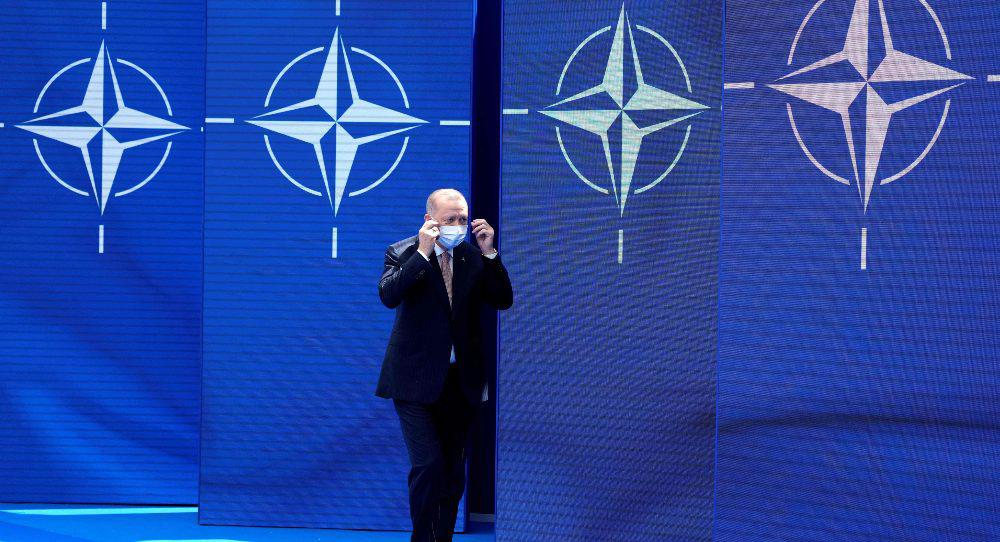
Driven by domestic considerations, Turkey has triggered a major crisis inside NATO by blocking the Finnish and Swedish membership bids. This move inevitably plays into the hands of the Kremlin.
It all started with a signature statement by President Recep Tayyip Erdoğan. He publicly went head-on against the preexisting consensus on NATO enlargement.
Turkey has issues with Finland’s and Sweden’s accession to the alliance, due to Stockholm cozying up too closely with Turkish Kurds and Helsinki implementing an arms embargo on Ankara.
The move was quickly dismissed as a minor issue by Western powers and even minimized by Turkey’s Foreign Minister Mevlut Çavuşoğlu and Erdoğan’s Chief Adviser Ibrahim Kalin.
But then, grandstanding morphed into a veto against a historical move within NATO. Turkey had engineered a roadblock.
Scholars and journalists have provided explanations. It would be about style rather than substance. Some limited concessions would suffice. There would be no way Turkey would long resist pressure within NATO.
There are, however, reasons to believe that this unforeseen episode could last for a while, because of Erdoğan’s strong, or rather, vital political interests.
As in many countries, in Turkey foreign policy is a direct function of domestic politics. Polls unanimously show an important lag (10 percentage points or more) for the incumbent president in the upcoming election. Given the president’s unwillingness to break the deadlock on economic and monetary policy, one of the few ways to catch up with the opposition coalition is to play the strongman’s role on the international stage.
Choosing issues such as NATO enlargement, the “unfair” treatment of Turkey by Western countries, and the fight against the Kurdistan Workers’ Party (PKK) goes down well with the nationalist strand of public opinion, while simultaneously muting opposition voices. Sweden and Finland have fallen victim to these tactics.
Despite the relatively small—and hitherto muted—criticisms against the two countries, whipping them up into an existential fight for the country’s national interests serves Erdoğan well, especially if this fight could go on for a while and if, as announced on May 23, Turkey’s military would launch a new operation in northeastern Syria.
The real frustrations are essentially with the United States’ support for the Syrian Kurdish forces, the People’s Protection Units (YPG), deemed by Ankara to be offshoots of the PKK. Blocking Finland’s and Sweden’s accession to NATO is meant as an indirect hit to U.S. President Joe Biden’s administration, its revived leadership within the alliance, and its distancing from Erdoğan.
In both style and tactics, the argument about NATO enlargement is similar to several other foreign policy initiatives meant to, in the eyes of Turkey’s leadership, boost its visibility and importance on the world stage.
Remember 2020 and the divergences with NATO’s Sea Guardian operation (monitoring the arms embargo against all forces in Libya), the numerous incidents linked to gas and oil exploration in contested areas in the Mediterranean, or the paramilitary assault on the land border with Greece.
All these episodes ended in a noticeable degradation of Turkey’s international image.
Today, the same risk is resurfacing with the NATO enlargement crisis, especially as Finland’s and Sweden’s accession is seen by the rest of NATO as a major element of the Western response to Russia’s unprovoked and brutal aggression against Ukraine.
The paradox of Ankara’s position is that, while being keen to demonstrate its solidarity with the West—the “second most important NATO army,” alignment with UN General Assembly resolutions and NATO’s ministerial statements—its abrupt moves that are dictated by domestic political imperatives make Turkey the chief disruptor in the Western camp.
This has momentous implications for Turkey’s current leadership and for the country itself.
Erdoğan had already estranged himself from the West in 2019 by taking delivery of Russian S-400 missile systems, in effect eliminating the prospect of NATO-origin missile deployment in Turkey. That decision hampers NATO’s defense architecture for Europe, and indirectly gives Russia the massive benefit of facing on its southern flank a Turkish air force and navy deprived of a total of 120 F-35 stealth fighters.
In such a context, delaying for an unknown period of time the accession to the alliance of two reliable northern European countries inevitably plays into the hands of the Kremlin, regardless of the denials from the presidential entourage. It will require more acrobatic narratives to convince Western capitals that Erdoğan is staunchly defending them against Russian aggression.
For Turkey itself, this latest episode will negate the bonus points garnered in the wake of Russia’s invasion of Ukraine.
Recently, most NATO capitals were keen to praise Ankara’s political support to UN General Assembly resolutions, its closure of the Turkish Straits after the start of the invasion, the (timid) mediation efforts between Russia and Ukraine, or the efficiency of its Bayraktar drones.
Instead, what will prevail now is the glass half empty: no troops committed to NATO’s reassurance deployment on its eastern flank, no trade sanctions, no flight restrictions, and a warm welcome to the cohort of Russian oligarchs.
The much-touted balanced policy between Moscow and Kyiv is resulting in another major disruptive stance against NATO at one of the most critical times since its establishment.
The irony is that Turkey had relatively simple issues worth discussing with Finland and Sweden, issues which could have been settled quietly in NATO’s back corridors. Instead, for electoral reasons, Ankara once again chose megaphone diplomacy to impose a kind of public bargaining totally at odds with NATO’s traditions and interests in a period of acute tensions with Moscow.
To say the least, Ankara’s frustrations at not being treated with the strong power status it believes to have may last a bit longer. Whether this incident will ultimately benefit Turkey’s opposition is an open question.
This blog is part of the Transatlantic Relations in Review series. Carnegie Europe is grateful to the U.S. Mission to the EU for its support.

Senior Fellow, Carnegie Europe
Marc Pierini is a senior fellow at Carnegie Europe, where his research focuses on developments in the Middle East and Turkey from a European perspective.
Recent Work
Marc Pierini
Marc Pierini
Carnegie does not take institutional positions on public policy issues; the views represented herein are those of the author(s) and do not necessarily reflect the views of Carnegie, its staff, or its trustees.

With its public finances in shambles, the far right polling at 35 percent ahead of the 2027 presidential election, and a growing protest movement, is France’s crisis a threat to the EU’s geopolitical awakening?

Rym Momtaz, ed.

Ahead of a tough winter for Ukraine, Donald Trump’s swing back toward Russia bodes ill. But instead of panicking, Kyiv’s European allies are focusing on action.
Rym Momtaz

While the EU and European governments are embracing the much-lauded middle-power moment, this entails three difficult conundrums.

Richard Youngs

Much has been said of the changes Brussels is trying to make to the EU enlargement process. Here’s why gradual integration might—or might not—be the answer.

Dimitar Bechev

The European Commissioner for Trade is headed to China. But after President Xi’s bridge-building visit to Washington, can a more isolated EU overcome Beijing’s stranglehold on critical raw materials? Who will blink first?
Rym Momtaz, ed.