
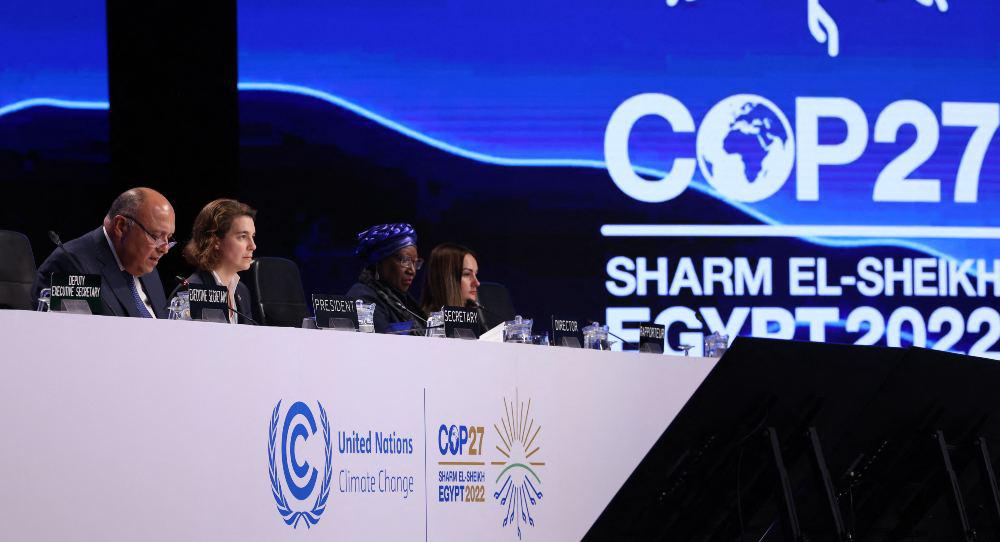
COP27 was an African COP, making it important in and of itself, as it addressed issues that had been left wanting at COP26: climate finance, adaptation, and, of course, loss and damage. This year’s climate catastrophes made it clear that we have moved into climate-unravelling territory and that negotiations on finance compete with those on mitigation in terms of urgency.
This would have been enough to explain why COP27 was a defensive COP. But there were other reasons too. Russia’s war in Ukraine protracted negotiation conditions. It compounded inflation, which complicated many countries’ recovery path following the pandemic. The war also magnified significant risks around food security, most of all for fragile and climate-vulnerable countries. And of course, the war-related energy crises and the weaponization of fossil fuels pitted short-term energy security in Europe against that in other countries, including those most at risk of climate change and economic shocks due to the scramble for gas and the supply crunch it led to. It also now risks locking in fossil investments in Africa at a time when the world needs to accelerate toward clean tech.
In this context, geopolitical fault lines were on full display, and there was a real risk for backsliding on the 1.5°C target. Not only did this not happen; geopolitical fault lines actually led to tectonic shifts. Climate-vulnerable countries led the negotiations dance with grit, creativity, and relentlessness—a trend which will strengthen in the years to come. This resulted in a series of breakthroughs.
The first and most obvious one is the establishment of a loss and damage (L&D) facility, something U.S. climate envoy John Kerry publicly scolded as being impossible just a few weeks ago. True, the L&D facility is for now an empty shell, and much work will be required to ensure it delivers the type of finance that is urgently needed. This is why the second breakthrough is of particular significance: the BridgeTown initiative, which Barbados Prime Minister Mia Mottley proposed at COP27, and which countries like France fully supported, is now reflected in the final COP27 cover text. The latter calls on “the reform of multilateral development banks and financial institutions,” sending a loud and clear message: the Bretton Woods institutions are not fit for purpose when it comes to climate, and the global macroeconomic architecture is compounding the risks associated to climate breakdown and maladaptation.
What an admission. What an opportunity for transformative thinking.
One key challenge looking ahead will be avoid risk aversion. The latter would set the global system on a path toward geoeconomic fragmentation, further de-solidarization, and securitization. On the other hand, a healthy and bold risk-openness will deliver needed reforms in financial institutions and international economics, leading to a more resilient global system.
For this, we need an assumptions shift. So far, economic policies, including at COPs, aim to spur economic growth in the hopes of having fiscal buffering and managing shocks. Let’s turn that on the head going forward: disasters and shocks need to become the central pillar around which we design economic activity. This will guide new thinking on how to mitigate and adapt, and how to create international economic exchanges fit for climate breakdown.
This is why COP was significant on another account: the introduction of a working program on agriculture and food security. Macroeconomic exchange starts with food in any global economic system. Redesigning food systems means we could accelerate toward a new global economic metabolism. The latter will need to deliver on regenerative and complex cultures that support local and regional resilience on the basis of nature- and soil-relevant contexts. This is something that research, civil society, and policy actors need to mobilize for in the next four years.
And finally, the Fossil Fuel Non-Proliferation Treaty—a civil society initiative which aims to ban new exploration of fossil fuels and fast-track climate solutions—made extraordinary progress at COP27. Vanuatu and Tuvalu endorsed the treaty and brough it up at negotiations. Treaty-endorsing African civil society actors provided strong evidence that gas investments in Africa are dangerous for the continent’s mitigation and adaptation potential, and for its development pathway. While it did not amount to cover text breakthrough, the march is now on to name all forms of fossil energy in next negotiation rounds, with likely rapid progress.
All of this amounts to one shining outcome: climate-vulnerable countries delivered an extraordinary COP against all odds. By doing so, they showed they are the powerful and visionary actors that global systems rivalry needs to deliver on global public goods.
It is all the more significant therefore that the EU fought tooth and nail to support the delivery of climate-vulnerable countries’ leadership, and to demonstrate its own simultaneously. Not only did the EU threaten to withdraw from negotiations if the 1.5°C was not upkept; it was the first to support the L&D facility proposition in a dramatic change of stance. This step led to the United States following suit.
The EU and its member states also committed additional funds for adaptation in Africa and supported stronger partnerships. The EU clocked in on the right side of history, and most importantly, the right side of the future as we now head into an age of systems transformation.
Climate-vulnerable countries continue to perceive the EU as hypocritical. There’s no denying that much remains to be done to improve coherence, particularly with regard to European gas investments in Africa. But things are heading in the right direction. Just as COP27 was happening, the EU held its Raw Materials week, during which the nuts and bolts of EU climate policy were intensively discussed. A truly geopolitical security and geoeconomic strategy is still missing to solidify the EU’s trajectory for true systems change going beyond decarbonization only.
This is why the EU’s memorandum of understanding (MoU) with Namibia on critical raw materials, signed on November 8, 2022, is a golden opportunity to use industrial policy for visionary change for coresilience. The MoU’s scope is currently too narrow though and should be deepened within the roadmap development in the next six months. The partnership should lead toward synergistic investments in decarbonization and regeneration along with research on climate-adaptive development. As such, it can act as a test for how economics can be designed for shock resilience rather than business-as-usual transactional partnerships. This would go a long way in building trust between Europe and Africa whilst accelerating climate action in concrete and solidary ways.
Buckle up, the time for middle powers has come. The quality of their relationship will define what public goods on climate and security fronts look like. The ride will look like a highway to hell, but disruptions will open up opportunities for new thinking and transformative international relations. This is what will deliver climate action. And this is why the EU needs to build upon its achievements and think boldly.
The EU’s future will look brighter once it understands the future of its peace project and single market hinges on better and deeper partnerships with partners in Africa and beyond.


