

Report
- +9
Richard Youngs, Erik Jones, Dan Baer, …
{
  "authors": [
    "Rosa Balfour"
  ],
  "type": "commentary",
  "blog": "Strategic Europe",
  "centerAffiliationAll": "",
  "centers": [
    "Carnegie Endowment for International Peace",
    "Carnegie Europe"
  ],
  "collections": [
    "Europe’s Eastern Neighborhood",
    "EU Integration and Enlargement"
  ],
  "englishNewsletterAll": "",
  "nonEnglishNewsletterAll": "",
  "primaryCenter": "Carnegie Europe",
  "programAffiliation": "",
  "programs": [],
  "projects": [],
  "regions": [
    "Europe",
    "Eastern Europe",
    "Ukraine",
    "Western Europe"
  ],
  "topics": [
    "EU",
    "Democracy"
  ]
}
Source: Getty
To make enlargement work, the EU has to marry geopolitics to democracy. By doing so, it can restore its credibility in candidate countries and avoid a Balkans scenario in Ukraine.
The geopolitical turn of history would cancel ideas and emotions for realpolitik calculations. Yet these immaterial factors do shape events, even if it is hard to quantify their role.
Morale is one of these intangibles. Ukrainian President Volodymyr Zelensky clearly knows this.
In his annual speech to the Rada at the end of last year, Zelensky reiterated that “despite the Russian superiority in the number of soldiers and weapons, Ukrainian soldiers have an advantage in determination and the strength of their motherland under their feet.”
Future historians will assess how much the morale of the Ukrainian military—or “warriors,” as Zelensky calls them—and citizens will have determined the outcome of its defence against the Russian invasion. But to contemporary observers it seems critical—and the role civil society has played has been extraordinary.
Ukraine’s public diplomacy is also geared to maintain the mobilization of the West, as Europeans dithered over beefing up their military supplies and the United States debate about how the war may end heads in a different direction to the total “victory” the Ukrainian government is envisaging. When Ukrainians speak, they do so to their own fellow citizens as much as to those supporting them from afar.
Once the guns fall silent, peacetime morale will be equally critical in Ukraine. A traumatized post-war society and savaged state will have to reconstruct, rebuild, seek justice to war crimes, and carry out profound reforms if it wants to achieve its long-time goal of joining the EU. If it recaptures its territories illegally occupied by Russia, it will also have to heal torn apart communities. Whoever will be leading Ukraine will have a hard toll ahead.
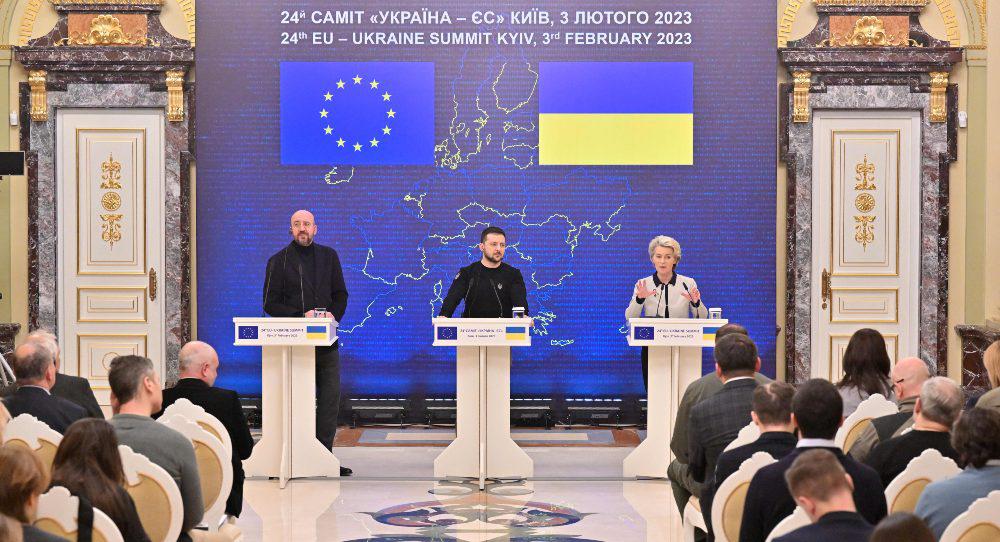
At the EU-Ukraine summit in Kyiv on February 3, 2023, symbolism, ambition, and expectation management were the diplomatic goals of the day. Having made the historic decision in June 2022 to accept Ukraine—along with Moldova—as an EU candidate country, Brussels has been under pressure by political leaders in Kyiv to accelerate the track to membership. In response, the EU has reiterated its commitment to providing “political and military support as long as it takes’” but avoided mentioning the accession timeline.
A geopolitical logic was behind the EU’s fast response in embracing a new project of enlargement—and it is beyond doubt that this was a historic decision it could not shy away from.
But the geopolitical logic will, by necessity, have to be reconciled with one tied to democracy. Recent scandals and resignations among Ukrainian officials suggest Zelensky is aware of the importance of robust anti-corruption ethics, for the West but also because Ukrainian civil society demands it.
But the democracy question is not just about Ukraine. For all its rhetoric around values and interests, the EU has performed poorly in marrying geopolitics and democracy.
In the Western Balkans, it is widely believed that the EU sacrificed democracy for stability in the region; this is the starting point of any conversation about enlargement there.
Political reform has stagnated in the region, institutions have been subject to state capture and, in the case of Serbia, democracy has been backsliding for the past few years. Even when reform was carried out, notably in the case of North Macedonia agreeing with Greece to change its name and of Albania’s reform of the judiciary, the process of accession did not move forward.
The EU, in the meantime, was too concentrated on its own crises to respond—whether by the logic of geopolitics or the reform-driven progress logic of enlargement.
This is where morale comes back into the picture.
In 2022, in the midst of the Russian war against Ukraine, public opinion in Serbia shifted for the first time to a larger plurality against joining the EU. This may not be surprising in a country that sees giant billboards featuring Russian President Vladimir Putin to mark his birthday.
Beyond the Russian sympathies in Serbia, those political and societal forces working for reform have become skeptical of the EU and the prospects to join it. Brave civil society activists campaigning for a better future in the region have increasingly felt isolated, facing the dilemma between? staying at home to fight losing battles or emigrate to Western Europe to offer better futures for their children. They are also often victims of smear campaigns and media attacks.
Apply this scenario of disappointment with the EU to Ukrainian society after the war and you have the ingredients for the country’s unraveling after the extraordinary wartime mobilization.
Losing the confidence of pro-EU political and societal forces is possibly one of the biggest failures of the union. It is a failure that is intimately tied to the EU’s own setup.
One of the reasons for the EU’s cold feet is the loss of faith that the process of enlargement works. Amid a general erosion of democracy globally, Central and Eastern Europe has not done well—and that includes countries that joined in 2004. One reading of Freedom House scores over the years finds that only two countries that joined in the past twenty years did not experience democratic backsliding.
This bolsters the arguments of those who are weary of too large an EU. And the correlation between democratic backsliding within the union and the challenges to the functioning of its institutions are increasingly visible, especially in the context of the present war.
There are proposals for reforming the enlargement process to address the long list of challenges and on how to connect efforts made toward Ukraine and Moldova with the lessons learnt in the Western Balkans.
But the main lesson to be drawn for the present is that reformers need support, that civil society is vital, and that morale, societal energy, vision, and confidence are among those intangibles that make a difference.

Director, Carnegie Europe
Rosa Balfour is the director of Carnegie Europe. Her fields of expertise include European politics, institutions, and foreign and security policy.
Recent Work


Richard Youngs, Erik Jones, Dan Baer, …
Rosa Balfour
Carnegie does not take institutional positions on public policy issues; the views represented herein are those of the author(s) and do not necessarily reflect the views of Carnegie, its staff, or its trustees.

Are Germany’s economic, industrial, and political struggles becoming a liability for the EU’s ability to rise to the geopolitical moment?

Rym Momtaz, ed.

European Commission President Ursula von der Leyen is about to give her annual address on the state of the EU. Here’s what she won’t—but should—say.
Rym Momtaz

The aftermath of the Ceuta crisis shows Europe has drawn the wrong lessons. Rather than doubling down on failed migration policies, the EU needs to address the underlying roots of such episodes.
Richard Youngs

An overwhelming victory by a far-right-wing party in a small state in eastern Germany will have major repercussions for Chancellor Friedrich Merz’s coalition.

Judy Dempsey

Canadian Prime Minister Mark Carney has twice inspired praise for standing up to U.S. President Donald Trump: at the 2026 World Economic Forum in Davos and on Canada-U.S. trade negotiations. Is Carney showing a third way better than the EU has in dealing with the Trump administration?
Rym Momtaz, ed.