

Commentary
Ahead of a tough winter for Ukraine, Donald Trump’s swing back toward Russia bodes ill. But instead of panicking, Kyiv’s European allies are focusing on action.
Rym Momtaz
{
  "authors": [
    "Gustavo Müller"
  ],
  "type": "commentary",
  "blog": "Strategic Europe",
  "centerAffiliationAll": "",
  "centers": [
    "Carnegie Endowment for International Peace",
    "Carnegie Europe"
  ],
  "collections": [],
  "englishNewsletterAll": "",
  "nonEnglishNewsletterAll": "",
  "primaryCenter": "Carnegie Europe",
  "programAffiliation": "",
  "programs": [],
  "projects": [],
  "regions": [
    "Europe",
    "North America",
    "South America",
    "Western Europe"
  ],
  "topics": [
    "Foreign Policy",
    "Economy",
    "EU",
    "Climate Change"
  ]
}
Source: Getty
Having long neglected Latin America, the EU now seeks to strengthen its ties with the region. The Association Agreement with Mercosur provides a unique opportunity to redefine that relationship.
This blog is part of ENGAGE, a project that examines challenges to global governance and EU external action. A consortium of thirteen academic institutions and think tanks seeks to assess the EU’s ability to harness all its foreign policy tools and identify ways to strengthen the EU as a global actor.
***
Back in 2019, a unique set of circumstances made the once considered improbable Association Agreement (AA) between the EU and the Southern Common Market (Mercosur) seem attainable. Brussels reached an agreement in principle with the bloc comprising Argentina, Brazil, Paraguay, and Uruguay. For two decades, protectionist stances on both sides and diverging economic visions amplified by interest groups had amounted to unsurmountable obstacles for the conclusion of an agreement.
Amid the global trade turbulence fueled by former U.S. president Donald Trump’s administration’s protectionist stance and the weakening of the World Trade Organization, the EU sought to send a clear message to champion rules-based international trade. At the same time, economically liberal governments in Brazil and Argentina appeared as willing partners to finalize a trade deal twenty years in the making. This synergy created a rare window of opportunity for an agreement that could redefine EU’s relations not only with Mercosur, by facilitating inter-bloc trade and investment as well as regulatory alignment, but also with the broader region of Latin America. The EU is Mercosur’s second largest trade partner and the bloc’s first investor.
Despite the optimism of four years ago, when the deal was “agreed in principle,” the path to finalizing and ratifying the EU-Mercosur AA remains fraught with hurdles, both political and economic. Politically, interest groups on the European side have attached great importance to standards of sustainability, labor rights, and animal welfare. It is worth mentioning that modern trade deals go far beyond tariff reduction and encompass agreements on common standards, certification origin, intellectual property, investment protection, public procurement, and much more.
The EU’s insistence on stringent environmental safeguards, while reflective of its values, risks undermining the process of ratification and even finalization of the legal text. The EU’s more recent unilateral trade measures, such as its so-called Deforestation Regulation that bans certain commodities originating from deforested areas, are complicating factors in the negotiations. Over the years, national and subnational parliaments of EU member states have expressed opposition to the agreement, arguing that it does not go far enough in the protection of the environment, and have even called for a full renegotiation. Groups at the European Parliament also oppose the deal on similar grounds.
From Mercosur’s perspective, these demands are seen as redundant given its member countries’ existing environmental laws and their current multilateral commitments in global agreements. The demands also hint at European protectionism to preserve the fragile but structurally important compromises of the EU’s Common Agricultural Policy. The situation is further complicated by Brazil’s new administration under President Luiz Inácio Lula da Silva, whose emphasis on the country’s re-industrialization might clash with the trade openness required by the deal. This tension underscores the complex balancing act of pursuing economic liberalization while safeguarding national industrial interests. Access to public procurement, therefore, has been one the negotiations’ most complex issues, especially because of Brazil’s prioritization of local business in its current growth model.
The EU-Mercosur deal, however, is about more than just commerce and the union’s relationship with Mercosur countries. It is also about the EU’s foothold in the region.
Latin America has not traditionally been a focus of the EU’s external action when compared to the nearby regions of North Africa and Southeastern Europe, transatlantic relations, or, more recently, the Indo-Pacific. Our research within the Horizon 2020 project ENGAGE shows that Latin America does not figure prominently in EU member states’ foreign policy documents. However, the region has gained strategic importance in the EU’s quest for allies amid Russia’s war against Ukraine and the escalating Sino-American geopolitical and geoeconomic competition.
Spain and Portugal are notable exceptions when it comes to prioritizing Latin America in their foreign policy. As a matter of fact, the Spanish rotating presidency of the Council of the EU was expected to create momentum for the negotiations of the EU-Mercosur AA and the EU’s broader partnership with Latin America.
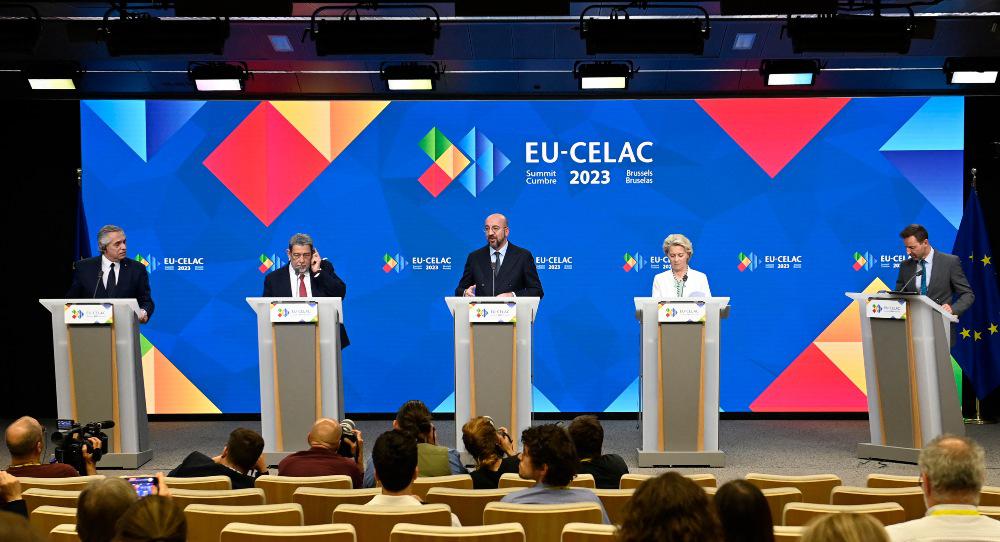
Yet, the July 2023 summit between the EU and the Community of Latin American and Caribbean States (CELAC)—the first high-level meeting in more than eight years—fell short of introducing significant bi-regional initiatives, as leaders shied away from contentious issues. The fact that the summit took place at all was an achievement. Its content, however, shows that the EU struggles as a latecomer in Latin America even if it has been, perhaps paradoxically, a longstanding partner of the region.
A failure to conclude the EU-Mercosur agreement would have significant implications for both regions. For the EU, it would represent a lost opportunity to strengthen its influence in Latin America. For Mercosur, internal challenges loom large. Uruguay’s threat to independently negotiate a trade deal with China in the absence of the EU-Mercosur AA could destabilize bloc. Argentina’s upcoming presidential election and Brazil’s growing focus on industrialization add to the uncertainty.
The EU-Mercosur Association Agreement is more than a trade deal. It highlights the need for the EU to think strategically and act coherently in its external action, coordinating economic and geopolitical interests. It is also a test of the EU’s ability to foster long-term, mutually beneficial relationships with Latin America.
It is rare for the EU to negotiate an economic partnership with a bloc that is both an agricultural powerhouse and highly ambitions in the industrial and service sectors. In purely economic terms, however, the deal is unlikely to substantially change growth figures.
In today’s global competitive international landscape, the EU is compelled to rethink its approach to trade and association agreements. To differentiate itself from competitors like the United States and China, the bloc needs to consider more creative and inclusive economic offers that address the structural inequalities of global North-South dynamics.
The EU must offer a vision that goes beyond economic transactions and lectures on sustainability—one that promises shared prosperity and acknowledges the complex interplay of geopolitical, environmental, technological, and industrial factors shaping today’s global politics.
Gustavo Müller is a senior researcher at the Leuven Centre for Global Governance Studies of the University of Leuven and member of the Horizon 2020 project ENGAGE.


Gustavo Müller
KU Leuven
Gustavo Müller is a senior researcher at the Leuven Centre for Global Governance Studies of the University of Leuven and member of the Horizon 2020 project ENGAGE.
Carnegie does not take institutional positions on public policy issues; the views represented herein are those of the author(s) and do not necessarily reflect the views of Carnegie, its staff, or its trustees.

Ahead of a tough winter for Ukraine, Donald Trump’s swing back toward Russia bodes ill. But instead of panicking, Kyiv’s European allies are focusing on action.

Rym Momtaz

While the EU and European governments are embracing the much-lauded middle-power moment, this entails three difficult conundrums.

Richard Youngs

Much has been said of the changes Brussels is trying to make to the EU enlargement process. Here’s why gradual integration might—or might not—be the answer.

Dimitar Bechev

The European Commissioner for Trade is headed to China. But after President Xi’s bridge-building visit to Washington, can a more isolated EU overcome Beijing’s stranglehold on critical raw materials? Who will blink first?
Rym Momtaz, ed.

The domestic impacts of how long it is taking to end the war in Ukraine have pushed the French electorate to the political extremes and compromised the country’s diplomatic capacity.
Rym Momtaz