

Article
Thomas de Waal
{
  "authors": [
    "Thomas de Waal"
  ],
  "type": "commentary",
  "blog": "Strategic Europe",
  "centerAffiliationAll": "",
  "centers": [
    "Carnegie Endowment for International Peace",
    "Carnegie Europe"
  ],
  "collections": [
    "Europe’s Eastern Neighborhood",
    "Aso Tavitian Initiative"
  ],
  "englishNewsletterAll": "",
  "nonEnglishNewsletterAll": "",
  "primaryCenter": "Carnegie Europe",
  "programAffiliation": "",
  "programs": [],
  "projects": [],
  "regions": [
    "Russia",
    "Europe",
    "Türkiye",
    "Eastern Europe",
    "Caucasus",
    "Azerbaijan",
    "Armenia"
  ],
  "topics": [
    "Security",
    "EU"
  ]
}
Source: Getty
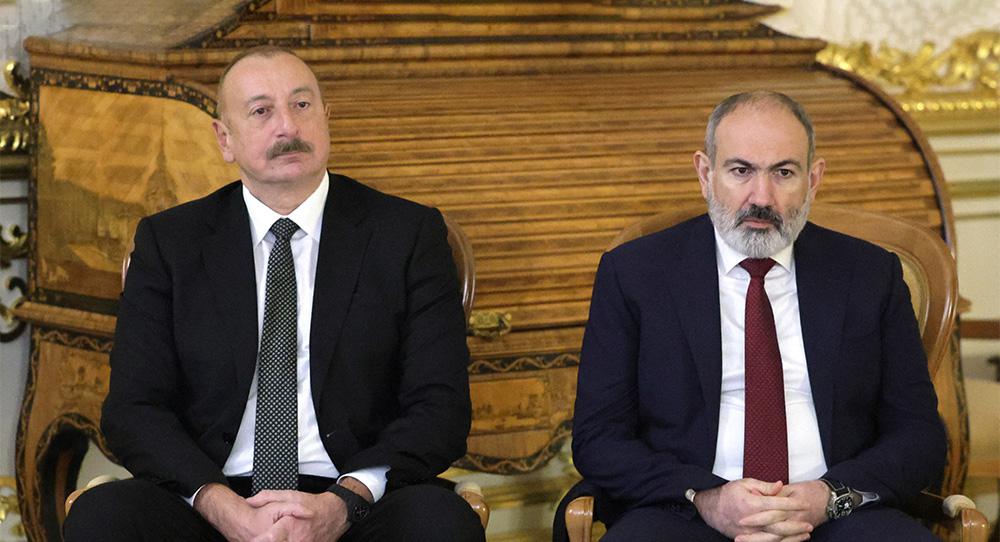
Armenia and Azerbaijan may be nearing a bilateral peace agreement, but the threat of violence persists. A major sticking point is the Zangezur Corridor, where Baku and Moscow may pursue a deal to the detriment of Yerevan and the West.
As in Ukraine, so in the South Caucasus, 2024 will be a critical year, and one that will also test European decisionmakers.
The second half of the year will be difficult for Georgia. In October, there will be an election in which the Georgian Dream ruling party seeks to win an unprecedented fourth term and tighten its increasingly illiberal grip on the country—while still keeping its newly acquired EU candidate status.
Before that looms the issue of Azerbaijan and Armenia and whether, yet again, this is a year of war or peace. Negotiations are ongoing for a bilateral peace agreement that would normalize relations between the two countries after thirty years of conflict, but there is still the threat of violence in and around southern Armenia—in the region called Syunik, historically known as Zangezur.
On February 13, the Armenian military reported that two of its soldiers had been killed by fire from the Azerbaijani side near the village of Nerkin Hand in Syunik. It is an area close to Azerbaijan, where monitors from the EU border mission, EUMA, have previously been denied access by Russian border guards.
Azerbaijan still holds most of the cards. President Ilham Aliyev was re-elected for a fifth term as president on February 7. He has never looked so confident. Aliyev derives new legitimacy with the public from his military victory last September when his forces captured Nagorny Karabakh in a lightning operation, forcing the entire Armenian population to flee and resolving the decades-old conflict by violence.
The Karabakh operation accelerated a cooling of relations between Azerbaijan and the West, which had been trying to broker a peaceful resolution of the conflict until the last moment. This as the Armenia-Russia relationship is in a process of spectacular breakdown and the EU steps up its engagement with Armenia.
Conversely, Aliyev’s confidence derives from a double insurance policy with his two big neighbors: a tight alliance with Turkish President Recep Tayyip Erdoğan and a mutually advantageous partnership with Russian President Vladimir Putin. The stress on the two leaders rather than their countries is deliberate—these are very personal bonds between men who speak the same macho language of power and money.
The Western-facilitated negotiation tracks in Brussels and Washington have been suspended since last summer. What is left is a bilateral process, led by the Armenian and Azerbaijani national security advisers, working on the text of a peace agreement.
It is a serious process that delivered a good outcome on December 7, when Armenian detainees were released in return for Armenia dropping a veto on Azerbaijan hosting the COP-29 climate summit in Baku at the end of 2024.
A bilateral peace process without mediators has the advantage that no foreign agendas or egos can get in the way of a deal. But the Armenian side also fears that in a situation of asymmetry Baku can use it to impose its agenda, demanding concessions while still threatening to use force.
There are reported to be three main sticking points in reaching a deal. One is the demarcation of the border between Armenia and Azerbaijan, where multiple maps from different parts of the Soviet era give different interpretations of where lines should be drawn.
The second issue is what kind of international guarantees and dispute resolution mechanism there will be to make an agreement sustainable. The Armenians want as much international backup as possible, while the Azerbaijanis want to see very little written here.
The third issue is the highly contentious one of reopening a long-closed corridor or transit route across 43 kilometers of Armenian territory connecting the main part of Azerbaijan to its exclave of Nakhchivan, bordering Türkiye. Azerbaijan has an interest in reconnecting the two parts of its territory with routes that have as little Armenian control over them as possible. Armenia does not want to cede sovereignty or security over its strategically vital southern border area.
There is a strong Western strategic interest in the second point, and even more so in the third one—the issue of the so-called Zangezur Corridor. When it comes to security, Azerbaijan is insisting that Russian Federal Security Service (FSB) border guards should guard the rail and road connection. They cite a trilateral Armenian-Azerbaijani-Russian ceasefire statement of November 2020, which explicitly mentions this point—even though the rest of that agreement has now been rendered defunct by events. In January, Russian Foreign Minister Sergei Lavrov again insisted that this part of the deal must be enforced.
For its part, the Armenian side is working to rid itself of Russian influence, including the border guards deployed there after the fall of the Soviet Union. It would be a major strategic blow if the Russians were to stay, at the behest of Azerbaijan.
The working assumption in Armenia is that there is a deal between Baku and Moscow here, which Ankara has quietly assented to. There is at least circumstantial evidence to back this up. For the Russians, control of the transit route would be a big success. They would be formally handed control of a stretch of railway that links Russia and Iran—and routes onward to the Persian Gulf—for the first time in decades. This would be the major north-south rail route for Russia to rebuild its connections with the Middle East as war with Ukraine and contestation with the West stretch into the future.
The worrying scenario is that a peace deal will not be signed until Azerbaijan gets what it wants in southern Armenia. To put it another way, in 2024 Armenia is likely to come under big pressure from both Baku and Moscow, using different methods, to accede to a plan for the Zangezur Corridor that suits neither Yerevan nor the Western powers.
That is also why local incidents of violence, such as the one near Nerkin Hand, need to be watched very closely. New conflict and fateful consequences for the entire region could flow from small clashes like this one.

Senior Fellow, Carnegie Europe
Thomas de Waal is a senior fellow at Carnegie Europe, specializing in Eastern Europe and the Caucasus.
Recent Work
Thomas de Waal
Thomas de Waal
Carnegie does not take institutional positions on public policy issues; the views represented herein are those of the author(s) and do not necessarily reflect the views of Carnegie, its staff, or its trustees.

Are Germany’s economic, industrial, and political struggles becoming a liability for the EU’s ability to rise to the geopolitical moment?

Rym Momtaz, ed.

European Commission President Ursula von der Leyen is about to give her annual address on the state of the EU. Here’s what she won’t—but should—say.
Rym Momtaz

The aftermath of the Ceuta crisis shows Europe has drawn the wrong lessons. Rather than doubling down on failed migration policies, the EU needs to address the underlying roots of such episodes.

Richard Youngs

An overwhelming victory by a far-right-wing party in a small state in eastern Germany will have major repercussions for Chancellor Friedrich Merz’s coalition.

Judy Dempsey

Canadian Prime Minister Mark Carney has twice inspired praise for standing up to U.S. President Donald Trump: at the 2026 World Economic Forum in Davos and on Canada-U.S. trade negotiations. Is Carney showing a third way better than the EU has in dealing with the Trump administration?
Rym Momtaz, ed.