

Commentary
The EU can impose sanctions but struggles to enforce them without the United States. With Washington increasingly disinterested in backing European interests, the bloc must now fend for itself.
Nicu Popescu, Tiago Antunes
{
  "authors": [
    "John R. Deni"
  ],
  "type": "commentary",
  "blog": "Strategic Europe",
  "centerAffiliationAll": "",
  "centers": [
    "Carnegie Endowment for International Peace",
    "Carnegie Europe"
  ],
  "collections": [
    "Transatlantic Cooperation"
  ],
  "englishNewsletterAll": "",
  "nonEnglishNewsletterAll": "",
  "primaryCenter": "Carnegie Europe",
  "programAffiliation": "",
  "programs": [],
  "projects": [],
  "regions": [
    "Russia",
    "Europe",
    "North America",
    "United States",
    "Western Europe"
  ],
  "topics": [
    "Security",
    "EU",
    "NATO",
    "Defense"
  ]
}
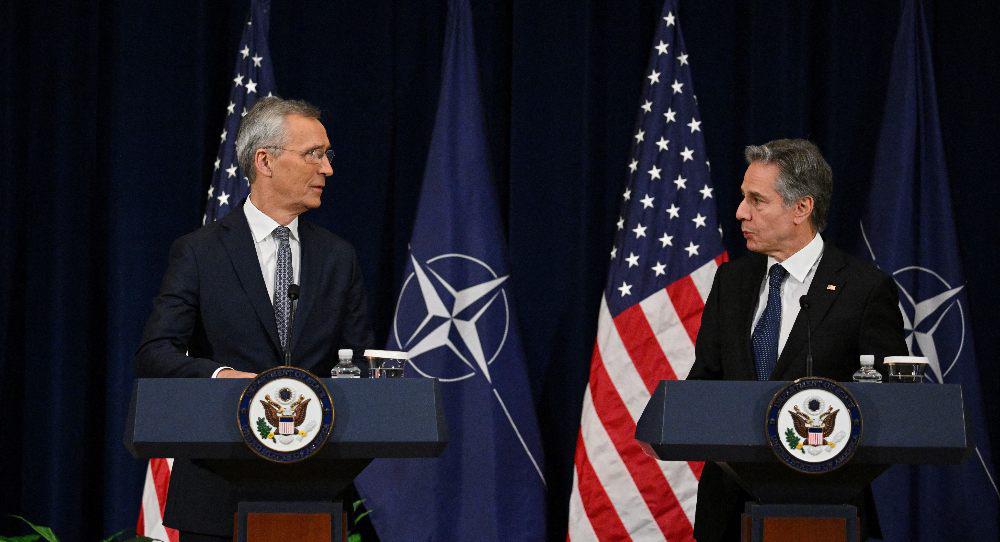
Source: Getty
Despite achieving notable successes over its seventy-five years of existence, NATO today faces a major challenge. A change in the United States’ commitment could spell the demise of the alliance.
The North Atlantic Alliance should justifiably mark the seventy-fifth year since its founding, but this may not be the time to pop champagne corks.
NATO has been labeled “the most successful alliance in history,” and depending on how one defines success, this label is fairly accurate. However, the alliance faces a fundamental challenge today, one that might mean the operative phrase in that superlative is “in history.”
If America’s commitment to the alliance changes significantly after January 20, 2025—perhaps through an overt policy change like formal withdrawal or perhaps just by conditioning U.S. commitment—NATO may indeed be consigned to history.
Since its founding in April 1949, the alliance has indeed had several major successes. Foremost among them was containing and then essentially rolling back Soviet/Russian political control of and decisive influence in Europe. This resulted in a seventy-five-year absence of a continent-wide war in Europe, rivaling the period from the 1815 Congress of Vienna to the 1914 outbreak of World War I.
Exactly thirty years ago, the alliance had another notable success—expanding its repertoire by going “out of area” to address the instability unfolding on its doorstep. Bosnia and Kosovo are still far from exemplars of Western liberal democracy, but NATO’s intervention decisively ended the first instances of ethnic cleansing in Europe since World War II.
More recently, the alliance has shown early signs of success in re-embracing Article 5. In the years after Russia’s first invasion of Ukraine in 2014, the changes necessary to refocus on collective defense came slowly. For example, the Readiness Action Plan, Enhanced Forward Presence, the Four 30s initiative, and a revised Strategic Concept unfolded over the course of several years.
In contrast, since February 2022 and Russia’s far more brutal second invasion of Ukraine, NATO’s re-embrace of collective defense appears to be on steroids. A new force model, successful integration of Finland and Sweden, more robust presence along the Eastern flank, and stronger emphasis on technological innovation and defense industry collaboration have all come in quick succession over the last two years, at least relative to NATO’s normal plod.
Despite these successes, the alliance still struggles with sufficient resourcing and equitable responsibility-sharing, achieving necessary capability and capacity goals, and fully embracing the threat posed by China in Europe today. Moreover, its efforts in Libya and Afghanistan led to mixed results at best. Beyond these recent operations, NATO’s history has been punctuated by several disagreements or crises, some quite serious. Admitting West Germany, Suez, French withdrawal from the military command, deployment of ground launched cruise missiles and Pershing missiles, and America’s 2003 invasion of Iraq all stand out.
Over the decades, journalists, academics, and other observers have taken note of these moments, frequently declaring NATO to be in an unprecedented crisis threatening its existence. This phenomenon has been so common that one prominent academic has labeled it “alliance crisis syndrome”.
Yet the alliance endured. Reasons for this vary among scholars, but included in the list of likely explanatory variables is the fact that the democracies that comprise NATO periodically elect new leaders who are capable of—and indeed typically rewarded politically for—overcoming disagreements and finding new ways to reach compromise.
Today, though, the alliance is on the precipice of a challenge that may indeed lead to its demise. If the alliance’s foremost member formally leaves the treaty named for its capital, then NATO will surely crumble. But a similar outcome could befall the alliance if the United States were to condition its willingness to defend its allies, creating doubt among friends and foes alike.
To be clear, NATO’s success in deterring first the Soviet Union and more recently Russia hinges on one factor—the Kremlin’s perception that the United States would intervene decisively to counter militarily any aggression against alliance members. It’s possible the Kremlin finds the relatively small nuclear arsenals of the United Kingdom and France, the sizeable Turkish army, or Poland’s increasingly capable forces all somewhat worrisome. But it’s safe to assume that America’s massive nuclear arsenal, its large conventional military, and its ability to project power across the globe are the key reasons for whatever restraint still exists in Moscow. Only the United States has the capability and capacity to decisively change outcomes in Europe, and Russia knows it.
Moscow also probably knows that American isolationists on the far right—as well as the far left—aren’t in the majority, and that polling consistently shows most Americans support NATO. Yet there’s a chance those with less appreciation for NATO’s irreplaceable role in the stability and security of Europe, in transatlantic trade and investment, and hence in the American way of life could fundamentally upend U.S. policy toward the alliance. If so, NATO’s seventy-fifth anniversary could be prelude to a tragedy.
In 2011, then-secretary of defense Robert Gates suggested that future U.S. leaders might not consider the return on America’s investment in NATO worth the cost. Perhaps his warning is coming true. But given the array of threats facing the West today and the alliance’s proven ability to adapt to those challenges, it’s clear on this seventy-fifth anniversary that NATO has never been more worth it.
John R. Deni is a research professor at the U.S. Army War College’s Strategic Studies Institute, a nonresident senior fellow at the Atlantic Council, and an associate fellow at the NATO Defense College. He is the author of NATO and Article 5. The views expressed are his own.

John R. Deni
Atlantic Council
John R. Deni is a research professor at the U.S. Army War College’s Strategic Studies Institute, a nonresident senior fellow at the Atlantic Council, and an associate fellow at the NATO Defense College. He is the author of NATO and Article 5. The views expressed are his own.
Carnegie does not take institutional positions on public policy issues; the views represented herein are those of the author(s) and do not necessarily reflect the views of Carnegie, its staff, or its trustees.

The EU can impose sanctions but struggles to enforce them without the United States. With Washington increasingly disinterested in backing European interests, the bloc must now fend for itself.


Nicu Popescu, Tiago Antunes

Russia is testing the waters of NATO’s mutual defense clause. What do strikes in Romanian territorial waters mean for the alliance’s posture toward Moscow?

Dimitar Bechev

With its public finances in shambles, the far right polling at 35 percent ahead of the 2027 presidential election, and a growing protest movement, is France’s crisis a threat to the EU’s geopolitical awakening?

Rym Momtaz, ed.

Ahead of a tough winter for Ukraine, Donald Trump’s swing back toward Russia bodes ill. But instead of panicking, Kyiv’s European allies are focusing on action.
Rym Momtaz

While the EU and European governments are embracing the much-lauded middle-power moment, this entails three difficult conundrums.

Richard Youngs