

Commentary
Rym Momtaz, ed.
{
  "authors": [
    "Rym Momtaz"
  ],
  "type": "commentary",
  "blog": "Strategic Europe",
  "centerAffiliationAll": "",
  "centers": [
    "Carnegie Endowment for International Peace",
    "Carnegie Europe"
  ],
  "englishNewsletterAll": "",
  "nonEnglishNewsletterAll": "",
  "primaryCenter": "Carnegie Europe",
  "programAffiliation": "",
  "programs": [],
  "projects": [],
  "regions": [
    "Lebanon",
    "Middle East"
  ],
  "topics": [
    "Military",
    "Foreign Policy",
    "Defense"
  ]
}
Source: Getty
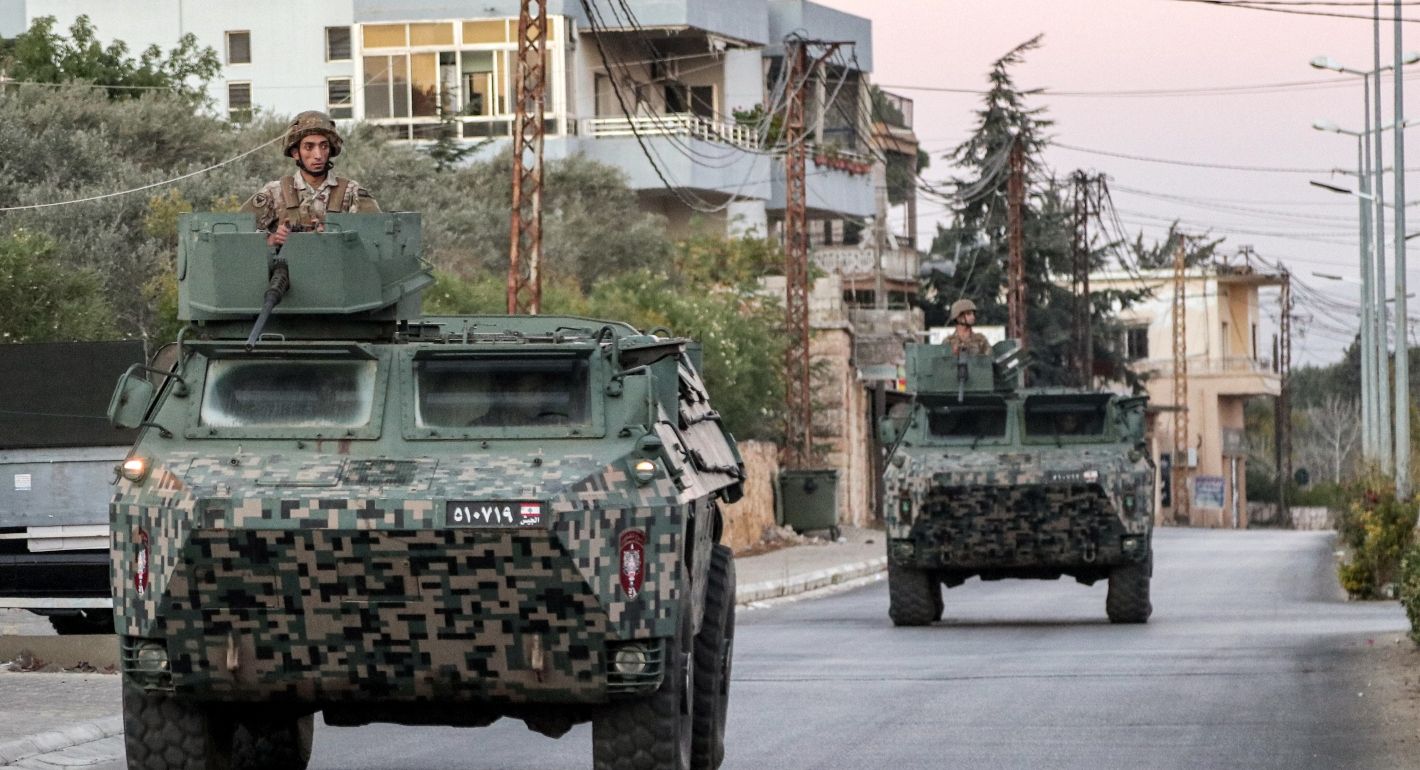
The Lebanese Armed Forces have a critical role to play in bringing peace and stability to the Middle East. By scaling up assistance for the army, Europeans can effect change on the ground and make Lebanon a proof of concept for geopolitical Europe.
Strengthening the Lebanese Armed Forces (LAF) has never been more critical for peace and stability in the Middle East and Europe’s southern flank. But Lebanon’s allies are still struggling to deliver support at scale.
Meeting at the “International Conference in Support of Lebanon’s People and Sovereignty,” officials from Europe, the Arab world, and a handful of other countries successfully mobilized massive humanitarian aid and reinforced crucial diplomatic support for UNIFIL, the UN peacekeepers at the Lebanese-Israeli border. And yet, they didn’t pull together a transformational aid package for the Lebanese army.
The vital conference convened by France in Paris yielded $1 billion in pledged support, including $800 million for humanitarian needs—but only $200 million for the LAF.
While the humanitarian aid is critical and will provide urgent relief, if the LAF are not supercharged at turbo speed at this critical juncture of the struggling country’s history, the state of Lebanon is at serious risk of further collapse and fragmentation. It also faces the potential formation of new, more radical armed groups.
The LAF has to take control of southern Lebanon from the Iran-backed Lebanese armed group Hezbollah and thwart weapons smuggling from Syria while preventing the disintegration of civil peace as well as a potential migration crisis for Europe. To succeed in this mission, it needs financial support and procurement at a game-changing scale, which for now remains elusive.
Diplomatic efforts to reach a ceasefire in Lebanon are centered on exploring whether to adapt United Nations Security Council (UNSC) resolutions and mandates to secure the border and prevent Hezbollah from further threatening Israel. States like France, Italy, Poland, and the UK can be more effective by unilaterally boosting their troop levels within UNIFIL as well as their rules of engagement in southern Lebanon, building on the LAF’s Land Border Regiments on the Syrian border and providing it with a procurement package that gives it a decisive operational advantage over Hezbollah.
This would increase European credibility with the main belligerents, Israel—and indirectly the United States—and Iran, provide a work-around a potential Russian veto at the UNSC, and present a less costly approach to resolving the conflict than risking the ripple effects of Lebanon’s total collapse, which grows likelier as Israeli aggression continues.
The Italian-led Military Technical Committee for Lebanon could be the main coordinating body, not just for bolstering the LAF in the south but also on the Syrian border. The committee can build on France’s leading holistic role, the UK-led land border regimen program, Poland and Slovenia’s beefed up diplomatic involvement, and the European Peace Facility already deployed in Lebanon.
To be sure, this cannot be effective without the Lebanese political class snapping out of its abdication of sovereignty and responsibility. A good place to start would be by declaring a unilateral ceasefire, committing to supporting the LAF’s mission and ensuring its weapons don’t end up in Hezbollah’s hands.
The €200 million pledged at the conference in Paris will certainly provide much-needed support. The LAF is still reeling from the historic financial crisis Lebanon has been enduring since 2019. It has relied on international assistance—including from Qatar and the United States—to feed its soldiers and provide fuel for their vehicles. Attrition has affected its most qualified elements, while the lower-ranking soldiers work outside jobs to feed their families.
But it is a far cry from the pivotal plan to overhaul the capabilities of the LAF that Saudi Arabia and France had committed to in 2014. At the time, Saudi Arabia allocated $3 billion—the equivalent of the total amount of military aid the United States has provided Lebanon since—toward the procurement of French advanced weapons for the LAF, from CAESAR howitzers to refurbished helicopters outfitted with anti-tank missiles.
These would have transformed the balance of power between the LAF and Hezbollah, without threatening Israel’s military hegemony, which remains a top priority for many Western countries. But a political crisis between the then Hezbollah-dominated government and Saudi Arabia, as part of Saudi-Iranian tensions, scuttled the plan. Replicating it today would have the added bonus of strengthening the Gulf’s hand in its balancing game with Iran.
Despite this setback, and significant political and economic crises since, the LAF have managed to preserve their cohesiveness. They are resolutely NATO-centric, despite some recent Russian and Chinese aid, and, within their means, are an operationally capable force that can be trusted by international supporters, as French President Emmanuel Macron said on Thursday.
The LAF’s leadership has more recently stood its ground in southern Lebanon despite taking direct fire from the Israeli military and suffering casualties. This has been crucial to show the Lebanese population that the state is willing to protect all its territory.
Through a British-led initiative, the LAF established four land border regiments to control the Syrian-Lebanese border and counter smuggling. While these have improved the situation, with seventy-five new watch towers, several forward operating bases as well as ISR capabilities, they do not cover a central area that constitutes an essential supply corridor for Hezbollah from Syria. That gap will need to be filled.
UNIFIL could even provide support as UNSC resolution 1701 allows it to operate outside the area South of the Litani upon the request of the Lebanese government.
Europeans could commit an additional 5,000 troops to UNIFIL, to bring the levels up from the current 10,000 to the maximum 15,000 allowed. They could also make the political decision to toughen the rules of engagement to allow more enforcement of the mandate.
All of the above are robust actions with immediate effect that Europeans can take independently of the United States. They have an opportunity to turn Lebanon into a proof of concept for geopolitical Europe.

Editor in Chief, Strategic Europe
Rym Momtaz is the editor in chief of Carnegie Europe’s blog Strategic Europe. A multiple Emmy award-winning journalist-turned-analyst, she specializes in Europe and the Middle East and the interplay between those two spaces.
Recent Work
Rym Momtaz, ed.
Rym Momtaz
Carnegie does not take institutional positions on public policy issues; the views represented herein are those of the author(s) and do not necessarily reflect the views of Carnegie, its staff, or its trustees.

With its public finances in shambles, the far right polling at 35 percent ahead of the 2027 presidential election, and a growing protest movement, is France’s crisis a threat to the EU’s geopolitical awakening?
Rym Momtaz, ed.

Ahead of a tough winter for Ukraine, Donald Trump’s swing back toward Russia bodes ill. But instead of panicking, Kyiv’s European allies are focusing on action.
Rym Momtaz

While the EU and European governments are embracing the much-lauded middle-power moment, this entails three difficult conundrums.

Richard Youngs

Much has been said of the changes Brussels is trying to make to the EU enlargement process. Here’s why gradual integration might—or might not—be the answer.

Dimitar Bechev

The European Commissioner for Trade is headed to China. But after President Xi’s bridge-building visit to Washington, can a more isolated EU overcome Beijing’s stranglehold on critical raw materials? Who will blink first?
Rym Momtaz, ed.