

Commentary
Judy Dempsey
{
  "authors": [
    "Judy Dempsey"
  ],
  "type": "commentary",
  "blog": "Strategic Europe",
  "centerAffiliationAll": "",
  "centers": [
    "Carnegie Endowment for International Peace",
    "Carnegie Europe"
  ],
  "englishNewsletterAll": "",
  "nonEnglishNewsletterAll": "",
  "primaryCenter": "Carnegie Europe",
  "programAffiliation": "",
  "programs": [],
  "projects": [],
  "regions": [
    "Germany",
    "Western Europe",
    "United States"
  ],
  "topics": [
    "Foreign Policy",
    "Political Reform",
    "EU",
    "Security"
  ]
}
Source: Getty
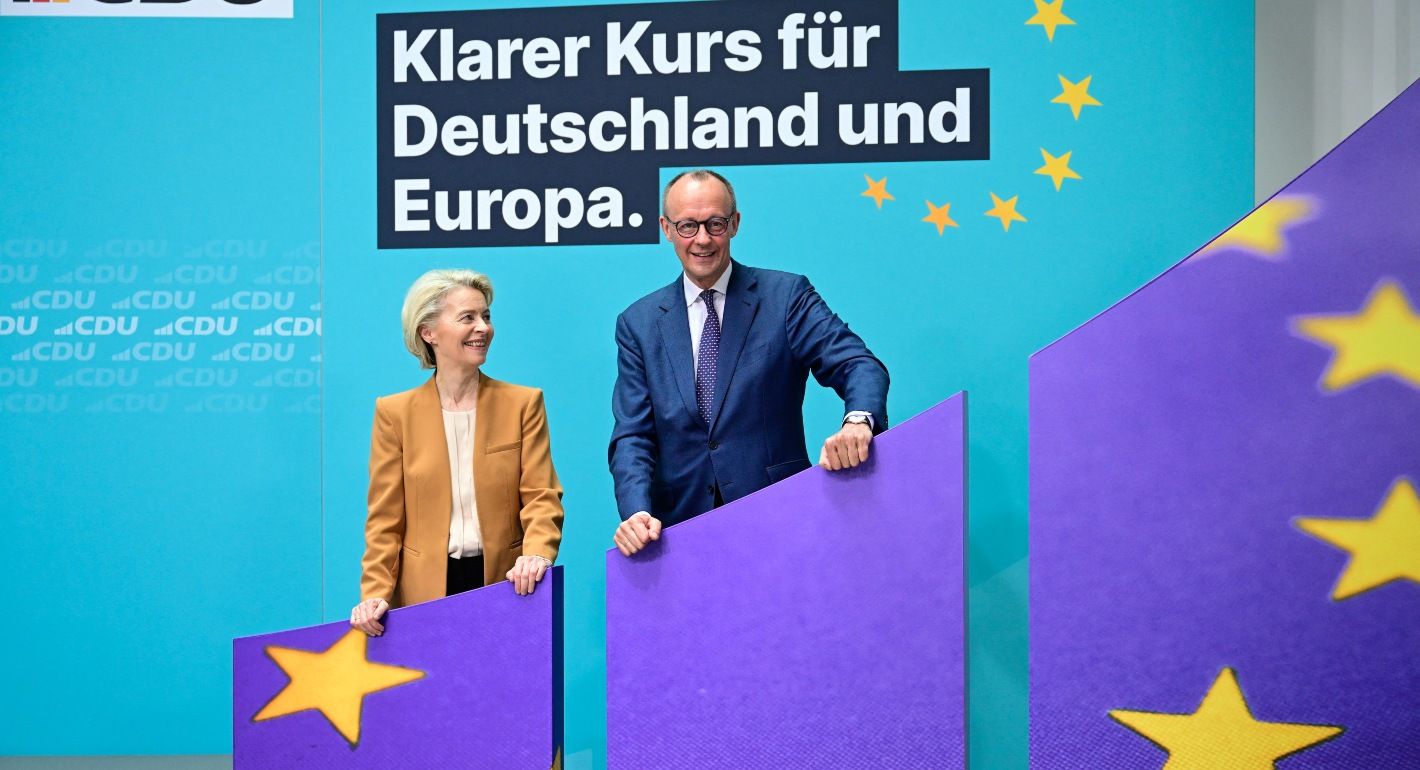
With Trump undermining the transatlantic alliance, Europe is in need of leadership. Germany’s incoming chancellor has a unique opportunity to empower the EU to take charge of its own security and defense.
Friedrich Merz finally has the job he has long craved.
Once sworn in as Germany’s new chancellor, probably before Easter, the leader of the Christian Democratic Union (CDU) wants to move quickly to deal with the plethora of problems facing his country and Europe.
Chief among them is the current U.S. administration, led by President Donald Trump, which is undermining the democratic institutions that underpin the West and the transatlantic alliance.
NATO and the EU have been the essential pillars that have anchored post–1945 Germany in the West. If the NATO pillar is weakened, Germany needs to strengthen the EU one. Doing so requires bolstering its own resilience to Russia, which seeks to exploit the pro-Russian sentiments held by Germany’s far-right and far-left parties—and even among some Social Democrats, who still hanker after the old Ostpolitik.
Coping with all these challenges demands that Germany provide Europe—and NATO—with a strategic outlook and meaningful leadership. Up until now, this has been sorely lacking, leaving the EU’s largest economy relegated to the sidelines and of its own volition.
It’s a daunting task for Merz, who is raising expectations of giving Germany a much-needed voice in Europe. To deliver, he needs to overhaul Germany’s defense and security policies.
After winning the federal election on February 23, roundly defeating outgoing Chancellor Olaf Scholz’s Social Democrats-led coalition, Merz didn’t mince his words. He said Germany had to fundamentally rethink its security arrangements. This meant ending a decades-long reliance on Washington. He seemed to be shocking himself when he said “it must be an absolute priority to strengthen Europe as quickly as possible so that, step by step, we actually achieve independence from the USA.” He paused and continued: “I wouldn’t have thought I’d have to say something like that […] But after Donald Trump’s statements, it is clear that the Americans, at least this American government, are largely indifferent to the fate of Europe.”
Merz added that his immediate task was to form a coalition with the Social Democrats as quickly as possible: “The world will not wait for us.”
Merz’s domestic agenda is clear: boosting investment across the board—including by loosening the debt break introduced in 2010 to curb surging government debt—and raising defense expenditure ahead of the NATO summit in June.
But his defense and security agenda not only requires a DNA change for Germany; it is financially daunting. Merz needs to find political and financial support from the Bundestag to modernize the country’s armed forces instead of tinkering with reforms in the defense ministry.
At the same time, the new chancellor will need to push for bold strategic decisions at the EU level. This won’t be easy. The far-left and far-right parties will try and sabotage his ambitious plans. Domestically, Merz’s Social Democrat coalition partners, who suffered a historic loss in the election, are dependent on the CDU. Their miserable stint in power over the past four years could make them amenable to Merz’s agenda.
As coalition talks start, Merz and his foreign policy advisors should focus on a few key areas that require a major German input to give the country and Europe the security profile they need.
First, Europeans should finally move from words to action and create their caucus in NATO. There is no reason they cannot assume the leadership of the Ramstein forum—also known as the Ukraine Defense Contact Group. Given Trump’s ambiguity on Ukraine and benevolent view of Russian President Vladimir Putin, surely Germany, France, or Poland could take over the forum’s leadership. After all, EU countries have been providing more than half of the support to Ukraine.
Second, under the Berlin Plus agreement, the EU has access to NATO assets and planning capabilities for operations in which the alliance is not militarily involved. That could be the military backbone of an EU coalition of the willing—one that Germany could support—for Ukraine, since NATO will not take on that task.
Third, Trump’s commitment to continue providing Europe with a U.S. security guarantee—the nuclear umbrella—cannot be taken for granted. In theory, the Europeans could turn to Britain and France, Europe’s two nuclear powers as an alternative umbrella, though the practicalities are daunting but not insurmountable. Merz sent a groundbreaking signal in that direction on February 21, when he said “we need to have discussions with both the British and the French […] about whether nuclear sharing or at least nuclear security […] could also apply to us.”
Merz’s Social Democrat partners and the far-right and left-wing parties in the Bundestag would surely oppose such a security umbrella. But as Merz said, Europe faces a new era.
Fourth, there is a need to restart arms control talks. The non-proliferation regime has been progressively weakened, as Cold War–era treaties managing arms races in the European theater have been allowed to lapse. Again, tackling this won’t be easy. And Trump has already floated the idea of holding such discussions—but solely with China and Russia, excluding the Europeans.
Fifth, the Europeans need to diversify their weapons purchases. There are some positive developments in this direction: Poland is now buying more weapons from South Korea. And between February 2022 and September 2024, European NATO members procured 52 percent of new systems from within Europe and only 34 percent from the United States. That said, America still provides indispensable systems.
Making progress on all the above issues necessitates a major German role. If Merz follows up his statements with concrete and strategic actions, he could give Europe the leadership it requires. This could be the necessary anchor for Berlin in light of Washington’s change of direction.

Nonresident Senior Fellow, Carnegie Europe
Judy Dempsey is a nonresident senior fellow at Carnegie Europe
Recent Work
Judy Dempsey
Judy Dempsey
Carnegie does not take institutional positions on public policy issues; the views represented herein are those of the author(s) and do not necessarily reflect the views of Carnegie, its staff, or its trustees.

Before the next wave of EU enlargement takes place, the union needs to grapple with thorny questions of how power is distributed among its members.


Emil Sondaj Hansen, Ditte Brasso Sørensen

A summer of escalation in the Black Sea has hurt Ukraine economically and is exacerbating world food security. A truce is needed—as is a broader reframing of Europe’s Ukraine strategy.

Thomas de Waal

Are Germany’s economic, industrial, and political struggles becoming a liability for the EU’s ability to rise to the geopolitical moment?

Rym Momtaz, ed.

European Commission President Ursula von der Leyen is about to give her annual address on the state of the EU. Here’s what she won’t—but should—say.
Rym Momtaz

The aftermath of the Ceuta crisis shows Europe has drawn the wrong lessons. Rather than doubling down on failed migration policies, the EU needs to address the underlying roots of such episodes.

Richard Youngs