

Commentary
The domestic impacts of how long it is taking to end the war in Ukraine have pushed the French electorate to the political extremes and compromised the country’s diplomatic capacity.
Rym Momtaz
{
  "authors": [
    "Yuliya Bidenko"
  ],
  "type": "commentary",
  "blog": "Strategic Europe",
  "centerAffiliationAll": "",
  "centers": [
    "Carnegie Endowment for International Peace",
    "Carnegie Europe"
  ],
  "collections": [
    "EU Integration and Enlargement"
  ],
  "englishNewsletterAll": "",
  "nonEnglishNewsletterAll": "",
  "primaryCenter": "Carnegie Europe",
  "programAffiliation": "",
  "programs": [],
  "projects": [],
  "regions": [
    "Ukraine",
    "Russia"
  ],
  "topics": [
    "Defense",
    "Security",
    "Domestic Politics",
    "Democracy"
  ]
}
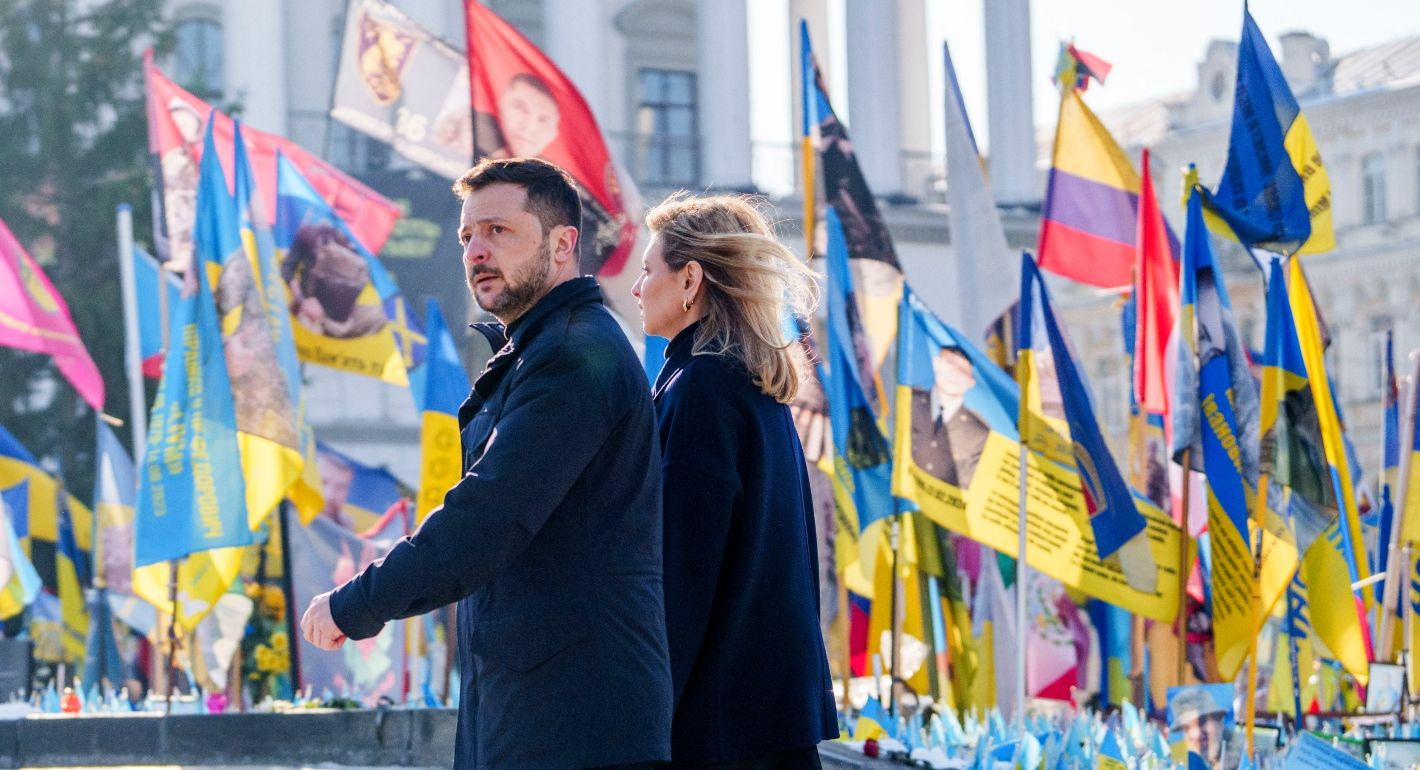
Source: Getty
Despite the immense toll of Russia’s war and growing U.S. pressure to negotiate a deal, Ukrainians’ resolve remains unshaken. Their ability to stay united amid growing political and economic challenges will determine the country’s trajectory.
Much of the international attention this past week has been on the war of words between U.S. and Ukrainian presidents Donald Trump and Volodymyr Zelensky, as they have gotten ever more personal and tough on each other. But it is Ukrainian society that is showing remarkable signs of resilience, despite experiencing war fatigue and reeling from the increased pressure the United States, one of its most trusted allies, is exerting.
Trump attacked Zelensky, calling him a “dictator” and erroneously claiming he had a 4 percent approval rating while the threat of a hasty, disadvantageous deal looms from the ongoing U.S.-Russia negotiations. And yet, the Ukrainians’ trust in their president has increased by several percentage points since December 2024, reaching 57 percent or 65 percent in February 2025, depending on the poll.
More than an indicator of Zelensky’s chances for an enduring political future, it demonstrates how Ukrainians continue to remarkably rally around the flag three years into the full-scale Russian invasion of their country. The former commander in chief of the Ukrainian armed forces and Ukraine’s current ambassador to the United Kingdom, Valery Zaluzhny, is currently more popular in polls than Zelensky.
The impact of this resilience on the agency of the Ukrainian people to shape outcomes on the ground should not be underestimated, despite the massive U.S. pressure to reach a quick ceasefire. Trump’s choice to engage Russian President Vladimir Putin bilaterally without involving Ukraine—or the Europeans—could further galvanize the population.
America’s extractive attempt to get Ukraine to sign away its rare earths rights—under threat of cutting off the vital communications system Starlink has become—in exchange for the aid provided so far, and without committing to future security guarantees, has reminded Ukrainians of the Soviet colonialism they endured.
Contrary to Trump’s claims, most Ukrainians do not insist on holding elections now. In fact, the majority of the public—63 percent—supports holding elections, both presidential and parliamentary, only when the war ends.
Unlike some other post-Soviet states, Ukraine has held very competitive elections since its independence in 1991. And it has a strong, democratically vibrant civil society.
Ukrainians’ enduring unity in the face of Russia’s efforts to subjugate it, and their attachment to a democratically plural polity is due to multiple factors.
First, Ukraine has been a horizontally organized society of a free people who escaped from the slavery or poverty of empires since the seventeenth century. Having experienced colonial rule for centuries, Ukrainians developed two key features: distrust of vertical institutions of power, and an ability to survive and unite in the most critical moments.
Second, Ukrainians’ attachment to democratic participation has been buoyed by the revolutions in 2004 and 2014. Despite the violent backlash, it also showed them that people have power and can decide the future.
The decentralization reform launched in 2015–20 has increased civic engagement at the local level and empowered local actors. As a result, communities that were liberated in 2022 were able to recover fast, engaging residents, businesses, and foreign donors.
Third, a majority of Ukrainians perceive Russia as an existential threat. Russia’s occupation of Crimea and Donbas, its attempts to capture Kharkiv and Odesa in 2014, as well as the full-scale invasion in 2022 and the ensuing mass destruction, torture camps, and mass graves have firmly cemented this perception and helped Ukrainians forge a real national identity.
Nevertheless, Ukrainian resilience is facing political, economic, financial, and societal challenges.
In many ways, the elements that unite and divide Ukrainians often mirror each other.
For instance, the fight against corruption and economic prosperity serve as unifying forces, whereas increasing corruption and economic decline contribute to division. Furthermore, post-war recovery and accession to the EU and NATO, as guaranties of the long-lasting security, are seen as key factors fostering unity among Ukrainians.
But despite the massive war-related stress and different views on how best to engage in negotiations to end the conflict, most citizens—71 percent—remain optimistic about the future of Ukraine and the majority—69 percent—continues to believe in Ukraine’s ability to repel a Russian attack. While there has been episodic discontent with Zelensky’s management of the war since February 2022, the armed forces remain the most trusted national institution. The army is seen as a central source of hope and optimism, as well as a catalyst for citizens’ active political engagement in the future, once peace is achieved.
Interviews with Ukrainians in the frontline regions of Donbas and Kharkiv indicate that they remain steadfast in their struggle against Russian occupation despite undeniable fatigue and a deepening feeling of betrayal by the United States. In line with the ingenious innovation Ukrainians have showcased since the beginning of the war, some are starting to work on building an alternative to Starlink.
For Ukrainians, the choice is between continuing to fight for their sovereignty and independence and submitting to an imperialist, genocidal Russian enterprise.
Yuliya Bidenko
Former Visiting Scholar, Carnegie Europe

The domestic impacts of how long it is taking to end the war in Ukraine have pushed the French electorate to the political extremes and compromised the country’s diplomatic capacity.

Rym Momtaz

Before the next wave of EU enlargement takes place, the union needs to grapple with thorny questions of how power is distributed among its members.


Emil Sondaj Hansen, Ditte Brasso Sørensen

A summer of escalation in the Black Sea has hurt Ukraine economically and is exacerbating world food security. A truce is needed—as is a broader reframing of Europe’s Ukraine strategy.

Thomas de Waal

Are Germany’s economic, industrial, and political struggles becoming a liability for the EU’s ability to rise to the geopolitical moment?
Rym Momtaz, ed.

European Commission President Ursula von der Leyen is about to give her annual address on the state of the EU. Here’s what she won’t—but should—say.
Rym Momtaz