

Commentary
Are Germany’s economic, industrial, and political struggles becoming a liability for the EU’s ability to rise to the geopolitical moment?
Rym Momtaz, ed.
{
  "authors": [
    "Agathe Demarais"
  ],
  "type": "commentary",
  "blog": "Strategic Europe",
  "centerAffiliationAll": "",
  "centers": [
    "Carnegie Endowment for International Peace",
    "Carnegie Europe"
  ],
  "englishNewsletterAll": "",
  "nonEnglishNewsletterAll": "",
  "primaryCenter": "Carnegie Europe",
  "programAffiliation": "",
  "programs": [],
  "projects": [],
  "regions": [
    "Russia",
    "Europe",
    "United States"
  ],
  "topics": [
    "Foreign Policy",
    "EU",
    "Trade"
  ]
}
Source: Getty
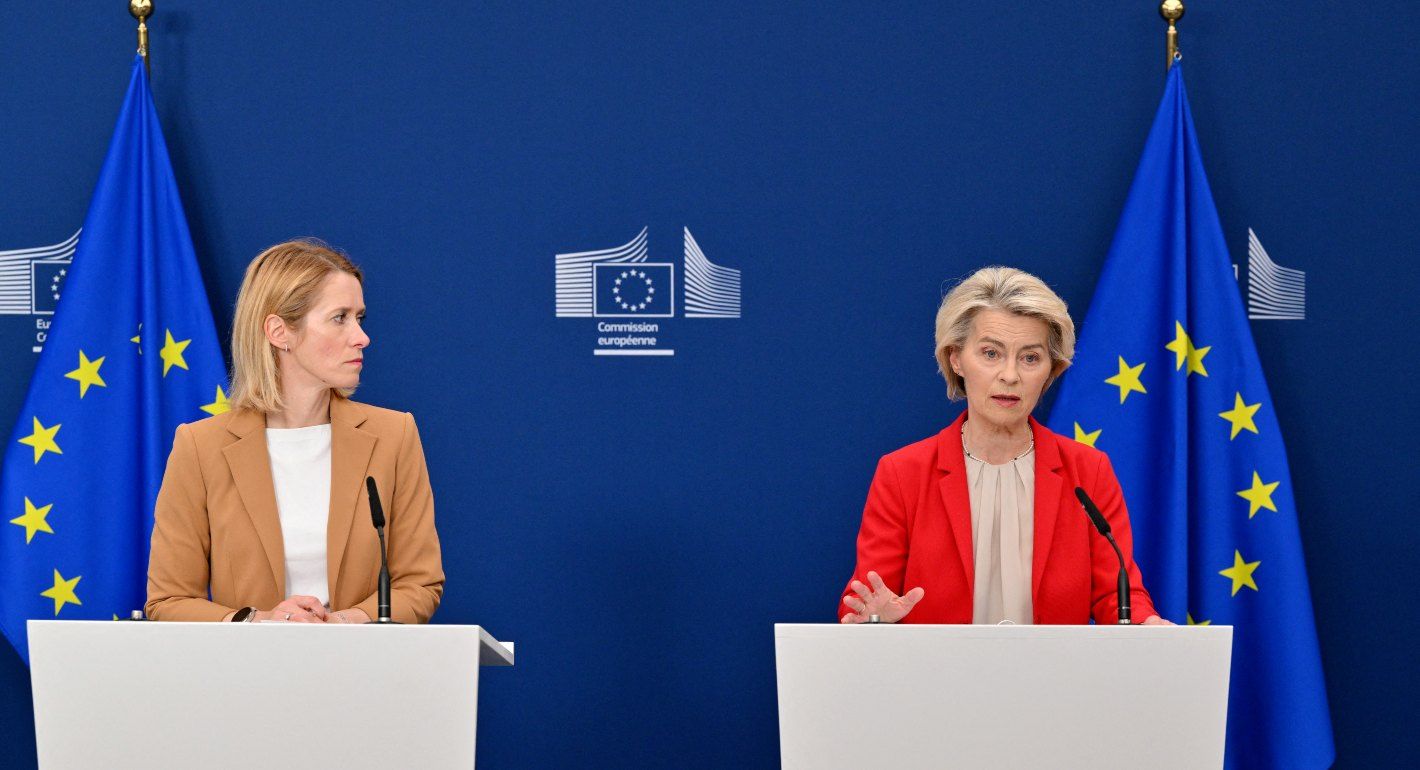
As the European Council summit takes place this week, EU leaders have options to beef up sanctions on Russia by targeting the country’s oil and gas exports. Implementing additional measures would demonstrate Brussels’s ability to act without Washington and rethink the EU’s institutional framework for sanctions.
Ahead of Thursday’s European Council summit, it is hard to deny that EU sanctions on Russia are facing headwinds. Beyond the usual resistance from Hungary and Slovakia, U.S. President Donald Trump has come out against additional sanctions and hinted he could lift existing ones. Meanwhile, the conflict between Israel and Iran could fuel a spike in oil prices, giving Moscow some reprieve on the financial front.
As European leaders prepare to gather, they have an opportunity to overcome these challenges. To do so, EU leaders need to prioritize three elements: learning how to act without the United States on sanctions, focusing their efforts on measures that resourceful targets like Russia will find hard to circumvent, and rethinking the EU’s institutional set up for sanctions to undercut the veto of Russia-friendly member states.
At the Kananaskis G7 summit, Trump made it clear that he has no intention to double down on Russia sanctions, refusing to consider lowering the price cap on Russia oil exports from $60 per barrel to $45 or to set up a working group to beef up the implementation of this measure. As a result, it is probably futile for EU leaders to continue promising “massive sanctions” on Russia that would require coordination with the United States.
Instead, EU policymakers should lean into another, probably more effective, way to weigh on Moscow’s oil earnings.
Since late 2022, the G7 price cap has set a maximum price of $60 per barrel for those barrels of oil that Russian companies export with the assistance of western shipping or insurance firms. However, Russia has worked around the cap by building a shadow fleet of oil tankers that have zero ties to G7 or EU countries and thus could not care less about the measures. The figures are stark: Dark vessels ship 75 percent of Russian oil exports. However, there is a catch: Most of Moscow’s oil exports originate from Baltic ports, meaning that they have to transit via European waters to reach their global customers.
As a first sanctions priority, Europeans could leverage this Russian vulnerability by forcing ships transiting via EU maritime choke points, such as the Danish straits or the Gulf of Finland, to have proper spill liability insurance. There are precedents for this: Turkey requires tankers transiting through its waters to prove they have such insurance from a well-capitalized—that is to say western—firm. Considering that sanctions already restrict the access of Russian firms to western insurance companies, such a policy would deal an immediate blow to Moscow—and it does not require U.S. buy-in.
Seeing that Russia has managed to dodge the price cap so easily with its shadow fleet of oil tankers, the EU’s second sanctions priority should entail doubling down on measures that inventive targets like Moscow will find hard to circumvent—for good. Targeting hydrocarbon earnings is a no-brainer: Oil and gas exports provide 30 percent of Moscow’s fiscal revenues, meaning that Russia would be hard-pressed to finance its war against Ukraine without this income. For the EU, lowering the share of Russian oil to just 3 percent of the bloc’s total crude imports in 2024 was a first step, but it is not enough: Moscow can always ship its oil elsewhere.
Europe’s best leverage comes in the form of access to the EU market—especially for Russian piped gas shipments. With Moscow still supplying nearly 20 percent of EU piped gas imports, mostly to Hungary and Slovakia, the union has untapped leverage. This is because Russia has no other market than the EU for its piped gas shipments, which need to go through pipelines it cannot build quickly. China, the only other major potential market for Gazprom, has made it clear that it has no interest in buying more Russian gas.
Policies curbing Russia’s access to the EU’s gas market, like the EU proposal to ditch all imports of Russian hydrocarbons by early 2028, would thus deal a blow to Moscow—leaving the Kremlin with no easy way to circumvent such measures. Four years ago, most European member states would have considered such a policy as heretical. Yet it is now mainstream, with just three EU member states—Hungary, Slovakia, and Austria—opposing it.
The fact that a handful of small EU economies could block a proposal endorsed by the other twenty-four members highlights what should be Europe’s third priority when it comes to sanctions: future-proofing the bloc’s institutional setup to avoid policy paralysis. Irritation with Hungary’s hard-line stance and myriad of blocking tactics means that policymakers are getting creative.
To adopt the proposed phasing out of the Russian hydrocarbons, the European Commission is attempting to use trade law. In turn, passing the measure would only require a qualified majority vote—the support of fifteen EU member states that represent 65 percent of the EU population—instead of unanimity in the European Council.
The debate for a switch to qualified-majority voting for all sanctions is gaining traction in Brussels. The path toward such a shift is probably less tortuous than it seems. EU treaties allow a shift from unanimity to qualified-majority voting for some foreign policy-related measures, including sanctions. Besides, only major milestones—the adoption, renewal, or lifting—of sanctions require unanimity; the nitty-gritty of implementing these measures already falls under qualified-majority voting.
A switch to qualified-majority voting would have obvious benefits. It would help to prevent the watering-down of sanctions proposals to their lowest common denominator as twenty-seven capitals argue that sanctions should not impact their respective national champions. It would also prevent policy paralysis and project EU unity, instead of placing the spotlight on the fringe stances of a handful of EU states. Finally, it would help shield the EU from the divide-and-rule tactics of Russia, China, and other adversaries.
The EU faces a myriad of challenges on sanctions that all illustrate how Europe must learn to navigate a fragmenting international landscape on its own to remain a credible global actor. The good news is that the EU has everything it needs to overcome these challenges, and sanctions against Russia offer a perfect template for Europeans to smash their to-do list.
Agathe Demarais is a senior policy fellow at the European Council on Foreign Relations (ECFR).
Agathe Demarais
Senior Policy Fellow, European Council on Foreign Relations (ECFR)
Agathe Demarais is a senior policy fellow at the European Council on Foreign Relations (ECFR), a visiting professor at the College of Europe, a columnist for Foreign Policy, and the author of Backfire, a book on the global ripple effects of U.S. sanctions.
Carnegie does not take institutional positions on public policy issues; the views represented herein are those of the author(s) and do not necessarily reflect the views of Carnegie, its staff, or its trustees.

Are Germany’s economic, industrial, and political struggles becoming a liability for the EU’s ability to rise to the geopolitical moment?

Rym Momtaz, ed.

European Commission President Ursula von der Leyen is about to give her annual address on the state of the EU. Here’s what she won’t—but should—say.
Rym Momtaz

The aftermath of the Ceuta crisis shows Europe has drawn the wrong lessons. Rather than doubling down on failed migration policies, the EU needs to address the underlying roots of such episodes.

Richard Youngs

An overwhelming victory by a far-right-wing party in a small state in eastern Germany will have major repercussions for Chancellor Friedrich Merz’s coalition.

Judy Dempsey

Canadian Prime Minister Mark Carney has twice inspired praise for standing up to U.S. President Donald Trump: at the 2026 World Economic Forum in Davos and on Canada-U.S. trade negotiations. Is Carney showing a third way better than the EU has in dealing with the Trump administration?
Rym Momtaz, ed.