

Article
Marina Ottaway, Omar Hossino
{
  "authors": [
    "Marina Ottaway"
  ],
  "type": "other",
  "centerAffiliationAll": "dc",
  "centers": [
    "Carnegie Endowment for International Peace",
    "Malcolm H. Kerr Carnegie Middle East Center"
  ],
  "collections": [],
  "englishNewsletterAll": "menaTransitions",
  "nonEnglishNewsletterAll": "",
  "primaryCenter": "Malcolm H. Kerr Carnegie Middle East Center",
  "programAffiliation": "MEP",
  "programs": [
    "Middle East"
  ],
  "projects": [],
  "regions": [
    "Middle East",
    "Iran",
    "Israel",
    "Türkiye",
    "Saudi Arabia",
    "Egypt",
    "Gulf",
    "Levant",
    "Maghreb"
  ],
  "topics": [
    "Political Reform",
    "Security",
    "Foreign Policy"
  ]
}
Source: Getty
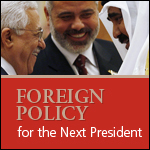
President-elect Obama emphasizes the need for greater diplomacy and a willingness to engage with hostile regimes. This commitment to “return to diplomacy” will not be enough to end the deadlock in the Middle East. Obama should break from traditional U.S. posture and support peace initiatives originating with Arab countries.
During the campaign, President-elect Obama emphasized the need for greater diplomacy and a willingness to engage with hostile regimes. This commitment to “return to diplomacy” will not be enough to break the deadlock in the Middle East. Obama should break from traditional U.S. posture and support peace initiatives originating with Arab countries, urges a new paper by the director of the Carnegie Middle East Program.
Marina Ottaway explains that the United States lacks the legitimacy and capacity to monopolize leadership in the peace process. The new administration should signal its support for three key Arab undertakings: Syrian–Israeli negotiations under Turkish leadership, Hamas–Fatah talks brokered by Egypt, and the Arab–Israeli initiative most recently proposed by Saudi Arabia.
Key Conclusions:
Ottaway concludes:
“The new administration needs to rethink the U.S. role in the politics of the Middle East, abandon the assumption that it must be at the center of every initiative, build on what the regional countries are trying to do, and, in the process, encourage them to take more responsibility. At a time when American solutions appear deadlocked and the new president will have to concentrate his attention on the economy, sharing the burden provides a way forward.”

Former Senior Associate, Middle East Program
Before joining the Endowment, Ottaway carried out research in Africa and in the Middle East for many years and taught at the University of Addis Ababa, the University of Zambia, the American University in Cairo, and the University of the Witwatersrand in South Africa.
Recent Work
Marina Ottaway, Omar Hossino
Marina Ottaway
Carnegie India does not take institutional positions on public policy issues; the views represented herein are those of the author(s) and do not necessarily reflect the views of Carnegie, its staff, or its trustees.

In any defense establishment, change is an ongoing process. However, despite the best of intentions, existing bureaucracies, bound by habit and years of socialization, have their limits in implementing transformative change.

Anit Mukherjee

After the chill in ties between 2020 and 2024 that brought India–China relations to their lowest point in several decades, the two countries have engaged each other afresh. This paper argues that there are predominantly four imperatives guiding India’s approach to China, and they exist in an order of priority.

Saheb Singh Chadha

This piece argues that India’s central challenge is not managing a single flashpoint but resolving the underlying tension between expansion and institutional coherency of the BRICS grouping.

Vrinda Sahai

A partnership between India, a country of subcontinental size, and Africa, a continent of fifty-four countries, may seem asymmetric until one notes that both are home to nearly the same number of people—1.4 billion. This essay spells out the existing challenges to the partnership, its optimal potential, and the possible pathways to realize it over the next quarter-century.

Rajiv Bhatia

The India–EU Free Trade Agreement (FTA) is shaping up to be one of the most consequential trade negotiations, both economically and strategically. But, what’s in the agreement, what’s missing, and what will determine its success in the years ahead
Vrinda Sahai, Nicolas Köhler-Suzuki