

Commentary
Dmitri Trenin
{
  "authors": [
    "Dmitri Trenin"
  ],
  "type": "legacyinthemedia",
  "centerAffiliationAll": "",
  "centers": [
    "Carnegie Endowment for International Peace",
    "Carnegie Russia Eurasia Center"
  ],
  "collections": [],
  "englishNewsletterAll": "",
  "nonEnglishNewsletterAll": "",
  "primaryCenter": "Carnegie Russia Eurasia Center",
  "programAffiliation": "",
  "programs": [],
  "projects": [],
  "regions": [
    "North America",
    "United States",
    "Caucasus",
    "Russia"
  ],
  "topics": [
    "Political Reform",
    "Foreign Policy",
    "Nuclear Policy"
  ]
}
Source: Getty
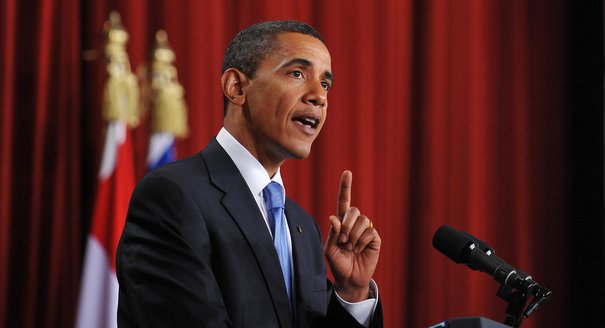
On the anniversary of President Obama’s election, relations with Russia have become a bright spot among the president’s ambitious foreign policy efforts, while other central international goals remain unachieved.
Source: Foreign Policy

As president-elect, Barack Obama moved to reset the entire U.S. foreign policy. A year later, he is still committed to winding down U.S. military involvement in Iraq; defeating al Qaeda while stabilizing Afghanistan, and helping Pakistan stabilize itself; helping a Palestinian state emerge, in peace with Israel; engaging Iran in an effort to prevent it from going nuclear; negotiating away North Korea’s nukes; jointly reducing strategic arsenals with Russia and building a case for ratifying the comprehensive test ban treaty; and addressing climate change. His biggest foreign-policy concern in the first year at the White House, of course, was mounting a concerted global effort to deal with the economic crisis.
He managed to restore America’s moral standing in the world through practical steps: closing Guantánamo, listening to other countries’ concerns, making U.S. goals clear, and boldly embracing a broad vision of the future. At the same time, Obama has been stepping carefully, seeking to combine lofty principles and pragmatic interests. Not only did he provide sustained leadership, but, almost miraculously, he managed to keep his high-powered and ambitious foreign policy team cooperating among themselves, instead of fighting with one another. Yet, he has not achieved much regarding his central international goals. And, he was visibly embarrassed by his winning of the Nobel Peace Prize, probably granted more to stimulate his behavior than to recognize his good deeds.
Achievements will be exceedingly difficult to score. Afghanistan, the war he has adopted, does not look good. Neither does Pakistan. Reaching an acceptable agreement with Iran -- making it a certifiably non-nuclear weapons state -- will stretch almost to the limit the human capacity for diplomacy. In the short term, one thing looks surprisingly bright: relations with Russia, a non-priority on inauguration day, which is about to yield a new strategic arms reduction treaty and promises closer cooperation on high-priority issues, such as Afghanistan and Iran. To many observers, this may not amount to much. Yet, slightly over a year ago, the United States and Russia were on a collision course. Turning that relationship around has not been a bad thing.
Former Director, Carnegie Moscow Center
Trenin was director of the Carnegie Moscow Center from 2008 to early 2022.
Recent Work
Dmitri Trenin
Dmitri Trenin
Carnegie India does not take institutional positions on public policy issues; the views represented herein are those of the author(s) and do not necessarily reflect the views of Carnegie, its staff, or its trustees.

How is AI reshaping space security, creating governance challenges, and where does international diplomacy stand today?


Tejas Bharadwaj, Almudena Azcárate Ortega

After the chill in ties between 2020 and 2024 that brought India–China relations to their lowest point in several decades, the two countries have engaged each other afresh. This paper argues that there are predominantly four imperatives guiding India’s approach to China, and they exist in an order of priority.

Saheb Singh Chadha

This piece argues that India’s central challenge is not managing a single flashpoint but resolving the underlying tension between expansion and institutional coherency of the BRICS grouping.

Vrinda Sahai

A partnership between India, a country of subcontinental size, and Africa, a continent of fifty-four countries, may seem asymmetric until one notes that both are home to nearly the same number of people—1.4 billion. This essay spells out the existing challenges to the partnership, its optimal potential, and the possible pathways to realize it over the next quarter-century.

Rajiv Bhatia

The U.S.–India semiconductor cooperation story is well-stocked with top-level strategic intent. What remains unresolved, however, are some underlying challenges that will determine whether the cooperation actually functions. Three such friction points stand out.

Shruti Mittal