

Commentary
Amr Hamzawy
{
  "authors": [
    "Amr Hamzawy"
  ],
  "type": "legacyinthemedia",
  "centerAffiliationAll": "",
  "centers": [
    "Carnegie Endowment for International Peace",
    "Carnegie Europe",
    "Malcolm H. Kerr Carnegie Middle East Center"
  ],
  "collections": [
    "Arab Awakening"
  ],
  "englishNewsletterAll": "",
  "nonEnglishNewsletterAll": "",
  "primaryCenter": "Carnegie Endowment for International Peace",
  "programAffiliation": "",
  "programs": [],
  "projects": [],
  "regions": [
    "North Africa",
    "Egypt",
    "Middle East"
  ],
  "topics": [
    "Political Reform"
  ]
}
Source: Getty
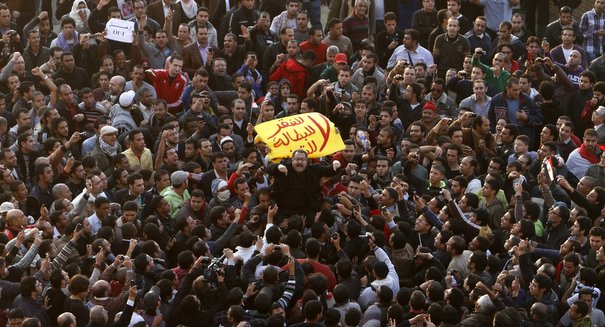
As Egypt hovers on threshold of transition toward democratic governance, the current regime has an opportunity to administer a peaceful transition of power by responding to the demands of the Egyptian people.
Source: Commentary

Egyptian citizens are bravely overcoming attempts by some to incite fear with chaos. The popular will to change has not wavered. Rather, the people have persisted with a clear, collective and frank expression of their desire to oust the current regime and create a democratic, free and just nation.
The matter has been decided and the clock’s hands will not turn back to the time of authoritarianism.
Egypt stands today assuredly on the threshold of transition toward democratic governance. Egyptians are now demanding the realization of swift national consensus regarding the method of this transition and its administration.
Given the choice of the military to cooperate both with the people and the existing government, the regime has an opportunity right now to administer a safe transition toward democracy. Such a transition could prevent Egypt from a dragged-out confrontation between the prevailing popular will to change and the desire of some power-players in the current regime to resist it.
A peaceful transition of power is dependent on the current regime responding to the demands Egyptians are raising:
The moment for the military to administer a secure transition toward democracy and guarantee a dignified exit for President Mubarak is now. It is time to open the door of political life wide to the plethora of Egypt’s political players so that all may compete to represent the will of the people. What Egyptian citizens are accomplishing in this moment in history is magnificent. Yet, the clock is still ticking and time is running short. It is hoped that the military, with all its patriotism, will seize this opportunity and avoid the potential dangers posed by a volatile transition to democracy. Any other alternative could cost Egypt dearly.

Director, Middle East Program
Amr Hamzawy is a senior fellow and the director of the Carnegie Middle East Program. His research and writings focus on Egypt’s and other middle powers’ involvement in regional security in the Middle East, particularly through collective diplomacy and multilateral conflict resolution
Recent Work
Amr Hamzawy
Amr Hamzawy
Carnegie India does not take institutional positions on public policy issues; the views represented herein are those of the author(s) and do not necessarily reflect the views of Carnegie, its staff, or its trustees.

A partnership between India, a country of subcontinental size, and Africa, a continent of fifty-four countries, may seem asymmetric until one notes that both are home to nearly the same number of people—1.4 billion. This essay spells out the existing challenges to the partnership, its optimal potential, and the possible pathways to realize it over the next quarter-century.

Rajiv Bhatia

An Israeli response to Iran’s October 1 attack is imminent. The key question is of its intensity and potential fallout, both within Iran, in terms of nuclear security policy changes, and across the broader region. The coming days are likely to reshape West Asia irreversibly.
Gaddam Dharmendra
As India’s economy recovers from the coronavirus pandemic, Indian businesses need efficient financial structures to regain their ground. Key reforms to India’s Insolvency and Bankruptcy Code could fill these gaps.

Anirudh Burman

Access to cross-border data is an integral piece of the law enforcement puzzle. India is well placed to lead the discussions on international data agreements subject to undertaking necessary surveillance reforms.

Smriti Parsheera, Prateek Jha
After the coronavirus pandemic wanes, how will China’s reorientation of the Belt and Road Initiative to address global health concerns influence its relationships with South Asian countries?
Deep Pal, Rahul Bhatia