

Research
- +10
Rosa Balfour, Frances Z. Brown, Yasmine Farouk, …
{
  "authors": [
    "Moisés Naím"
  ],
  "type": "legacyinthemedia",
  "centerAffiliationAll": "",
  "centers": [
    "Carnegie Endowment for International Peace",
    "Carnegie Europe",
    "Carnegie China",
    "Carnegie Russia Eurasia Center"
  ],
  "collections": [
    "China’s Foreign Relations",
    "China and the Developing World"
  ],
  "englishNewsletterAll": "",
  "nonEnglishNewsletterAll": "",
  "primaryCenter": "Carnegie Endowment for International Peace",
  "programAffiliation": "",
  "programs": [],
  "projects": [],
  "regions": [
    "North America",
    "South America",
    "South Asia",
    "India",
    "East Asia",
    "China",
    "Caucasus",
    "Russia",
    "Western Europe",
    "Asia",
    "Europe"
  ],
  "topics": [
    "Economy",
    "Trade"
  ]
}
Source: Getty
Although Brazil, Russia, India, China, and South Africa enjoy significantly more power individually nowadays, as a group they still haven't mastered the methods for transforming their newfound economic prowess into global power.
Source: Huffington Post

Two interesting facts emerge from the cracks.
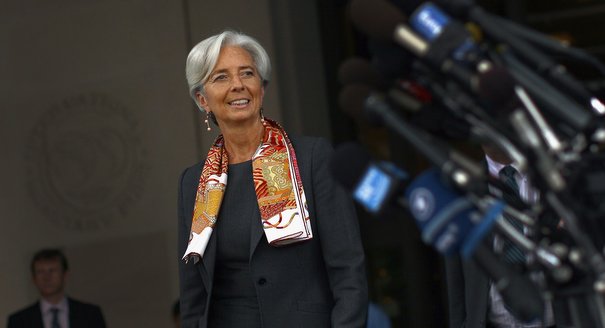
It's almost certain the next leader of the IMF is going to be the French Finance Minister Christine Lagarde. The selection process is still in progress and there might be something that prevents Lagarde from taking office at the last minute. But I doubt it. And there's little doubt in the minds of most informed observers on this subject.
I was invited to the IMF headquarters in Washington to talk about this topic in front of more than a hundred staff and directors of the institution. I began my presentation by asking for a show of hands by those who thought that Lagarde would NOT be selected for the position. Only 10 people put their hands up. This means that even before the selection process has concluded, a vast majority of observers now believe they know the outcome.
The problem is not whether Lagarde has the qualifications to head the IMF -- I believe she does -- but the fact that she will be elected through a rigged process. It's well known that in 1944 the United States and Europe agreed that the IMF chief would always be a European and the World Bank head would always be an American. No candidate from the rest of the world has any real chance of getting one of these appointments. This is obviously irrational. Even the heads of state of the Group of 20 pledged in 2008 that the IMF and World Bank leaders would be chosen through an "open, transparent, and merit-based selection process."
We now know that this was an empty promise. In practice nothing has changed and preserving this obsolete arrangement comes at the expense of values, principles, and even common sense.
Despite eloquent and emphatic promises and rhetorical contortions to make the process seem more open and meritocratic than it really is, an agreement signed in a colonial era still reigns in the twenty-first century: Europe will continue at the helm of the IMF.
But the problem is not just Europe, it is the whole selection process. Europe still controls a larger percentage of votes in the IMF than its current global economic weight justifies. Its percentage has been declining but remains disproportionally high since it's still based on Europe's weight at a time when most of the world was poor and undeveloped. Europe has shown no qualms in bluntly continuing to rely on its inherited power to preserve the privileges it claims to abhor. And Washington too is breaking its commitment to a fair, merit-based selection process for the leaders of these important institutions. Failing to support a European for the IMF is likely to mean that the United States will lose its prerogative to unilaterally anoint the head of the World Bank.
All this serves to remind us of a simple, basic rule: when it comes to power, words don't matter. What matters is military might, resources, or, as in this case, the percentage of votes you control. The rest is noise and rhetoric.
A second fact that has been illuminated by the IMF earthquake is that the power of Brazil, Russia, India, China, and South Africa -- the BRICS -- is still more potential than real. The BRICS have gone to great lengths to present a unified front in global negotiations. Thus, the opportunity to support a common BRICS candidate for the IMF would have been an ideal time to display their newly gained influence on the global stage. Or they could have made a concerted effort to change rules that effectively discriminate against them.
None of that happened. Beyond issuing hypocritical statements calling for a fair selection process, the BRICS showed no real interest in ending the unpalatable agreement between the United States and Europe and made no real effort to change the rules. Brazil, for example, made no effort to support the very competent Mexican candidate, Mexico's central bank chief Agustin Carstens, from the outset even though Brazil aspires to be seen as the nation that leads others in Latin America.
There is no doubt that the world has new power centers. But in this case, the new poles of power failed or refused to wield it. The lesson to learn from all of this is that although each of the BRICS enjoy significantly more power individually nowadays, as a group they still haven't mastered the methods for transforming their newfound economic prowess into global power. But if they ever succeed in doing so, that tectonic shift will create a very different world indeed.

Distinguished Fellow
Moisés Naím is a distinguished fellow at the Carnegie Endowment for International Peace, a best-selling author, and an internationally syndicated columnist.
Recent Work



Rosa Balfour, Frances Z. Brown, Yasmine Farouk, …
Moisés Naím
Carnegie India does not take institutional positions on public policy issues; the views represented herein are those of the author(s) and do not necessarily reflect the views of Carnegie, its staff, or its trustees.

In any defense establishment, change is an ongoing process. However, despite the best of intentions, existing bureaucracies, bound by habit and years of socialization, have their limits in implementing transformative change.

Anit Mukherjee
As AI grows more sophisticated, as the supply chains that power it become more contested, and as access to frontier models becomes geopolitically charged, India must begin to ask a different set of questions. Not what applications it can build on someone else’s infrastructure but what the world needs.

Konark Bhandari

The Indian Ocean Region hosts one of the densest concentrations of subsea cables in the world. Yet, despite accounting for a significant share of global internet traffic, India’s participation remains limited.

Charukeshi Bhatt

How is AI reshaping space security, creating governance challenges, and where does international diplomacy stand today?


Tejas Bharadwaj, Almudena Azcárate Ortega

After the chill in ties between 2020 and 2024 that brought India–China relations to their lowest point in several decades, the two countries have engaged each other afresh. This paper argues that there are predominantly four imperatives guiding India’s approach to China, and they exist in an order of priority.

Saheb Singh Chadha