

Commentary
- +1
Paul Haenle, Xue Gong, Ngeow Chow Bing, …
{
  "authors": [
    "Paul Haenle"
  ],
  "type": "legacyinthemedia",
  "centerAffiliationAll": "",
  "centers": [
    "Carnegie Endowment for International Peace",
    "Carnegie China"
  ],
  "collections": [
    "U.S.-China Relations",
    "China’s Foreign Relations"
  ],
  "englishNewsletterAll": "",
  "nonEnglishNewsletterAll": "",
  "primaryCenter": "Carnegie China",
  "programAffiliation": "",
  "programs": [],
  "projects": [],
  "regions": [
    "North America",
    "United States",
    "East Asia",
    "South Korea",
    "China",
    "North Korea"
  ],
  "topics": [
    "Security",
    "Arms Control",
    "Economy",
    "Nuclear Policy",
    "Foreign Policy"
  ]
}
Source: Getty
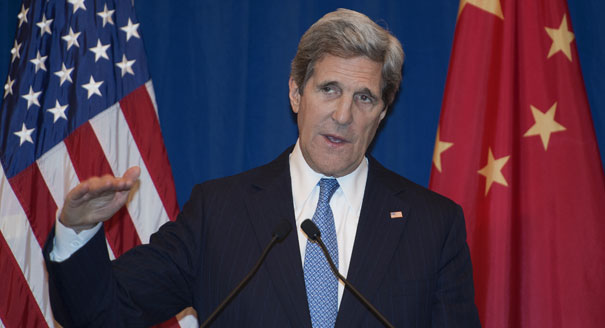
U.S. Secretary of State John Kerry’s first visit to China will likely see a focus on security on the Korean peninsula, the Trans-Pacific Partnership agreement, and cyber security.
Source: China Radio International
Speaking to China Radio International, Carnegie’s Paul Haenle detailed the strengths and agenda of the new U.S. Secretary of State, John Kerry. Haenle explained that throughout Kerry’s time on the Senate Committee on Foreign Relations, he showed a great commitment and interest in China. Now that he is Secretary of State, it is unlikely that the U.S. policy of rebalancing toward to Asia will change. Haenle stressed that this policy is not hostile or hardline and in fact is designed to facilitate cooperation and collaboration between both countries.
Haenle then turned to some of the individual issues likely to be raised during Kerry’s visit. Haenle stated that the United States is taking the threats coming from North Korea more seriously. He said that the “United States should be looking for opportunities, as the policy shifts in China, to find areas where China and the United States, South Korea, and Japan and the other members of the Six Party Talks can work together to bring stability to the region”. Haenle also clarified the nature of the Trans-Pacific Partnership and its origins and indicated that it would be beneficial for all if China would join. Cyber security is another area of tension between China and the United States, he added, but the nascent nature of this threat means there is greater scope for all major powers to work together to contain it.

Former Maurice R. Greenberg Director’s Chair, Carnegie China
Paul Haenle held the Maurice R. Greenberg Director’s Chair at the Carnegie Endowment for International Peace and is a visiting senior research fellow at the East Asian Institute, National University of Singapore. He served as the White House China director on the National Security Council staffs of former presidents George W. Bush and Barack Obama.
Recent Work


Paul Haenle, Xue Gong, Ngeow Chow Bing, …

Paul Haenle, Chong Ja Ian
Carnegie India does not take institutional positions on public policy issues; the views represented herein are those of the author(s) and do not necessarily reflect the views of Carnegie, its staff, or its trustees.

In any defense establishment, change is an ongoing process. However, despite the best of intentions, existing bureaucracies, bound by habit and years of socialization, have their limits in implementing transformative change.

Anit Mukherjee

How is AI reshaping space security, creating governance challenges, and where does international diplomacy stand today?


Tejas Bharadwaj, Almudena Azcárate Ortega

After the chill in ties between 2020 and 2024 that brought India–China relations to their lowest point in several decades, the two countries have engaged each other afresh. This paper argues that there are predominantly four imperatives guiding India’s approach to China, and they exist in an order of priority.

Saheb Singh Chadha

This piece argues that India’s central challenge is not managing a single flashpoint but resolving the underlying tension between expansion and institutional coherency of the BRICS grouping.

Vrinda Sahai

A partnership between India, a country of subcontinental size, and Africa, a continent of fifty-four countries, may seem asymmetric until one notes that both are home to nearly the same number of people—1.4 billion. This essay spells out the existing challenges to the partnership, its optimal potential, and the possible pathways to realize it over the next quarter-century.

Rajiv Bhatia