

Commentary
Jamie Kwong, Toby Dalton
{
  "authors": [
    "Toby Dalton"
  ],
  "type": "legacyinthemedia",
  "centerAffiliationAll": "dc",
  "centers": [
    "Carnegie Endowment for International Peace"
  ],
  "collections": [],
  "englishNewsletterAll": "ctw",
  "nonEnglishNewsletterAll": "",
  "primaryCenter": "Carnegie Endowment for International Peace",
  "programAffiliation": "NPP",
  "programs": [
    "Nuclear Policy"
  ],
  "projects": [],
  "regions": [
    "South Asia",
    "India",
    "Pakistan"
  ],
  "topics": [
    "Security",
    "Nuclear Policy"
  ]
}
Source: Getty
It is the job of heads of government to build political coalitions in favor of reconciliation and to lead their nations through the inevitable setbacks and violent opposition that are likely to befall a peace process before it succeeds.
Source: Diplomat
The Indian and Pakistani foreign secretaries were supposed to meet this week to “talk about talks.” India cancelled the dialogue as punishment after Pakistan’s high commissioner in Delhi met with Kashmiri political groups. In the aftermath, there has been a dramatic escalation of shelling along the Line of Control in Kashmir. This latest failure by both states to resume dialogue is unfortunate but not surprising, for the history of India-Pakistan dialogue has often witnessed two steps forward, followed by three steps back. To reverse this trend, it is time for the prime ministers of the two states, not their top diplomats, to step to the front.
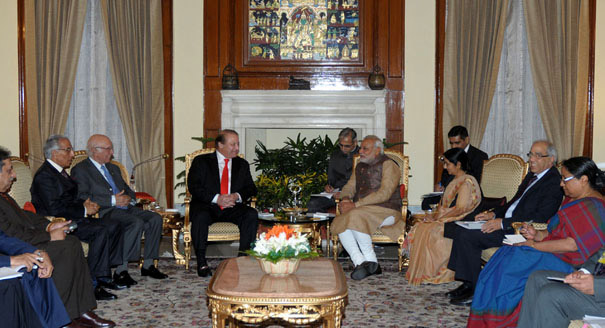
Hopes for peace were high this spring when Indian Prime Minister Narendra Modi invited his Pakistani counterpart, Nawaz Sharif, to his inauguration in Delhi. Their meeting in late May, as well as their subsequent “letter diplomacy,” suggested a personal connection between the two that would facilitate bold new steps in relations. But a spring thaw in relations has turned into summer dismay, as prospects for progress dimmed amidst regular cease-fire violations along the LOC, political turmoil in Pakistan, domestic distractions for the new government in India, and now the cancelled talks. Before they find themselves in other crisis, it is incumbent on the two prime ministers to get relations back on track by planning their next summit with a commitment to action, not just talk. Though planning for a summit while tensions are high may seem naïve, such symbolic gestures can play a central role in realigning relations and demonstrating leadership.
The most promising effort to normalize India-Pakistan relations came at the Lahore Summit in 1999. There, Prime Ministers Atal Bihari Vajpayee and Nawaz Sharif birthed the Composite Dialogue as well as nuclear confidence-building measures. More importantly, Vajpayee visited the Minar-i-Pakistan to send a powerful signal of Indian acceptance of the legitimacy of Pakistan. The symbolism and rhetoric of the visit were reminiscent of U.S.-Soviet efforts by Ronald Reagan and Mikhail Gorbachev during their summits in Washington and Moscow in 1987 and 1988, respectively, to change the negative images each population held of the other.These examples and others demonstrate the necessity of high-level leadership in peace efforts. The long-standing territorial, water and natural resource disputes between Argentina and Brazil, for instance, fed mutual suspicions and even motivated secret nuclear activities during the 1970s. But the personal involvement of successive presidents in a reconciliation process resulted in a new baseline of stable relations. A 1985 meeting between Brazilian President José Sarney and Argentine President Raúl Alfonsín on their shared border at Iguazu Falls, at which they inaugurated a new bridge connecting the two countries, provided an image of a shared future for both populations. Subsequently, leaders of the two countries exchanged visits to nuclear facilities, a confidence-building measure that ultimately led to the formation of a bilateral nuclear inspectorate.
Granted, Argentina and Brazil shared a far less violent history and neither possessed nuclear weapons; both factors shape the India-Pakistan narrative and complicate their security competition today. But there is no reason such a process built on symbolic steps advanced by committed political leaders could not be replicated in South Asia. Certainly, the regular tragedies that befall South Asia—the burning of the Samjhota Express and the attacks in Mumbai, to name just two of the most recent—will take time and political will to reconcile. And there remain actors in both states that prefer continued division and violence to reconciliation. Rather than let those incidents and actors continue to dominate the narrative and sow division, however, Modi and Sharif should work to forge new symbols of hope. For example, they could hold a meeting on Dal Lake or elsewhere in the Indus watershed, demonstrating their commitment to a peaceful resolution of the dispute over Kashmir and shared commitment to managing precious water. They could agree to demilitarize the Siachen glacier and declare it a joint national park. They could even contemplate reciprocal visits to nuclear power facilities in each country. These notions may seem Pollyannaish, but the point is that these kinds of symbolic steps can begin to challenge the dominant narratives that perpetuate conflict, just as Vajpayee’s visit to the Minar-i-Pakistan did in February 1999.
This approach to conflict resolution requires leadership that only heads of government can provide. Diplomats, well meaning though they may be, represent bureaucratic and institutional interests, rather than the national interest. They tend to be cautious, pragmatic. They can negotiate and implement incremental steps to institutionalize progress, but they cannot initiate the kind of changes that resolve long-lasting and deep-seeded disputes. It is the job of heads of government to build political coalitions in favor of reconciliation and to lead their nations through the inevitable setbacks and violent opposition that are likely to befall a peace process before it succeeds.
Prime Ministers Modi and Sharif are both planning to be in New York in September for the United Nations General Assembly meeting. They should make it a priority to meet. And rather than “talking about talks” or skirmishing over tactics, they should define a vision, accompanied by concrete steps, for moving relations between India and Pakistan past the divisions spawned by the 20th century and into the promise of the 21st.

Senior Fellow and Co-director, Nuclear Policy Program
Toby Dalton is a senior fellow and co-director of the Nuclear Policy Program at the Carnegie Endowment. An expert on nonproliferation and nuclear energy, his work addresses regional security challenges and the evolution of the global nuclear order.
Recent Work

Jamie Kwong, Toby Dalton

Ariel (Eli) Levite, Toby Dalton
Carnegie India does not take institutional positions on public policy issues; the views represented herein are those of the author(s) and do not necessarily reflect the views of Carnegie, its staff, or its trustees.

In any defense establishment, change is an ongoing process. However, despite the best of intentions, existing bureaucracies, bound by habit and years of socialization, have their limits in implementing transformative change.

Anit Mukherjee

As AI grows more sophisticated, as the supply chains that power it become more contested, and as access to frontier models becomes geopolitically charged, India must begin to ask a different set of questions. Not what applications it can build on someone else’s infrastructure but what the world needs.

Konark Bhandari

The Indian Ocean Region hosts one of the densest concentrations of subsea cables in the world. Yet, despite accounting for a significant share of global internet traffic, India’s participation remains limited.

Charukeshi Bhatt

How is AI reshaping space security, creating governance challenges, and where does international diplomacy stand today?


Tejas Bharadwaj, Almudena Azcárate Ortega

After the chill in ties between 2020 and 2024 that brought India–China relations to their lowest point in several decades, the two countries have engaged each other afresh. This paper argues that there are predominantly four imperatives guiding India’s approach to China, and they exist in an order of priority.

Saheb Singh Chadha