
• Research
  • About
  • Experts
Carnegie India logoCarnegie lettermark logo
AI
{
  "authors": [
    "Ananth Padmanabhan",
    "Madhav Khosla"
  ],
  "type": "other",
  "centerAffiliationAll": "",
  "centers": [
    "Carnegie Endowment for International Peace",
    "Carnegie India"
  ],
  "collections": [],
  "englishNewsletterAll": "",
  "nonEnglishNewsletterAll": "",
  "primaryCenter": "Carnegie India",
  "programAffiliation": "",
  "programs": [],
  "projects": [],
  "regions": [
    "South Asia",
    "India"
  ],
  "topics": [
    "Domestic Politics",
    "Political Reform",
    "Democracy"
  ]
}

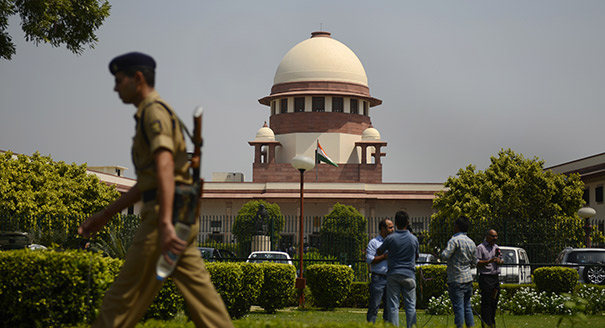
Source: Getty

Other
Carnegie India

The Supreme Court

Over time, the Supreme Court of India has evolved from being a court of law to a major institutional actor in the political arena.

Link Copied
By Ananth Padmanabhan and Madhav Khosla
Published on Apr 21, 2017

Source: Rethinking Public Institutions in India

Over time, the Supreme Court of India has evolved from being a court of law to a major institutional actor in the political arena. The present chapter analyses this transition by directing external and internal lenses on the court’s functioning. The external lens reveals engagement by the Court with legislative and executive domains of governance, and the current concerns of transparency and accountability that it faces. The internal lens scrutinizes the Court’s success as a court of law and its capability to streamline the judicial process such that the judicial system lives up to the legitimate expectations of the litigant public. Using the insights offered from these dual perspectives, the authors suggest important changes to the court’s functioning and a reorientation of its priorities that can render it a more effective public institution.

Read More

This chapter is in Rethinking Public Institutions in India, published by the Oxford University Press.

About the Authors

Ananth Padmanabhan

Former Fellow, Carnegie India

Ananth Padmanabhan was a fellow at Carnegie India, based in New Delhi. His primary research focus is technology, regulation, and public policy, and the intersection of these three fields within the Indian context.

Madhav Khosla

Authors

Ananth Padmanabhan
Former Fellow, Carnegie India
Madhav Khosla
Domestic PoliticsPolitical ReformDemocracySouth AsiaIndia

Carnegie India does not take institutional positions on public policy issues; the views represented herein are those of the author(s) and do not necessarily reflect the views of Carnegie, its staff, or its trustees.

More Work from Carnegie India

  • A Halting Turn: India’s Military Transformation
    Commentary
    A Halting Turn: India’s Military Transformation

    In any defense establishment, change is an ongoing process. However, despite the best of intentions, existing bureaucracies, bound by habit and years of socialization, have their limits in implementing transformative change.

      • Anit Mukherjee

      Anit Mukherjee

  • Article
    Build, Not Buy: The Semiconductor Lesson that Indian AI Experts Must Learn

    As AI grows more sophisticated, as the supply chains that power it become more contested, and as access to frontier models becomes geopolitically charged, India must begin to ask a different set of questions. Not what applications it can build on someone else’s infrastructure but what the world needs.

      Konark Bhandari

  • Article
    India’s Stake in the Global Subsea Cable Race

    The Indian Ocean Region hosts one of the densest concentrations of subsea cables in the world. Yet, despite accounting for a significant share of global internet traffic, India’s participation remains limited.

      Charukeshi Bhatt

  • Commentary
    AI in Outer Space: Opportunities, Risks, and the Governance Gap

    How is AI reshaping space security, creating governance challenges, and where does international diplomacy stand today?

      Tejas Bharadwaj, Almudena Azcárate Ortega

  • Paper
    Threading the Needle: India’s Path Forward with China

    After the chill in ties between 2020 and 2024 that brought India–China relations to their lowest point in several decades, the two countries have engaged each other afresh. This paper argues that there are predominantly four imperatives guiding India’s approach to China, and they exist in an order of priority.

      Saheb Singh Chadha

Get more news and analysis from
Carnegie India
Carnegie India logo, white
Unit C-4, 5, 6, EdenparkShaheed Jeet Singh MargNew Delhi – 110016, IndiaPhone: 011-40078687
  • Research
  • About
  • Experts
  • Projects
  • Events
  • Contact
  • Careers
  • Privacy
  • For Media
Get more news and analysis from
Carnegie India
© 2026 Carnegie Endowment for International Peace. All rights reserved.