

Other
- +1
Thomas Carothers, Marina Ottaway, Ms. Amy Hawthorne, …

REQUIRED IMAGE
Before the United States can determine whether its gradualist approach to democratic reform in the Middle East is the best remedy, we must first understand how Arab autocracies actually work. In particular, we must understand how the "liberalized autocracies" of the region endure despite frequent prediction of their imminent death.
No American administration has talked more about democracy in the Middle East than the Bush administration. The president and his advisors have spoken optimistically about a post-Saddam democracy in Iraq, one that might eventually become a veritable light to other Arab nations. This grand vision assumes that sooner or later, advocates of democracy throughout the Middle East will demand the same freedoms and rights that Iraqis are now claiming. Yet, however inspiring this vision appears, the actual reform plan that the administration has thus far set out is unlikely to produce radical changes in the Arab world. Regardless of how dramatic the change in Baghdad is, when it comes to our friends in Egypt, Jordan, Kuwait, Morocco, and Yemen, the administration's reform plan points to evolution rather than revolution.
In this working paper Daniel Brumberg argues that before the United States can determine whether this gradualist approach to democratic reform is the best remedy, we must first understand how Arab autocracies actually work, and, in particular, how the "liberalized autocracies" of the region endure despite frequent prediction of their imminent death.
This is the second in a series of working papers that will frame key issues relating to democracy promotion policies and programs in the Middle East. Also in the series: Promoting Democracy in the Middle East: The Problem of U.S. Credibility, Marina Ottaway.
About the Author
Daniel Brumberg is a visiting scholar in the Carnegie Endowment's Democracy and Rule of Law Project, on leave from his position as associate professor at Georgetown University. He is the author of Reinventing Khomeini: The Struggle for Reform in Iran (University of Chicago Press, 2001) and the coauthor of Democratic Mirage in the Middle East (Carnegie Endowment Policy Brief No. 20).
Available only online.
Former Senior Associate
Recent Work


Thomas Carothers, Marina Ottaway, Ms. Amy Hawthorne, …
Mr. Daniel Brumberg
Carnegie India does not take institutional positions on public policy issues; the views represented herein are those of the author(s) and do not necessarily reflect the views of Carnegie, its staff, or its trustees.

After the chill in ties between 2020 and 2024 that brought India–China relations to their lowest point in several decades, the two countries have engaged each other afresh. This paper argues that there are predominantly four imperatives guiding India’s approach to China, and they exist in an order of priority.

Saheb Singh Chadha

This piece argues that India’s central challenge is not managing a single flashpoint but resolving the underlying tension between expansion and institutional coherency of the BRICS grouping.

Vrinda Sahai

A partnership between India, a country of subcontinental size, and Africa, a continent of fifty-four countries, may seem asymmetric until one notes that both are home to nearly the same number of people—1.4 billion. This essay spells out the existing challenges to the partnership, its optimal potential, and the possible pathways to realize it over the next quarter-century.

Rajiv Bhatia

The India–EU Free Trade Agreement (FTA) is shaping up to be one of the most consequential trade negotiations, both economically and strategically. But, what’s in the agreement, what’s missing, and what will determine its success in the years ahead
Vrinda Sahai, Nicolas Köhler-Suzuki
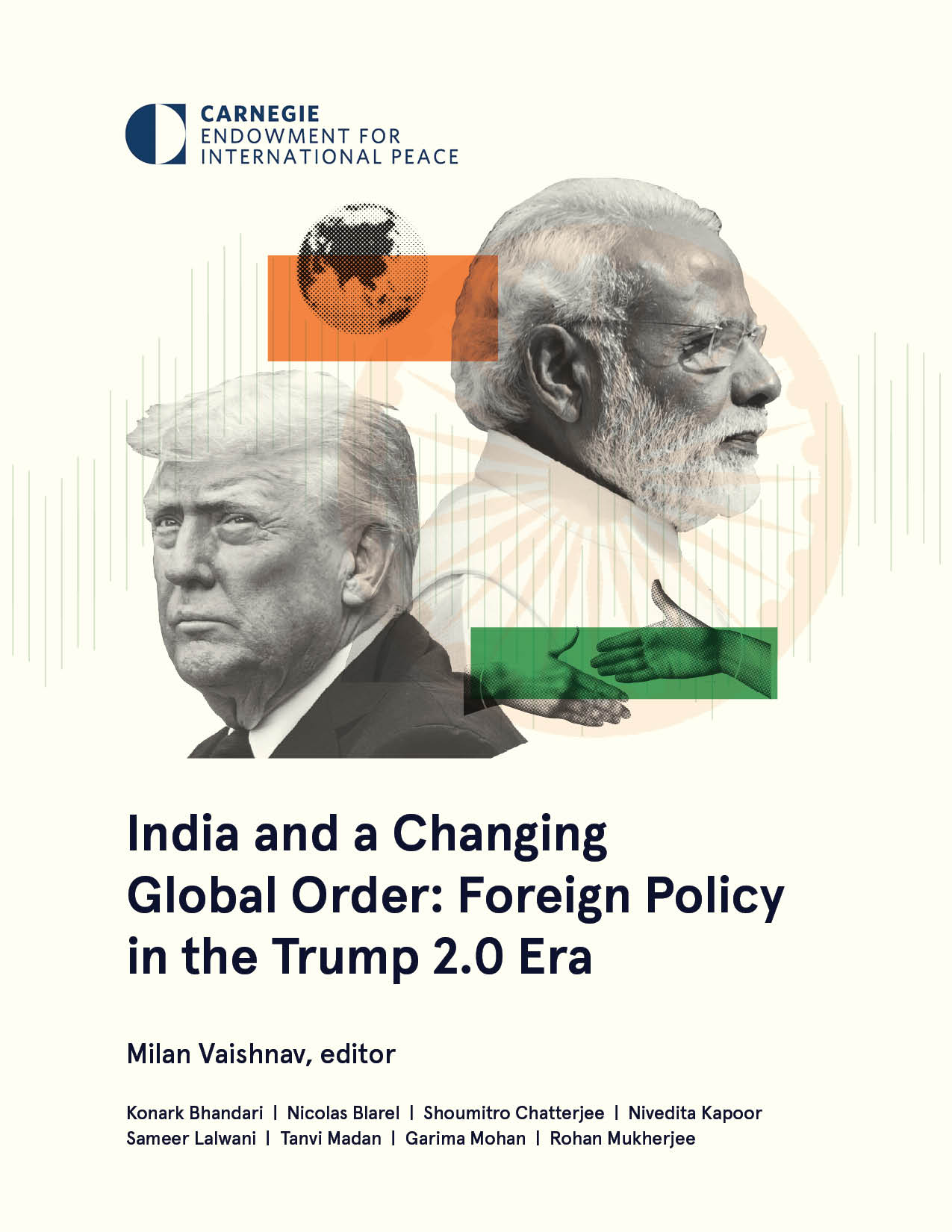
Trump 2.0 has unsettled India’s external environment—but has not overturned its foreign policy strategy, which continues to rely on diversification, hedging, and calibrated partnerships across a fractured order.



Milan Vaishnav, ed., Sameer Lalwani, Tanvi Madan, …