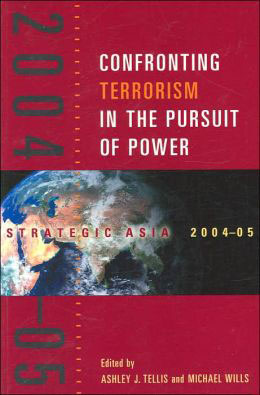
Strategic Asia 2004-05: Confronting Terrorism in the Pursuit of Power
A new book provides broad trend analyses of the major Asian sub-regions, as well as an array of transnational topical studies. It also evaluates current threats to regional peace and stability, considering how the strategic environment in Asia could change.
"The Strategic Asia Program is ambitious by drawing upon the best people in the nation, by analyzing key dynamics, and by tracking changes in the region."
—Robert A. Scalapino, University of California at Berkeley
Edited by Ashley J. Tellis and Michael Wills, and written by some of America’s leading specialists including Michael Swaine, senior associate at the Carnegie Endowment for International Peace, this new study provides an authoritative, independent assessment of the implications of the U.S.-led war on terrorism in Asia and analyzes its effects on the grand strategies of the region’s major powers.
Strategic Asia 2004–05: Confronting Terrorism in the Pursuit of Power includes broad trend analyses of the major Asian sub-regions, as well as an array of transnational topical studies. The reportcontains studies of five major powers in the region—the United States, China, Japan, Korea, and Russia—and regional studies on Central, South, and Southeast Asia, and the Middle East. It includes special studies on trends in energy security, proliferation of weapons of mass destruction, and science and technology in Asia, as well as alternative outcomes to the North Korean nuclear crisis.The book also evaluates current threats to regional peace and stability, and, through innovative forecasts, considers how the strategic environment in Asia could change surprisingly and underscores the reasons for, and implications of, such strategic discontinuities.
Carnegie India does not take institutional positions on public policy issues; the views represented herein are those of the author(s) and do not necessarily reflect the views of Carnegie, its staff, or its trustees.
In any defense establishment, change is an ongoing process. However, despite the best of intentions, existing bureaucracies, bound by habit and years of socialization, have their limits in implementing transformative change.
As AI grows more sophisticated, as the supply chains that power it become more contested, and as access to frontier models becomes geopolitically charged, India must begin to ask a different set of questions. Not what applications it can build on someone else’s infrastructure but what the world needs.
The Indian Ocean Region hosts one of the densest concentrations of subsea cables in the world. Yet, despite accounting for a significant share of global internet traffic, India’s participation remains limited.
After the chill in ties between 2020 and 2024 that brought India–China relations to their lowest point in several decades, the two countries have engaged each other afresh. This paper argues that there are predominantly four imperatives guiding India’s approach to China, and they exist in an order of priority.