

Article
Dalia Ghanem
{
  "authors": [
    "Dalia Ghanem"
  ],
  "type": "commentary",
  "blog": "Diwan",
  "centerAffiliationAll": "dc",
  "centers": [
    "Carnegie Endowment for International Peace",
    "Malcolm H. Kerr Carnegie Middle East Center"
  ],
  "collections": [
    "Civil-Military Relations in Arab States"
  ],
  "englishNewsletterAll": "menaTransitions",
  "nonEnglishNewsletterAll": "",
  "primaryCenter": "Malcolm H. Kerr Carnegie Middle East Center",
  "programAffiliation": "MEP",
  "programs": [
    "Middle East"
  ],
  "projects": [],
  "regions": [
    "Levant",
    "Maghreb",
    "Lebanon",
    "Jordan",
    "Tunisia",
    "Algeria",
    "Middle East",
    "North Africa"
  ],
  "topics": [
    "Political Reform"
  ]
}
Source: Getty
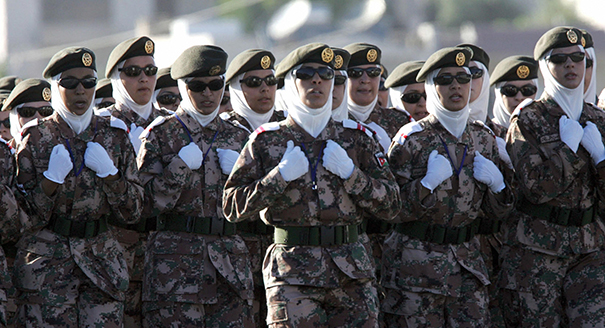
Arab armed forces are recruiting more females, who nevertheless continue to face a glass ceiling.
Last month, Tunisian Defense Minister Farhat Horchani stated that Tunisia had to examine the possibility of making military service mandatory for women. He explained that the “Tunisian Constitution … says that national service is a duty for every citizen… This duty applies to all citizens, female and male, and therefore, it is time to deepen this question, to study it.”
Nor is Tunisia alone in wanting to integrate women into the armed forces. Last August, Morocco approved a draft law to resume mandatory military service for men and women. In 2014, the Khawla Bint Al-Azwar Military School in the United Arab Emirates, the first of its kind in the Gulf, welcomed the first batch of female recruits for a voluntary nine-month period of military service.
The recruitment of women into the military is becoming a subject of increasing discussion in the Arab world and several countries have made significant efforts to acknowledge the rights of females and bring them into their armed forces. However, female integration into Arab armies remains incomplete as women are neither fully included in the militaries nor completely excluded. The road to full equality will be a bumpy and long one, as women are still facing a glass ceiling in the types of roles they are playing.
Among the countries that have integrated women and allowed them to reach the senior ranks are Algeria and Jordan. Algeria’s People’s National Army (PNA) established equality between males and females in 2006 and put in place a framework for equal opportunities. Algerian women today are more present in the PNA than before, with 30 times more women enrolled than in 1978. Women have joined the School of Cadets of the Nation, the National Gendarmerie Academy, the National Academy of Military Health, and the Naval Academy. Since 2006, five women have been promoted to the rank of general.
The Jordanian armed forces developed a strategy for women in the decade between 2006 and 2016. The aim was to build capacity through the recruitment and training of more women, generating broader participation and employment opportunities. As a result, women can enroll as civilian employees or as soldiers, whether as privates, officers, or non-commissioned officers. Their pay, promotions, and length of military service are equal to that of men.
Because of these efforts, according to a national report, female applications have exceeded the needs of Jordan’s armed forces. There are over 4,800 women in uniform—around 1,200 of them officers, as well as 2,400 servicewomen and 1,260 civilians. This represents some 3 percent of all of the country’s military forces. Jordanian women have access to the Air Force, the Military Police, the Royal Guard Protection Unit, and Military Intelligence. Several women have reached the ranks of brigadier general in the Armed Forces General Command and major general in the Royal Medical Services.
The Lebanese and Tunisian militaries have also made efforts to open their doors to females. The number of women in the Lebanese armed forces has increased steadily throughout the years to reach 3,000 in 2018, between the different military branches. This year, 1,640 females graduated from basic training specialized for female volunteers and 150 of them joined the Republican Guard Brigade. A gender policy has been set by the army to integrate more women and eventually place them in the front lines alongside their male counterparts. In Tunisia, similarly, women are not only present in the army, but have reached high-ranking positions in the navy and the air force, where 40 women are fighter pilots.
While it is true that Arab women have moved from the periphery to the center of military life, and that their numbers have gradually gone up, their integration into Arab militaries has been limited. As one illustration of this, from Tunisia, a country at the vanguard of women’s rights in the Arab world, females make up less than 7 percent of the military. Not only has the number of women remained relatively low, their access to the senior ranks of the armed forces has been difficult, and to decisionmaking positions inconsequential. By and large, and despite a few exceptions, women have been kept in more traditional and stereotypical roles for their gender—as secretaries, translators, nurses, mapmakers, and so on.
In addition, women have been systematically excluded from combat positions and cannot command military operations. This has made it difficult for them to be promoted to certain ranks for which combat experience is a prerequisite. The military institution remains a male sanctuary and this is probably the most significant obstacle to women’s full integration into Arab armed forces.
Yet integration does not simply mean including more females in the armed forces. Rather, it means, as the United Nations’ Economic and Social Council has put it, “making women’s as well as men’s concerns and experiences an integral dimension of the design, implementation, monitoring and evaluation of policies and programs in all political, economic and societal spheres so that women and men benefit equally and inequality is not perpetuated.” There is a clear gap between the rhetoric of equality and the reality of women in Arab military institutions. To overcome this gap, the military leadership needs to begin regarding women as full-fledged soldiers.
Former Senior Resident Scholar, Malcolm H. Kerr Carnegie Middle East Center
Dalia Ghanem was a senior resident scholar at the Malcolm H. Kerr Carnegie Middle East Center in Beirut, where her research focuses on Algeria’s political, economic, social, and security developments. Her research also examines political violence, radicalization, civil-military relationships, transborder dynamics, and gender.
Recent Work
Dalia Ghanem


Frances Z. Brown, Judy Dempsey, Dalia Ghanem, …
Carnegie does not take institutional positions on public policy issues; the views represented herein are those of the author(s) and do not necessarily reflect the views of Carnegie, its staff, or its trustees.

As the U.S. stumbles in its war with Iran, we are likely to see an acceleration of its disengagement from the region.

Michael Young
In Egypt’s dense cities, the disappearance of foliage has health implications and punishes daily commuters.

Angie Omar

The Zaidi government’s objective to collect weapons is constrained by regional conflict, but it can take certain measures at home.
Ali Al-Mawlawi

Huawei pushed hard to enter the Egyptian data centers market, until the Americans made a better offer.
Angie Omar

The accord represents a pivotal moment in the region to avert a security vacuum in the Gulf.


Azeema Cheema, Mohanad Hage Ali