

Article
Dalia Ghanem
{
  "authors": [
    "Dalia Ghanem"
  ],
  "type": "commentary",
  "blog": "Diwan",
  "centerAffiliationAll": "dc",
  "centers": [
    "Carnegie Endowment for International Peace",
    "Malcolm H. Kerr Carnegie Middle East Center"
  ],
  "collections": [
    "Arab Awakening",
    "Reaction Shot",
    "Arab Spring 2.0"
  ],
  "englishNewsletterAll": "menaTransitions",
  "nonEnglishNewsletterAll": "",
  "primaryCenter": "Malcolm H. Kerr Carnegie Middle East Center",
  "programAffiliation": "MEP",
  "programs": [
    "Middle East"
  ],
  "projects": [],
  "regions": [
    "Maghreb",
    "North Africa",
    "Algeria",
    "Middle East"
  ],
  "topics": [
    "Political Reform"
  ]
}
Source: Getty
Spot analysis from Carnegie scholars on events relating to the Middle East and North Africa
What Happened?
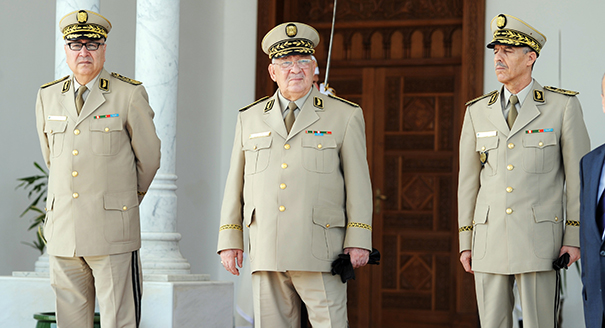
On September 15, Algeria’s interim president, Abdelkader Bensalah, announced that a presidential election would be held on December 12. The presidential election has already been canceled twice this year, on April 18 and July 4. The announcement came less than two weeks after Army Chief of Staff General Ahmad Gaïd Salah had promised that the election date would be known by mid-September, proving again that it is the military leadership that calls the shots in Algeria. The military is trying to impose a quick fix to the political crisis that has been shaking the country since the departure of former president Abdelaziz Bouteflika.
Why Does It Matter?
For months Algerians have been demonstrating against Algeria’s political elite and the system in place. The imposition of a new election date is viewed by many people as an effort by the military leadership to impose a president who will effectively be its pawn.
There are serious hurdles to holding elections on December 12. For instance, it is difficult to foresee how security conditions will be in three months if Algerians continue to demonstrate and the military chooses to continue implementing coercive measures to end the popular contestation movement. The security forces are already cracking down on activists and opposition figures, and are escalating their efforts. At the same time many mayors and judges are refusing to organize the election in their districts. As a result, the presidential election is likely to be neither free nor fair.
Moreover, the current constitution has been massively rejected by the popular movement and protestors want the document to be rewritten before any election takes place. The military leadership, in turn, has crafted electoral reforms to accelerate the election—reforms passed by the government and parliament against the will of protesters. Steps have even been taken to lower the number of signatures required for individuals to stand as candidates, from 60,000 to 50,000.
What Are the Implications for the Future?
There is no sign that Algeria’s opposition and civil society will accept the results should an election be held. The country’s political and military leadership is facing a severe legitimacy crisis, so that trying to push through an election without taking popular demands into consideration is almost certainly not going to resolve the crisis.
Algerian elections tend to hinder democracy, rather than the opposite. That is because they are characterized by the absence of any real transition. Instead, they give the political system a facelift and create an opportunity for this system—now widely rejected by many Algerians—to regenerate itself. For Algerians today, the ballot box is not synonymous with democracy but with the perpetuation of a political order that is undemocratic. By orchestrating a presidential election, the military is stifling the desire for genuine change in the country, and the consequences of doing so may have far-reaching implications for Algeria’s stability.
Former Senior Resident Scholar, Malcolm H. Kerr Carnegie Middle East Center
Dalia Ghanem was a senior resident scholar at the Malcolm H. Kerr Carnegie Middle East Center in Beirut, where her research focuses on Algeria’s political, economic, social, and security developments. Her research also examines political violence, radicalization, civil-military relationships, transborder dynamics, and gender.
Recent Work
Dalia Ghanem


Frances Z. Brown, Judy Dempsey, Dalia Ghanem, …
Carnegie does not take institutional positions on public policy issues; the views represented herein are those of the author(s) and do not necessarily reflect the views of Carnegie, its staff, or its trustees.

As the U.S. stumbles in its war with Iran, we are likely to see an acceleration of its disengagement from the region.

Michael Young

The accord represents a pivotal moment in the region to avert a security vacuum in the Gulf.


Azeema Cheema, Mohanad Hage Ali

In an interview, Jason Burke discusses his sweeping account of the “revolutionists” who so shaped the 1970s and early 1980s.
Michael Young
This will be the region’s most representative tournament, amid broad changes in its footballing landscape.
Issam Kayssi
As Iran defends its interests in the region and its regime’s survival, it may push Hezbollah into the abyss.
Michael Young