

Commentary
Aram Nerguizian
{
  "authors": [
    "Aram Nerguizian"
  ],
  "type": "commentary",
  "blog": "Diwan",
  "centerAffiliationAll": "dc",
  "centers": [
    "Carnegie Endowment for International Peace",
    "Malcolm H. Kerr Carnegie Middle East Center"
  ],
  "collections": [
    "Civil-Military Relations in Arab States",
    "Arab Spring 2.0",
    "Decoding Lebanon"
  ],
  "englishNewsletterAll": "menaTransitions",
  "nonEnglishNewsletterAll": "",
  "primaryCenter": "Malcolm H. Kerr Carnegie Middle East Center",
  "programAffiliation": "MEP",
  "programs": [
    "Middle East"
  ],
  "projects": [],
  "regions": [
    "Levant",
    "Lebanon",
    "Middle East"
  ],
  "topics": [
    "Political Reform",
    "Security"
  ]
}
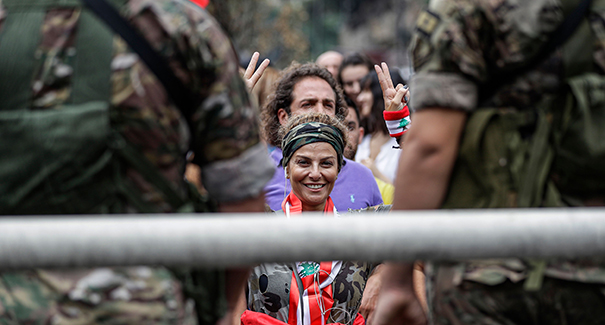
Source: Getty
In a period of unpredictable change, Lebanon’s armed forces are indispensable to internal stability.
Lebanon’s ongoing street protests against the political class and the sectarian political order have made the Lebanese armed forces indispensable to internal stability during a time of unpredictable change. The institution’s mission parameters are deceptively simple: protect key government institutions and the public, and stand for and with the protesters. To that end, the military has deployed all of its operational units—80 percent of some 80,000 personnel.
Throughout these unprecedented protests, the armed forces have worked to maintain a contentious balance between the needs and fears of Lebanon’s sectarian system and the demands and aspirations of a newly energized public. The institution has sidestepped calls from the country’s competing factions to bring the protests to an end, thus preserving the unique goodwill that the military enjoys.
As uncertainty transforms into a protracted cycle of civil unrest, Lebanon’s sectarian political elites will only redouble their demands that the armed forces restore the status quo ante, as will their scrutiny of the intent of the military leadership. But given the armed forces’ cross-sectarian appeal, the fact that officers and enlisted personnel can’t help but sympathize with the protesters and the truly historic nature of current events, the military faces a key test: It can either maintain the confidence of the large number of protesters, or it can backtrack and trigger a potential catastrophe on a scale few can predict, let alone fully understand.
The cross-sectarian character of the armed forces helped cement its role as Lebanon’s most popular national institution. It is also critical to understanding how the military responded to both previous protests and cases of civil unrest.
In 2005, when mass demonstrations took place following the assassination of former prime minister Rafiq al-Hariri, the military refused to carry out repressive orders from the Karami government. It had sensed a shift in the balance of power in Lebanon and the region, and opted instead to act as a protective buffer for anti-Syria demonstrators. In contrast, the military chose not to engage militarily during the May 2008 street clashes between Hezbollah and the embryonic militia of the predominantly Sunni Future Movement.
During my background discussions with senior military officers in 2014, some described May 2008 as a case of military neutrality. Others saw the armed forces’ inaction at the time as a watershed event and a key missed opportunity wherein the innocence of the post-Syria military was compromised. Be that as it may, the 2008 crisis underscored the armed forces’ indispensable domestic role after 2005 as a bulwark against any Sunni-Shi‘a military confrontation.
To the armed forces the current protests stand apart from past cycles of civil unrest. The anti-Syrian demonstrations of 2005 lacked a robust cross-sectarian character due the absence of the bulk of the Shi‘a community and other groups seeking favorable ties with Syria. The 2008 crisis went to the heart of Sunni-Shi‘a tensions in Lebanon. And the 2015 “You Stink” protests directed against the breakdown in waste management took place without the participation of much of Lebanon’s poor and the middle classes, who remained beholden to the country’s competing sectarian political forces.
The 2019 protests, in turn, have no equivalent in the country’s post-Independence history. They have been defined thus far by their broad geographic scope beyond metropolitan Beirut and their inclusiveness across traditionally stubborn sectarian dividing lines. Of critical importance this time are the tremendous risks being taken by poor and middle class Shi‘a to participate in protests across Lebanon. Furthermore, the protests also enjoy the support of poor and middle class Sunnis in Tripoli and throughout the country.
Throughout the latest events, Lebanese have expressed common narratives tied to collective socioeconomic conditions, citizenship, and national belonging. As a result the protests, born out of frustration with the ruling elite that cuts across class, sectarian, and geographic dividing lines, resonate with the ethos, aspirations, and self-image of today’s increasingly professional armed forces.
Lebanon’s sectarian factions all see the current mix of protests as an existential threat to their postwar political order and have pressed the armed forces to empty the streets and clear roads across the country. However, the military has brushed aside calls to clear protest centers in downtown Beirut and elsewhere. Indeed, army units deterred alleged Amal and Hezbollah sympathizers from disrupting peaceful demonstrations in the downtown. After initially obeying orders to remove roadblocks between Beirut and Jounieh, the armed forces quickly aborted that effort rather than break faith with protestors and the Lebanese in general. Lastly, the military publicly affirmed that it stood with the protesters’ right to demonstrate peacefully, so long as they avoided damage to public and private property.
As the civil unrest persists, the armed forces will be asked to play an ever-larger role given the scale of the economic and political challenges to come. To that end, the military must protect its image as a national institution. This will mean navigating Lebanon’s changing political minefield while remaining true to the faith so many Lebanese place in their military. To do otherwise would be a Potemkin moment that could cost the military what it needs most, namely the trust and support of the Lebanese people.
Former Senior Advisor, Program on Civil-Military Relations in Arab States, Malcolm H. Kerr Carnegie Middle East Center
Aram Nerguizian was senior advisor of the Program on Civil-Military Relations in Arab States at the Malcolm H. Kerr Carnegie Middle East Center, where his work focuses on the Lebanese security sector, long-term force transformation in the Levant, and efforts to develop national security institutions in post-conflict and divided societies.
Recent Work
Aram Nerguizian
Carnegie does not take institutional positions on public policy issues; the views represented herein are those of the author(s) and do not necessarily reflect the views of Carnegie, its staff, or its trustees.
Reconciliation councils are emerging throughout the country to mediate in intracommunal disputes, many from the war years.
Natacha Danon
As the U.S.-led Coalition withdraws, the Kurds’ reliance on Baghdad, and on themselves, will only increase.
Wladimir van Wilgenburg

As the U.S. stumbles in its war with Iran, we are likely to see an acceleration of its disengagement from the region.

Michael Young
The Zaidi government’s objective to collect weapons is constrained by regional conflict, but it can take certain measures at home.
Ali Al-Mawlawi

The accord represents a pivotal moment in the region to avert a security vacuum in the Gulf.


Azeema Cheema, Mohanad Hage Ali