

Article
Marc Pierini
{
  "authors": [
    "Marc Pierini"
  ],
  "type": "commentary",
  "blog": "Diwan",
  "centerAffiliationAll": "dc",
  "centers": [
    "Carnegie Endowment for International Peace",
    "Carnegie Europe",
    "Malcolm H. Kerr Carnegie Middle East Center"
  ],
  "collections": [],
  "englishNewsletterAll": "menaTransitions",
  "nonEnglishNewsletterAll": "",
  "primaryCenter": "Malcolm H. Kerr Carnegie Middle East Center",
  "programAffiliation": "MEP",
  "programs": [
    "Middle East"
  ],
  "projects": [],
  "regions": [
    "Middle East",
    "Türkiye",
    "Russia",
    "Caucasus"
  ],
  "topics": [
    "Political Reform"
  ]
}
Source: Getty
In an increasingly unpredictable global environment, expect Turkish foreign policy to be just as elusive.
Since the beginning of Russia’s invasion of Ukraine, Turkey has pursued a balanced policy and tried to use its influence to facilitate contacts between the two countries. Turkish President Recep Tayyip Erdoğan has for years sought to keep one foot in the NATO camp and another in the Russian camp, an approach that was illustrated by Turkey’s acceptance of the Russian S-400 air defense system in July 2019. Yet the threats last week by Russian President Vladimir Putin, who partially mobilized Russian forces and implied he might use nuclear weapons, combined with Erdoğan’s electoral priorities, make Turkey’s foreign policy course harder to predict.
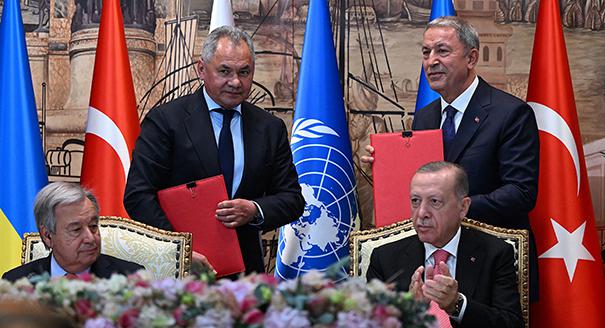
Only a few months ago, facing economic troubles and grim opinion polls, Erdoğan employed a “rally-around-the-flag” narrative to ramp up nationalist sentiment in his camp and neutralize his opponents. Simultaneously, Ankara’s communications apparatus was promoting the president’s peacemaker role and his nurturing, with the United Nations secretary general, of a grain deal between Russia and Ukraine. Behind this policy, Turkey continued delivering Bayraktar drones to Kyiv, avoided implementing Western sanctions against Russia, accepted financial transfers from Russian entities, and made financial deals with Rosatom and Russian oil operators in order to ease Turkey’s financial worries.
At the same time Erdoğan was also carefully managing his international image. He built on the grain deal and attended the Samarkand summit of the Shanghai Cooperation Organization, though he was invited as a “dialogue partner,” not a member. Nevertheless, in some instances the image paled somewhat, with Erdoğan’s absence from Queen Elizabeth’s funeral (where Putin was not invited) and his failure to meet with President Joe Biden at the UN.
However, last week the situation on the world stage worsened drastically. Putin’s mobilization on September 21, his announcement that he would annex more Ukrainian territory, and his threat to use weapons of mass destruction led Western nations to condemn Russia and voice support for Ukraine. Meanwhile, Putin’s policy faced unanticipated objections from the African Union, China, and India.
The Kremlin’s new strategy is no less than a massive game changer in global affairs. Putin decided to precipitate the annexation of Donetsk, Luhansk, and other territories with fabricated referendums, to be able to label Western support for Ukraine as an “attack on Russia,” provoking a confrontation with the United States and its European allies. The Biden administration, France, the United Kingdom, and NATO are already adjusting their strategies. China and India too have started to adapt their statements, and Turkey, invariably, will have to review its policies.
For Turkey specifically, Putin’s new threats have ominous implications. Should Russia decide to actually use tactical nuclear weapons (or any weapons for that matter) against a part of NATO’s territory, Ankara would be tied by Article 5 of the North Atlantic Treaty (“an attack on one is an attack on all”), and would therefore see its “balanced policy” instantly shattered. However, simultaneously, Ankara remains under severe pressure from the Kremlin in the military, financial, tourism, trade, and energy fields and is depending on Putin to continue implementing or modifying the grain deal.
The hardening of Moscow’s position has had another immediate effect in Ankara, in that it makes Erdoğan’s role as a mediator immensely more difficult. Which Ukrainian leader, or Western one, would be willing to come to Istanbul and discuss a ceasefire, or the security of a nuclear power plant, when Ukraine and the West are under the threat of Russian weapons of mass destruction? Kremlin’s outrageous stance has raised questions about Turkey’s vaunted “proximity” to Putin.
A third fallout for Turkey lies in an area that is central to Turkey’s foreign policy, namely the Eastern Mediterranean and Middle East, especially Cyprus, Greece, Israel, Egypt, Lebanon, Libya, Palestine, and Syria. Issues in this region remain important, but they have suddenly been dwarfed by Russia’s latest threats. As a result, Turkey’s capacity to exert influence or pursue its interests in its neighborhood has shrunk.
Ultimately, Turkey now faces harder realities. The country is still heavily dependent on economic relations with Western countries, especially the European Union. Russia or the Gulf countries can only offer it limited financial support. Its assertive positions on Cyprus, Greece, or Syria have raised objections from the Western community or Russia, depending on the case. In one instance, it is rumored that the Kremlin’s objections to a fifth military operation in northeastern Syria prompted Turkey to send its intelligence chief to Damascus for rare high-level contacts. It is impossible to predict the short-term outcome of such discussions, but they do represent a notable change in Ankara’s position.
Faced with a dramatic economic situation at home and what appears to be growing momentum for the opposition coalition, not to mention a considerable hardening of Putin’s position, Erdoğan may well revise his previous behavior. History has shown he is a pragmatist who can undertake spectacular political U-turns.
It is hard to foresee how the Turkish president will play his cards in the weeks to come. What we now know is that he will navigate these difficult seas with one major goal in mind, namely securing his reelection as president in June 2023. With regard to Turkey’s foreign policy, that means one thing: even greater unpredictability.

Senior Fellow, Carnegie Europe
Marc Pierini is a senior fellow at Carnegie Europe, where his research focuses on developments in the Middle East and Turkey from a European perspective.
Recent Work
Marc Pierini
Marc Pierini
Carnegie does not take institutional positions on public policy issues; the views represented herein are those of the author(s) and do not necessarily reflect the views of Carnegie, its staff, or its trustees.

As the U.S. stumbles in its war with Iran, we are likely to see an acceleration of its disengagement from the region.

Michael Young

Huawei pushed hard to enter the Egyptian data centers market, until the Americans made a better offer.

Angie Omar

The accord represents a pivotal moment in the region to avert a security vacuum in the Gulf.


Azeema Cheema, Mohanad Hage Ali
In an interview, Jason Burke discusses his sweeping account of the “revolutionists” who so shaped the 1970s and early 1980s.
Michael Young
There is a disturbing structural parallel between the old global energy economy and the new green transition.
Angie Omar