

Commentary
Nur Arafeh
{
  "authors": [
    "Nur Arafeh"
  ],
  "type": "commentary",
  "blog": "Diwan",
  "centerAffiliationAll": "",
  "centers": [
    "Carnegie Endowment for International Peace",
    "Malcolm H. Kerr Carnegie Middle East Center"
  ],
  "collections": [
    "Palestine: The Wars in the War"
  ],
  "englishNewsletterAll": "",
  "nonEnglishNewsletterAll": "",
  "primaryCenter": "Malcolm H. Kerr Carnegie Middle East Center",
  "programAffiliation": "",
  "programs": [],
  "projects": [],
  "regions": [
    "Palestine",
    "Israel",
    "United States"
  ],
  "topics": [
    "Foreign Policy"
  ]
}
Source: Getty
Donald Trump’s latest remarks aim to erase the Palestinians and ignore international law.
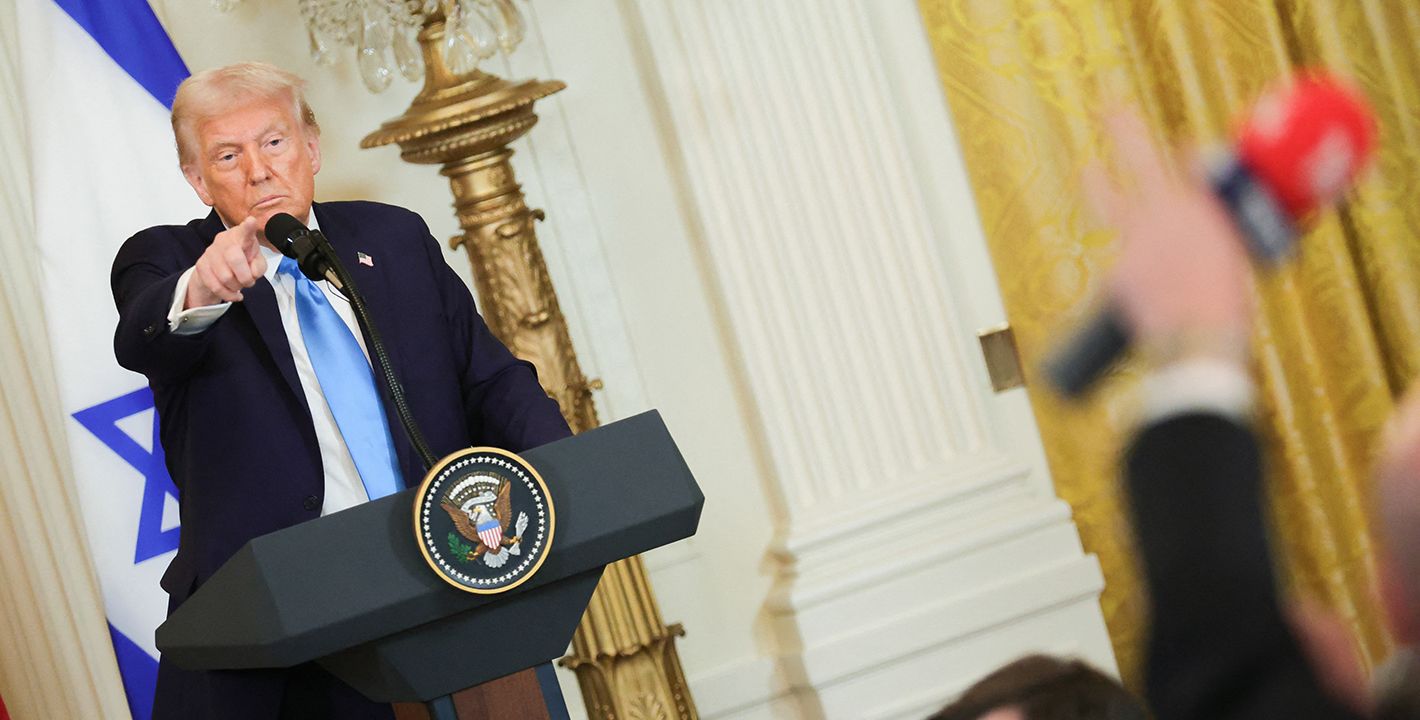
Since his election, President Donald Trump has insisted that he can achieve “peace” in the Middle East. In February, during the first phase of the ceasefire agreement between Israel and Hamas in Gaza, he even declared that he deserved a Nobel Peace prize. However, his approach to peace was revealed during his press conference with Israeli Prime Minister Benjamin Netanyahu this week. It is rooted in the forced displacement and erasure of the Palestinians, disregards international law, and reflects a neocolonial, profit-driven business mindset that views Gaza not as a home for its people but as prime real estate for private capital and development projects.
After his inauguration in January, Trump openly called for “cleaning out” Gaza and urged Egypt and Jordan to accept displaced Gazans. Despite international condemnation, he doubled down during the press conference with Netanyahu, again backing the permanent removal of Palestinians from Gaza. He insisted that Palestinians had no other option but to leave Gaza for somewhere “fresh, beautiful,” without the ability of returning home. He also renewed his calls for Egypt and Jordan to take in Palestinians, along with other countries he did not name. However, in the face of the global backlash against Trump’s remarks, his spokeswoman backtracked on February 5, saying that the supplanting of the Palestinians would only be temporary.
The president thus made it clear that his approach to peace in the Middle East does not involve reaching a political settlement. Instead, he is disregarding international law—forced displacement is an act considered an international crime—by seeking to engage in the forced displacement and ethnic cleansing of the Palestinian population, which he sees as the problem. In other words, his vision of “peace” is that it would be achieved through the elimination of the Palestinian cause and the sidelining of Palestinian political rights, including their right to self-determination, freedom, dignity, and land.
The erasure of the Palestinians was especially clear in Trump’s rhetoric, dehumanizing them through a racist and orientalist lens that stripped them of any agency. He portrayed Palestinians as if they were docile, with no political aspirations. This was evident in his remarks that “[t]he only reason they want to go back … is because they have no alternative… Who would want to go back?” Such phrases reflect a profound ignorance of Palestinian history and the deep-rooted connection Palestinians have to their land.
Trump also distorted reality by decontextualizing the situation in Gaza and reducing the territory’s suffering to a mere humanitarian catastrophe. He described Gaza as an “unlucky place” where Palestinians have “lived like hell,” insisting that “nobody can live” there and that “it’s guaranteed they will end up dying.” He framed the “hell” in Gaza as if it were the result of an unavoidable natural disaster that beset Palestinians, ignoring Israel’s 58-year occupation, seventeen-year blockade, and war of annihilation in the past fifteen months, waged with American weapons and military aid. It is a war that has killed more than 61,000 Palestinians, most of them women and children, demolished 92 percent of residential buildings, obliterated all critical infrastructure needed to sustain life, and left behind millions of tons of rubble that could take up to 20 years to clear.
Trump’s plan effectively brings to life the long-held ambitions of the Israeli right and far-right. It is an idea that once seemed far-fetched, but that has been recurrently repeated by Israeli officials. For instance, in the aftermath of the October 7 attacks, Likud politician Ariel Kallner, declared, “Right now, one goal: Nakba [expulsion of the Palestinians]. A Nakba that will overshadow the Nakba of ‘48.” Similarly, Israeli far-right ministers such as Itamar Ben Gvir and Bezalel Smotrich have long been advocating for the “voluntary migration” of Palestinians by making life so unbearable for them that they are forced to leave. It is therefore no surprise that Israeli officials were ecstatic after Trump’s press conference with Netanyahu, boasting that they could now work to “bury the dangerous idea of a Palestinian state permanently.” Indeed, they could never have imagined a U.S. president openly endorsing and calling for the mass removal of Palestinians.
However, Trump’s plan is not merely to appease the Israeli right, nor is it solely driven by his ideological affinity with Israel. It is also determined by business interests and a neocolonial mindset that views Gaza as a prime location for real estate development and private capital accumulation. Such a view may have come from Trump’s son-in-law Jared Kushner, who said in February 2024 that “Gaza’s waterfront property—it could be very valuable.” Since January this year, Trump has spoken of Gaza as having a lot of business potential and has expressed admiration for its location on the sea and its favorable climate. During the press conference, Trump went even further, declaring that the United States should “take over” Gaza and “own” the land—as if Palestinians did not exist—while laying out a vision to turn it into the “Riviera of the Middle East,” a high-end tourist destination on the Mediterranean. Though he did not explicitly mention them, the two gas fields off of Gaza’s coast are likely another factor prompting his interest in the territory, although he has been calling for an isolationist U.S. foreign policy.
By framing Gaza’s future as part of a U.S.-led business project in which Palestinians have no place, Trump has effectively discarded Phase Three of the current ceasefire agreement, which is focused on reconstruction. Instead, he has redefined reconstruction as a process that serves private investors rather than Palestinians, the land’s rightful owners.
While Trump’s plan is bound to fail due to the Palestinians ongoing rejection of forced displacement, its danger lies in the fact that it is normalizing a rhetoric that openly calls for the ethnic cleansing and elimination of an entire population—something that was once unthinkable. The president’s shocking statements also risk serving as a distraction from the reality on the ground, namely the failure of Israel’s efforts to impose a military solution in Gaza, especially its inability to destroy Hamas. Only a political solution and an end to Israel’s occupation will put an end to the recurring cycle of war and destruction.

Former Nonresident Scholar, Malcolm H. Kerr Carnegie Middle East Center
Nur Arafeh was a fellow at the Malcolm H. Kerr Carnegie Middle East Center and co-leader of its Political Economy Program.
Recent Work
Nur Arafeh
Nur Arafeh
Carnegie does not take institutional positions on public policy issues; the views represented herein are those of the author(s) and do not necessarily reflect the views of Carnegie, its staff, or its trustees.

In an interview, Rozina Ali discusses her new book on the rise and manifestations of Islamophobia in the United States.

Michael Young

In an interview, Ian Lustick and Eli Clifton discuss their new book on why a prominent ally has so much influence in America.
Michael Young

As the U.S. stumbles in its war with Iran, we are likely to see an acceleration of its disengagement from the region.
Michael Young

It is improbable that Israel’s forthcoming elections will alter much in terms of how the country thinks about security.

Nathan J. Brown

Middle Eastern states should welcome an accelerated U.S. disengagement from their region.
Michael Young