

Commentary
Armenak Tokmajyan
{
  "authors": [
    "Armenak Tokmajyan"
  ],
  "type": "commentary",
  "blog": "Diwan",
  "centerAffiliationAll": "",
  "centers": [
    "Carnegie Endowment for International Peace",
    "Malcolm H. Kerr Carnegie Middle East Center"
  ],
  "collections": [
    "Syria in a New Era"
  ],
  "englishNewsletterAll": "",
  "nonEnglishNewsletterAll": "",
  "primaryCenter": "Malcolm H. Kerr Carnegie Middle East Center",
  "programAffiliation": "",
  "programs": [],
  "projects": [],
  "regions": [
    "Syria",
    "Levant"
  ],
  "topics": []
}
Source: Getty
The government’s gains in the northwest will have an echo nationally, but will they alter Israeli calculations?
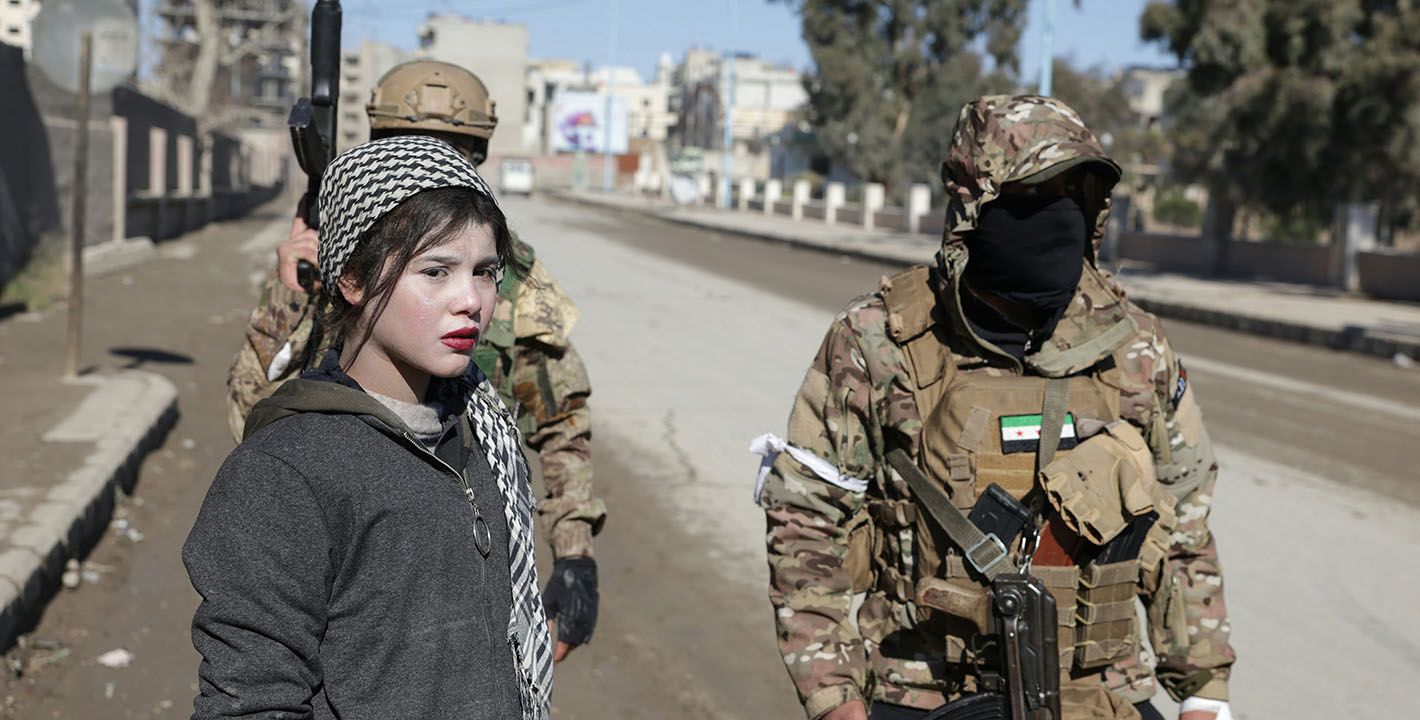
By crossing the Euphrates River in recent days, Syrian government forces broke through a decade-old boundary that had defined Syria’s conflict, behind which the Kurd-dominated Syrian Democratic Forces (SDF) had sustained a de facto autonomous area in northeastern Syria. The next phase could still swing from confrontation, if dialogue fails, to complex bargaining over Kurdish rights, control of weapons, and political participation, among other issues, that will not be easy to resolve. Syria’s cohesion looks set to be decided in the northeast, with reverberations in other parts of the country, not least in the south where influential figures in the Druze community have sought self-determination for Suwayda Governorate.
The recent developments began around the new year. After government forces pushed Kurdish fighters out of Aleppo, they turned their sites on areas west of the Euphrates, where the SDF had deployed during the period of vacuum that followed the downfall of Bashar al-Assad’s regime. The U.S. mediated in talks that ran parallel to the military buildup and briefly produced a workable formula: an SDF pullback east of the Euphrates. However, the rupture came during the withdrawal and handover, as Arab tribes in Deir al-Zor and Raqqa rose up against the SDF, forcing its units to pull back further north toward predominantly Kurdish areas. On January 18, a deal favoring Damascus briefly averted an all-out confrontation, only to collapse on January 20, triggering a call by the SDF for general mobilization, before the parties agreed to another pause in the fighting to resume negotiations, even as tensions remained very high.
The conflict in the northeast has many shades to it. It reflects Damascus’s drive to rein in rebellious peripheries. However, the northeast is also the main arena where two externally-driven strategic visions for Syria collide. One, associated above all with Israel and perhaps endorsed by the United Arab Emirates, sees an interest in a Syria broken into manageable pieces. The other, advanced by Türkiye and Saudi Arabia and later embraced by Washington, wagers on a top-down, centralized Syria ruled from Damascus, with the state having a monopoly over force and representation. According this approach, all of Syria’s ethnosectarian communities are to be brought back into the national fold through bargains with the regime. The problem is that, so far, this objective has been more akin to stitching Syria back together again than putting in place an enduring process of reintegration.
The collapse of the Kurdish-led de facto autonomous entity in northeast Syria is the clearest win yet for the second approach, above all that of Türkiye. As the SDF unraveled, some Kurdish commanders called for Israeli intervention. Yet this implicit appeal to an alliance of minorities notwithstanding, Ankara, the most consequential player, has long framed the Kurdish question as a national security problem on its southern border. Seen through this lens, the Kurdish entity represented a strategic threat for Türkiye. Undoing it became a central objective, pursued patiently and at high cost for over a decade. Israel may prefer a fragmented Syria and does not see eye-to-eye with Ankara on many issues, however expecting it to challenge Türkiye’s interests on its border, and against American preferences, was never realistic.
Türkiye’s border security policy is, ironically, a useful guide to Israel’s approach in the south. The SDF’s collapse has strengthened Damascus and those in Syria who reject the country’s fragmentation, which could in time temper Israel’s maximalist demands. Yet any southern arrangement will still have to accommodate Israeli border requirements, just as any arrangement in the north has to accommodate Turkish interests. What Syrian President Ahmad al-Sharaa can successfully obtain in the south after the success of the campaign in the northeast will still hinge on how Israel defines a security order on its northern frontier in the years ahead.
Israel’s policy in southern Syria is defined by two guiding principles: One is to create a buffer zone north of the occupied Golan Heights; the other is to pursue a policy of fragmenting Syria into ethnosectarian entities. The rationale for establishing buffer zones runs deep. It is embedded in the aftermath of past conflicts between Israel and Syria, particularly the 1974 disengagement agreement that followed the October 1973 war. It established a United Nations-monitored separation zone north of the Golan and limited the deployment of weapons on both sides of the demarcation line.
The conflict in Syria after 2011 widened the meaning of “buffer,” culminating in the Russian mediated deal of 2018. The deal embodied Israel’s priority of shifting from establishing a zone that would protect the Golan to a much broader aim of eliminating any potential threats emanating from southwestern Syria, whether from Damascus or its allies. Though Assad and Russia are no longer present, the substance of the 2018 deal still guides Israeli thinking. The attack from Gaza of October 7, 2023, hardened this approach further, so that the buffer zone in Syria has now become part of a wider ring of buffer zones surrounding Israel, which also encompasses Gaza and Lebanon.
This matters because even if Sharaa has strengthened his hand in the northeast and those favoring Syria’s fragmentation have been weakened, Israel will continue to defend a buffer zone strategy. What may change is its scope and packaging. Israel could be pushed toward a workable deal that gives Syria room to stabilize, in which the Israelis reduce their violations of Syrian sovereignty and tone down their demands, such as demanding a demilitarized zone reaching up to Damascus. But the balance of power still favors Israel, and creating a buffer zone represents a core national security question for the Israelis. Therefore no one should assume that they will make major concessions.
In contrast, the Israeli pursuit of fragmentation, which sustains some Druze aspirations for self-determination in Suwayda, is a shallower and more contingent policy shaped by the fractured landscape the Assad regime left behind, and by the genuine possibility that Syria could splinter further. The Druze have real grievances against a new president who, not long ago, was a jihadi, and these anxieties have driven their desire to seek autonomy. But whether such autonomy prevails will not be decided locally alone; it is bound up with Israel’s broader logic on fragmenting Syria.
Prime Minister Benjamin Netanyahu’s government may not abandon the Druze, given their political weight in Israel and prominence in the army. However, in a region where Türkiye and Saudi Arabia are pushing for a unified Syria, and Washington has lined up behind them, fragmentation is becoming harder for Israel to sustain as a policy principle. In fact, Israel’s own conduct hints at the hierarchy of its priorities. The Suwayda roadmap of September 2025 for resolving the crisis in the governorate, which met the demands of the Syria government, likely enjoyed Israel’s consent, suggesting that the Israelis are willing to be flexible on local political arrangements. By contrast, Israel’s repeated insistence on a robust buffer zone looks firmer, having the approval of Israel’s military, political, and security establishments.
For the echoes of the northeast to become audible in the south, Damascus must prove that it can consolidate its grip over the Kurdish hinterland. If it does, the ripple effects will reach other parts of Syria, including the south. However, the casualty will not be Israel’s entrenched approach to establishing a security zone inside Syria, even at the expense of its neighbors’ sovereignty, but the relative autonomy that the Druze have carved out for themselves in Suwayda, which would come under growing pressure.

Nonresident Scholar Malcolm H. Kerr Carnegie Middle East Center
Armenak Tokmajyan is a nonresident scholar at the Malcolm H. Kerr Carnegie Middle East Center in Beirut. His research focuses on borders and conflict, Syrian refugees, and state-society relations in Syria.
Recent Work
Armenak Tokmajyan
Armenak Tokmajyan

In an interview, Naysan Rafati assesses the first week that followed the U.S. and Israeli attack on Iran.

Michael Young
At heart, to impose unconditional surrender on Hezbollah and uproot the party among its coreligionists.

Yezid Sayigh
As Iran defends its interests in the region and its regime’s survival, it may push Hezbollah into the abyss.
Michael Young
A recent offensive by Damascus and the Kurds’ abandonment by Arab allies have left a sense of betrayal.
Wladimir van Wilgenburg
Beirut and Baghdad are both watching how the other seeks to give the state a monopoly of weapons.
Hasan Hamra