

Article
Armenak Tokmajyan, Laith Qerbaa
{
  "authors": [
    "Armenak Tokmajyan"
  ],
  "type": "commentary",
  "blog": "Diwan",
  "centerAffiliationAll": "",
  "centers": [
    "Carnegie Endowment for International Peace",
    "Malcolm H. Kerr Carnegie Middle East Center"
  ],
  "englishNewsletterAll": "",
  "nonEnglishNewsletterAll": "",
  "primaryCenter": "Malcolm H. Kerr Carnegie Middle East Center",
  "programAffiliation": "",
  "programs": [],
  "projects": [],
  "regions": [
    "Levant",
    "Israel",
    "Palestine",
    "Lebanon",
    "Syria",
    "Iraq"
  ],
  "topics": []
}
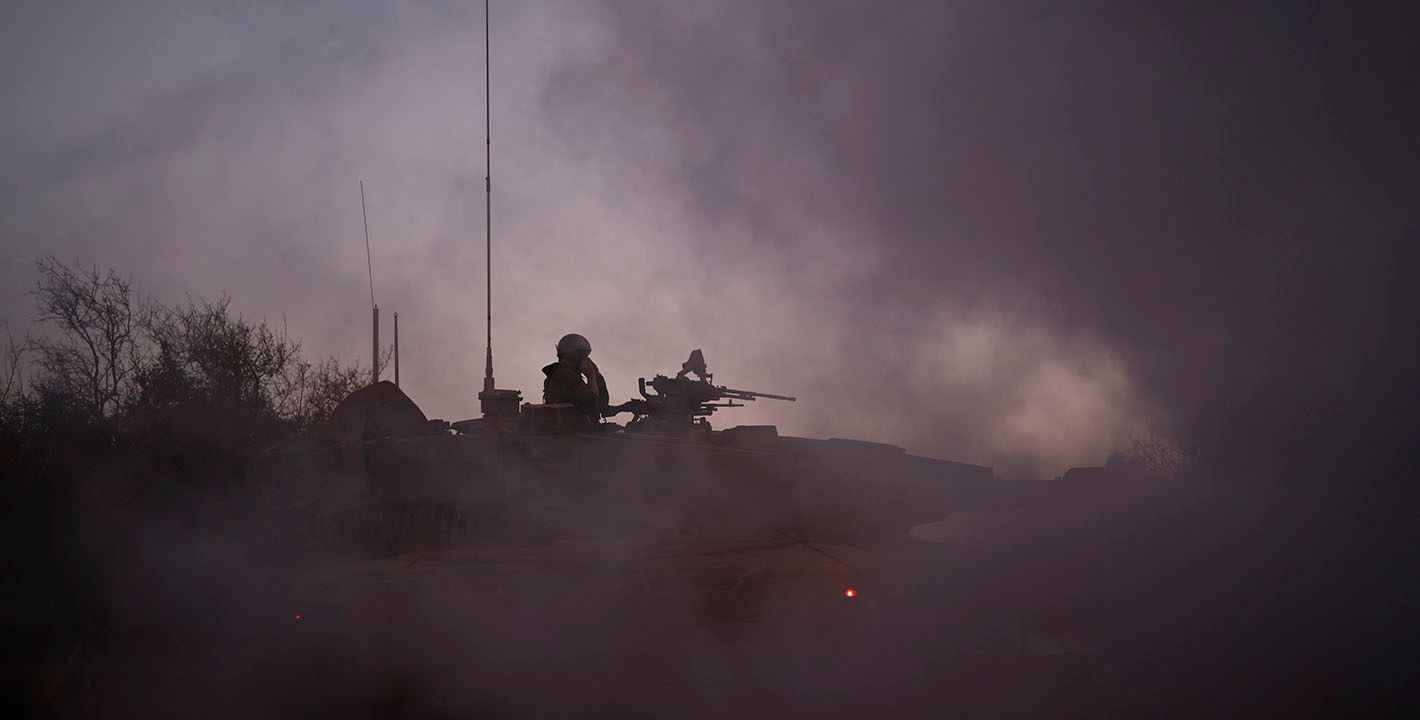
Source: Getty
In the aftermath of the October 7 attacks, the Israelis have transformed their neighbors’ borderlands to serve their own security interests.
The security order in the Levant is undergoing a major transformation, and the region’s borders stand witness to what is likely to come. The old order was shaped above all by Iran’s push to secure an unhindered ability to attack Israel by erasing the formal boundaries between Lebanon, Syria, and Iraq. Israel’s response, in turn, was to make these countries fair game for retaliation.
In the year that followed the October 7, 2023, Hamas attack against Israel, the Israelis severely damaged the Iranian network of alliances, turning their country into the main architect of an emerging security reality. While the consolidation of such a situation may take years, one thing is certain, namely that the new order will be defined by reinforced boundaries and expanded buffer zones encircling Israel.
The Arab uprisings shattered Syria’s borders, and with them many of the Levant’s borders. Fighters, weapons, and money poured into Syria, fueling a war that reshaped the country’s frontier regions and those of its neighbors. Syria became open to all sides, but it was Iran’s push to blur national boundaries and move its operations closer to Israel that ultimately defined what followed. Before the October 7 attack, Tehran and its proxies had almost uninterrupted access across the Iraq-Syria border, extending their reach to southern Damascus and the edge of the Golan Heights. They moved with ease toward the Lebanese frontier, reportedly building missile capabilities nearby. Hezbollah, meanwhile, eroded the distinction between Syria and Lebanon by being a central component in the Iranian “ring of fire” around Israel.
This only heightened Israeli anxieties. For years, Israel carried out what became known as the “campaign between the wars,” bombing Iran-linked activity and assets from Iraq to Lebanon. The tempo of these operations rose steadily, yet their ability to prevent Iranian expansion was limited. Washington’s preference under the Obama administration was for negotiating with Iran; and this, along with Russia’s aerial domination of Syria after 2015, imposed constraints on Israel. Following the October 7 attacks, however, Israel opened a multifront war with the declared aim of reshaping the Middle East. More than two years later, the Levant looks profoundly different and the pro-Iran Axis of Resistance has crumbled.
The remaking of the region’s borderlands lies at the heart of the new security order. However, there is a crucial difference between the present situation and the one prevailing during the eleven years after the outbreak of the Arab uprisings: instead of fractured borders, Israel is now pushing for the reinstatement of such borders in ways that serve its own security interests. The first step in this transformation is Israel’s determination to push its adversaries away from its own borders, replacing the so-called “ring of fire” with a “ring of buffer zones.”
In Gaza, Israel’s intention to carve out such a zone along the enclave’s perimeter was clear from the outset, as it razed everything roughly a kilometer deep across the stretch of Gaza’s border with Israel. This approach was later formalized in President Donald Trump’s 20-point ceasefire plan, which lays out a three-phase Israeli withdrawal. Even if all three phases are implemented—a big “if”—Israel is still expected to retain a buffer zone that is at least one kilometer wide.
Similarly, in Lebanon after the escalation of the war in 2024, Israel still occupies positions along the Lebanese border. Along Lebanon’s southern borders, Israeli forces have left behind a trail of destruction that still prevents a return to normal life, resulting in a wasteland that has functioned as a de facto buffer zone. Under the 2024 ceasefire agreement, and in line with United Nations Security Council Resolution 1701, Israel is pushing for the removal of Hezbollah’s weapons from south of the Litani River, while the resolution reaffirms Resolution 1559, which calls for the disarmament of militias throughout Lebanon. Hard-line voices in Israel have gone further, invoking the Awali River near Sidon as a potential new boundary for a Hezbollah-free zone. If Resolution 1701 and the 2024 ceasefire agreement are implemented, at the very minimum Israel would have a large area to its north with no Hezbollah military capabilities present.
In Syria, a buffer zone has separated Syrian and Israeli forces on the occupied Golan Heights since 1974, when the disengagement agreement also capped troop levels and armaments on both sides. The Syrian conflict and Assad’s downfall have upended much of that arrangement. Israel has occupied new parts of Syria, including the UN-mandated buffer zone where it intends to stay for an “unlimited amount of time.” Its demands in Syria are varied, but all share a buffer-zone logic. Beyond the occupied Golan and the UN buffer zone, Israel is reportedly pressing for a wider demilitarized area from Damascus to the Golan. However, there is no agreement over buffer zones with Syria yet. Instead, Israel has beefed up the perimeter around the Golan Heights, enjoys aerial superiority, and has compelled the Syrian side to withdraw its heavy weapons from the south.
A second pattern in the Levant’s shifting border landscape, alongside the spread of buffer zones, is the reinforcement of international boundaries. The Türkiye-Syria border is now more fortified than ever. The Iraq-Syria border meanwhile is no longer open to Iran and its militias, and has been reinforced with a 400-kilometer network of walls and trenches begun in 2022 to prevent infiltration from Syria. Jordan’s northern frontier, once a conduit for weapons and rebels into Syria, and later the scene of a semi-warlike campaign against drugs and arms smuggling into Jordan (some, according to pro-Israeli sources, heading to Palestinian areas), has witnessed a sharp decline in illicit activity. Taken together, these shifts mark a clear departure from the days of the Syrian conflict.
The best-case outcome is what might happen on the Syria-Lebanon border. Marked in 1923, but not fully demarcated, the border was blurred by Hezbollah during the Syrian war. Since Assad’s departure, Hezbollah has been confined on the Lebanese side. Syria and Lebanon, supported by Saudi Arabia, have formed a committee to coordinate security, curb smuggling, and prevent clashes between the two countries, while also stressing the need for the formal demarcation of their border. Although the process will be slow, its very initiation signals the erosion of Iran’s influence. The reengagement of both states, backed by Saudi, American, and Israeli support, points to a drive to consolidate a border regime that blocks the return of pro-Iran networks. Demarcation will be complicated, especially in the Syria-Lebanon-Israel triangle, but consolidating this boundary, and eventually formalizing it, would help to anchor the emerging regional order.
A less visible, though no less important, line of separation taking shape is the one between the Israeli and Turkish zones of operation inside Syria. The fall of the Iran-dominated order created a power vacuum now filled by the United States, Saudi Arabia, Türkiye, and Israel. The latter two countries, which have the region’s most powerful militaries, have an uneasy relationship, not only because of Gaza but also because of competing perceptions and interests inside Syria. Where the dividing line between their zones of operation will ultimately lie remains unclear. Geographically, Israel appears comfortable with entrenched Turkish influence in the north—now an established fact—but it will not tolerate a similar presence in the south. Yet geography is only part of the story. Turkish weapons flows into Syria, the degree of Israeli air access, and the management of proxy forces will all shape the contours of this emerging Turkish-Israeli boundary. For the two sides to reach a mutual understanding is crucial, both to secure a post-Iran order and to anchor greater stability in the Levant.
The remaking of Levantine borders according to these varied patterns will reshape the region’s security framework. In what is increasingly Israel’s Middle East, the outline is easy to imagine: a small powerful state with strengthened frontiers, expanded buffer zones, and neighboring borders sealed against the possibility of foreign meddling, within a wider map that determines where Israel’s strategic borders end and other borders or zones of operation, notably Türkiye’s, begin. Syria and Lebanon stand to benefit from some of these shifts. Yet it is also clear that such changes are coming at the expense of the sovereign rights of those states or territories—Gaza, Syria, and Lebanon—that were once under the control of the so-called Axis of Resistance.

Nonresident Scholar Malcolm H. Kerr Carnegie Middle East Center
Armenak Tokmajyan is a nonresident scholar at the Malcolm H. Kerr Carnegie Middle East Center in Beirut. His research focuses on borders and conflict, Syrian refugees, and state-society relations in Syria.
Recent Work

Armenak Tokmajyan, Laith Qerbaa
Armenak Tokmajyan
Reconciliation councils are emerging throughout the country to mediate in intracommunal disputes, many from the war years.
Natacha Danon
As the U.S.-led Coalition withdraws, the Kurds’ reliance on Baghdad, and on themselves, will only increase.
Wladimir van Wilgenburg

In an interview, Ian Lustick and Eli Clifton discuss their new book on why a prominent ally has so much influence in America.

Michael Young
The Zaidi government’s objective to collect weapons is constrained by regional conflict, but it can take certain measures at home.
Ali Al-Mawlawi

It is improbable that Israel’s forthcoming elections will alter much in terms of how the country thinks about security.

Nathan J. Brown