

Paper
Matthew Rojansky
{
  "authors": [
    "Matthew Rojansky"
  ],
  "type": "legacyinthemedia",
  "centerAffiliationAll": "dc",
  "centers": [
    "Carnegie Endowment for International Peace",
    "Carnegie Russia Eurasia Center"
  ],
  "collections": [],
  "englishNewsletterAll": "ctw",
  "nonEnglishNewsletterAll": "",
  "primaryCenter": "Carnegie Endowment for International Peace",
  "programAffiliation": "russia",
  "programs": [
    "Russia and Eurasia"
  ],
  "projects": [],
  "regions": [
    "Caucasus",
    "Russia"
  ],
  "topics": [
    "Political Reform",
    "Security"
  ]
}
Source: Getty
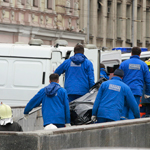
In the wake of the recent Moscow suicide bombings, the Russian people may begin to draw a connection between corruption among police and security forces and the inability of those security forces to protect Russian citizens from terrorist attacks.
Source: BBC Radio's Up All Night

Considering the history of terrorist attacks from the North Caucasus, Rojansky asserted that it is not unsurprising that the majority of Russians make the assumption that the bombings were linked to the North Caucasus. Most of the analysis thus far has suggested that these attacks were in retaliation for recent efforts by the federally backed forces in the North Caucasus to take out some of the militants hiding there. Rojansky explained that he expects the federal forces to react by further concentrating their counterterrorist efforts in the North Caucasus region.
These attacks should be seen as part of a series of attacks going back more than a decade, Rojansky stated. Generally speaking, Russians appreciate how difficult it is for their government to prevent such attacks, given the difficulty of penetrating militant communities. The Russian authorities have already taken significant actions against the militants believed responsible for the bombings, and Rojansky expressed doubts that the authorities have any good sources left. He added that further suicide attacks by female bombers, known as ‘black widows’ are especially difficult to prevent, as the bombers are often driven by strong personal emotions and sometimes operate almost independently.
Given that Russia has recently seen a number of protests about police accountability, corruption among security officials, and state power under Vladimir Putin and Dmitri Medvedev, Rojansky concluded with a question about whether the Russian people will speak out about the connection between police corruption and the inability of security forces to protect citizens from terrorist attacks.
Former Deputy Director, Russia and Eurasia Program
Rojansky, formerly executive director of the Partnership for a Secure America, is an expert on U.S. and Russian national security and nuclear-weapon policies.
Recent Work
Matthew Rojansky
Matthew Rojansky
Carnegie does not take institutional positions on public policy issues; the views represented herein are those of the author(s) and do not necessarily reflect the views of Carnegie, its staff, or its trustees.
In an interview, Sergei Melkonian discusses Armenia’s and Azerbaijan’s careful balancing act among the United States, Israel, and Iran.

Armenak Tokmajyan

Just look at Iraq in 1991.

Marwan Muasher

Baku may allow radical nationalists to publicly discuss “reunification” with Azeri Iranians, but the president and key officials prefer not to comment publicly on the protests in Iran.

Bashir Kitachaev
The country’s leadership is increasingly uneasy about multiple challenges from the Levant to the South Caucasus.
Armenak Tokmajyan
In an interview, Daniela Richterova speaks about her book on Czechoslovakia’s Cold War ties to Palestinian groups and others.

Michael Young