

Paper
George Perkovich
{
  "authors": [
    "George Perkovich"
  ],
  "type": "legacyinthemedia",
  "centerAffiliationAll": "dc",
  "centers": [
    "Carnegie Endowment for International Peace"
  ],
  "collections": [],
  "englishNewsletterAll": "ctw",
  "nonEnglishNewsletterAll": "",
  "primaryCenter": "Carnegie Endowment for International Peace",
  "programAffiliation": "NPP",
  "programs": [
    "Nuclear Policy"
  ],
  "projects": [],
  "regions": [
    "South Asia",
    "Pakistan"
  ],
  "topics": [
    "Security",
    "Military",
    "Foreign Policy",
    "Nuclear Policy"
  ]
}
Source: Getty
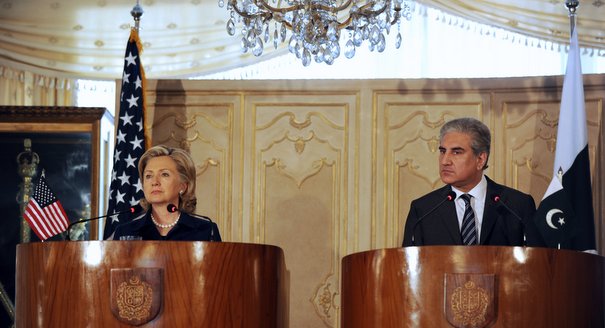
Washington should act to end its reliance on the Pakistani security establishment so that it can more effectively promote civilian political and economic development in the country.
Source: New York Times

For example, the United States' effort to help India become a global power, including by building up its nuclear and advanced conventional armories, makes the Pakistani establishment ever more angry and distrustful of the United States. The deployment of unaccountable mercenaries like Raymond Davis turns average Pakistanis against the U.S. These and other U.S. policies, including drone attacks in the tribal areas, may be tactically necessary because Pakistan’s own security establishment will not do its best to counter terrorists acting against India and Afghanistan. India’s growing power and importance inevitably will make the U.S. and others seek favorable terms of cooperation with it.
But aid combined with these other U.S. policies clearly has not changed the Pakistani military’s obsession with contesting India. There is nothing India or the United States can realistically do that will change this self-destructive obsession because the problem is India’s existence itself.
The pattern in U.S.-Pakistan relations merely repeats mutual frustrations and failings since the early 1950s. The U.S. always treats Pakistan as a means to achieve a larger end -- preventing the export of terrorism from Afghanistan now -- and Pakistan uses the U.S. to build capabilities to fight India. In fact, Pakistan is more important than Afghanistan, and too important to instrumentalize.
The U.S. would do less harm, and perhaps more good, by seeking the most friendly possible end of the symbiotic relationship with the Pakistani Army and intelligence services. By moving decisively to negotiate conditions for the withdrawal of most U.S. military forces from Afghanistan, the U.S. would greatly reduce its reliance on the Pakistani security establishment and that establishment’s leverage on Washington. The U.S. could then concentrate on Pakistan’s civilian political-economic development, offering assistance only in and as the Pakistani state itself is clearly committed to combating terrorism and promoting internal development.

Japan Chair for a World Without Nuclear Weapons, Senior Fellow
George Perkovich is the Japan Chair for a World Without Nuclear Weapons and a senior fellow in the Carnegie Endowment for International Peace’s Nuclear Policy Program. He works primarily on nuclear deterrence, nonproliferation, and disarmament issues.
Recent Work
George Perkovich
George Perkovich
Carnegie does not take institutional positions on public policy issues; the views represented herein are those of the author(s) and do not necessarily reflect the views of Carnegie, its staff, or its trustees.

In an interview, Ian Lustick and Eli Clifton discuss their new book on why a prominent ally has so much influence in America.

Michael Young

By failing to address Palestinian representation, the current process is bound to lead to just another temporary arrangement.

Nathan J. Brown

The armed forces champion a form of capitalism that is generating revenue, but its reliance on rent faces diminishing returns, leaving the country with massive sunk costs and deferred returns, deepening dependency on external borrowing.

Yezid Sayigh
In an interview, Marc Lynch discusses his new book decrying the post-1990 U.S.-dominated order in the Middle East.
Michael Young

Just look at Iraq in 1991.

Marwan Muasher