

Commentary
Nathalie Tocci, Jan Techau
{
  "authors": [
    "Jan Techau"
  ],
  "type": "legacyinthemedia",
  "centerAffiliationAll": "",
  "centers": [
    "Carnegie Endowment for International Peace",
    "Carnegie Europe"
  ],
  "collections": [],
  "englishNewsletterAll": "",
  "nonEnglishNewsletterAll": "",
  "primaryCenter": "Carnegie Europe",
  "programAffiliation": "",
  "programs": [],
  "projects": [],
  "regions": [
    "Europe"
  ],
  "topics": [
    "Foreign Policy"
  ]
}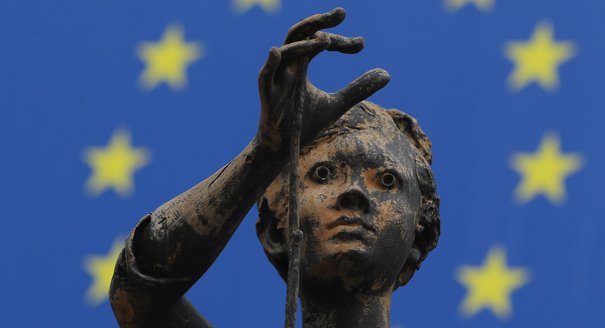
Source: Getty
The EU will only survive if it develops a strategic sense of self, both for integration at home and for an active role in the world.
Source: European Voice

Its social stability, economic strength, and the ability to innovate might still be strong and its political influence, especially in its immediate neighbourhood, still considerable. But relative to the rest of the planet, the ‘old world' is rapidly losing ground. This diminution of power puts at risk the freedom, peace, and prosperity that Europeans are so used to.
More alarmingly, Europeans are culturally ill-equipped to cope with their decline. Europeans have always been on top, either because of their own strength – until the 1940s – or as part of the West in alliance with – and by the grace of – the United States. This privileged position has made them lazy in their strategic thinking about the world and themselves. Today, they lack the proper mindset to fight their demise.
In order to survive in this new, scary world in which they find themselves, Europeans need to learn how to be more strategic with limited means and less influence. To develop a robust strategic mindset requires five actions.
First, Europeans need the courage and openness to think about the world, themselves, and the future in more realistic terms. Despite the various crises, the current political debate in Brussels and other European capitals is still being conducted as if nothing much will change, as if internal quarrels are really existential, and as if European wealth and importance can be taken for granted.
A new-found European realism involves developing a healthy sense of Europe's own size and influence, and its dependence on access to global markets – for both imports and exports. Europeans need to acknowledge that peace and freedom rely on the willingness and ability to defend them militarily, if needed. Europeans – pampered by seven comfortable post-war decades – often show a bothersome reluctance to accept such truisms. And their political leaders show little appetite to speak the full truth to the people.
Second, Europeans need stability and cohesion at home if they want to be strong abroad. This has two dimensions: social cohesion at the national level and political integration on the European level. The glue that holds both together is the legitimacy of the integration project. Far more integration will be needed to cope with global challenges. This deepening of the Union cannot be based solely on output legitimacy – the ability to produce benefits for the people – as it was in the past. It will need a lot more input legitimacy – the possibility for the people to have a say.
If the unification of Europe continues to be an elite project, the people will revolt either openly or by silently withdrawing their loyalty and support from both the EU and their home nations. Populism, extremism, isolationism, and potentially even violence could be the result. The EU needs a participatory revolution to boost legitimacy for integration.
Third, Europeans need to stay rich if they want to matter in the world. The reason why Europe is still relevant today is because of its immense economic power. This is due to an unprecedented economic integration process that created a single market, turned the EU into a global trade powerhouse and made Europe attractive for immigration.
All of this bought global influence. But with budgets in tatters, many economies' unreformed and sub-standard growth rates were considered normal, this influence is now dwindling. Europe needs to revamp its economic model if it wants to count for something in the future.
Fourth, Europeans have to accept that their strategic posture will be untenable without a close partnership with the United States. The US crucially underwrote the European integration process – a fact comfortably forgotten by many Europeans – by providing both the capital and security umbrella that made it possible. It still provides the defence guarantees that keep Europeans safe from political blackmail and allow them to dramatically underperform militarily.
Even in times of austerity, Americans are unlikely to give up on Europe entirely, but they will need far greater contributions, more political creativity, and a stronger sense of responsibility from Europeans in order to justify the expense of propping up the old continent. The uncomfortable truth is that while the US is possible without Europe, Europe is impossible without the US.
And finally, Europeans need to develop a limited but ambitious agenda for their external affairs. The key to this will be the ability to make tough policy choices. ‘Global Europe', a catchphrase from the more ambitious past, is over. This is the age of Strategic – read: selective – Europe. The top issues on Europe's strategic agenda must include its neighbourhood (eastern and southern), its military capabilities, energy, Asia, and global trade.
European ‘strategic-ness' must combine the internal and the external dimension of the integration process. The old dichotomy that played internal cohesion against external engagement is no longer useful. Integration without an active role in the world will fail. A role in the world without integration is impossible. In the long run, the only real hope for Europe's dwindling number of citizens is that decline will make them smart. If it doesn't, hard times lie ahead.

Director, Europe Team, Eurasia Group
Techau is director with Eurasia Group's Europe team, covering Germany and European security from Berlin. Previously, he was director of Carnegie Europe.
Recent Work

Nathalie Tocci, Jan Techau
Jan Techau
Carnegie does not take institutional positions on public policy issues; the views represented herein are those of the author(s) and do not necessarily reflect the views of Carnegie, its staff, or its trustees.

By failing to address Palestinian representation, the current process is bound to lead to just another temporary arrangement.

Nathan J. Brown

Just look at Iraq in 1991.

Marwan Muasher

A coalition of states is seeking to avert a U.S. attack, and Israel is in the forefront of their mind.

Michael Young

Baku may allow radical nationalists to publicly discuss “reunification” with Azeri Iranians, but the president and key officials prefer not to comment publicly on the protests in Iran.

Bashir Kitachaev
The country’s leadership is increasingly uneasy about multiple challenges from the Levant to the South Caucasus.

Armenak Tokmajyan