

Commentary
Dmitri Trenin
{
  "authors": [
    "Dmitri Trenin"
  ],
  "type": "legacyinthemedia",
  "centerAffiliationAll": "",
  "centers": [
    "Carnegie Endowment for International Peace",
    "Malcolm H. Kerr Carnegie Middle East Center",
    "Carnegie Russia Eurasia Center"
  ],
  "collections": [
    "Arab Awakening"
  ],
  "englishNewsletterAll": "",
  "nonEnglishNewsletterAll": "",
  "primaryCenter": "Carnegie Russia Eurasia Center",
  "programAffiliation": "",
  "programs": [],
  "projects": [
    "Eurasia in Transition"
  ],
  "regions": [
    "Levant",
    "Middle East",
    "Syria",
    "Caucasus",
    "Russia"
  ],
  "topics": [
    "Political Reform",
    "Foreign Policy"
  ]
}
Source: Getty
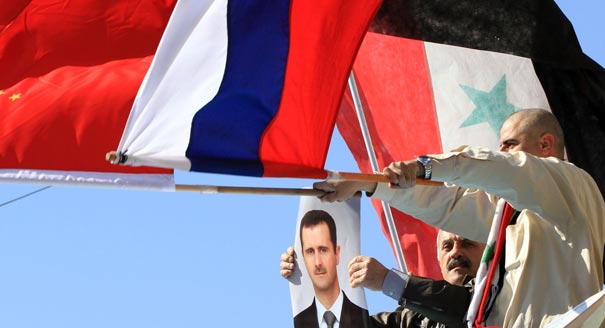
Russia's position on Syria is often described as a result of Damascus being Moscow's political ally, a major arms client, and a fellow authoritarian regime, but the reality is more complex.
Source: Global Times

Syria certainly used to be a Soviet ally, even though its then leader Hafez al-Assad, current leader Bashar al-Assad's father, used to get more out of the Kremlin than the other way around. The Russian Federation has no allies in the region for the simple reason that it stopped, from the time of its creation, competing against the US in the Middle East. Russia uses the Syrian port of Tartus as a resupply facility for its ships, occasionally passing through the Mediterranean, but it is a far cry from a regular naval base.
Syria remains a Russian arms client. Its military is Russian-equipped and trained. This relationship is four decades old, but Syria is neither a particularly big market for Russian arms, nor a very lucrative one: In order to sell more, Moscow has had to forgive Damascus its Soviet-era debt. Russia's Rosatom State Nuclear Energy Corporation has planned to build a nuclear reactor in Syria, but these plans have been put on hold.There is no doubt that the Assad family has ruled Syria in an authoritarian manner. It is also true that Putin has been a mildly authoritarian ruler of Russia. It does not follow, however, that there is such a thing as authoritarian solidarity. Bashar al-Assad's detractors include the authoritarian rulers of Saudi Arabia and Qatar. By contrast, Russia's position on Syria is echoed by India, which likes to call itself the world's largest democracy.
Russia's Syria stance is shaped by several factors. The arms relationship is one. The naval facility is another. Connections among the Syrian governing elite, built over the last four decades, certainly count. Other things, however, are equally or even more important.
One is Russia's rejection of a regime change engineered from abroad. Russians insist, as a matter of principle, on non-interference in other countries' internal affairs. In part, this is self-protection; in part, it is an attempt to protect their neighbors from becoming objects of US-supported revolutions.
Equally important is Russia's refusal to support foreign military interventions. Moscow views such interventions, even those dubbed humanitarian, as futile but destructive, and as generally encouraging the use of force in solving international issues. Russians fear that the US, with its overwhelming military power, may become addicted to such tools.
In the particular case of Syria, Moscow wants to make sure that UN Security Council resolutions expressly exclude the options of outside-induced regime change and of military intervention. Moreover, Russia does not want to condemn Assad alone. While acknowledging and deploring the regime's massive repressions, the Russians equally denounce the violence perpetrated by the anti-Assad forces.
Finally, Russia is paying back the West for its forces' recent conduct in Libya. There, Moscow's abstention during the UN Security Council vote, together with China, allowed the no-fly zone to be enacted, which meant in practice a NATO offshore military operation. The Russians then professed to be deceived by their US and European partners, and vowed not to allow a repeat of the Libyan episode.
Russia's position may look principled, reasoned and logical, yet it is costing Russia a lot in the eyes of Western liberal public opinion, the radical Arab street, and the conservative Gulf monarchies. Moscow understood too late that saying no to the West may have been brave, but was not good enough. It also realized that its offer of talks to the Assad government and the opposition, in order to be effective, should have come 10 months earlier.
As a result, Russian Foreign Minister Sergei Lavrov and Mikhail Fradkov, the head of Russia's Foreign Intelligence Service, are flying to Damascus to try to persuade Assad to become more flexible. For months, Russians have been contrasting the tough Western attitude to Syria to its much more lenient treatment of Yemen.
In Yemen, however, the US and Saudi Arabia worked hard to make President Ali Abdullah Saleh hand over power in exchange for immunity. If Moscow wants to show its influence, and not merely its principles, it should strive to match that record in Syria.
Former Director, Carnegie Moscow Center
Trenin was director of the Carnegie Moscow Center from 2008 to early 2022.
Recent Work
Dmitri Trenin
Dmitri Trenin
Carnegie does not take institutional positions on public policy issues; the views represented herein are those of the author(s) and do not necessarily reflect the views of Carnegie, its staff, or its trustees.
As the U.S.-led Coalition withdraws, the Kurds’ reliance on Baghdad, and on themselves, will only increase.
Wladimir van Wilgenburg

In an interview, Ian Lustick and Eli Clifton discuss their new book on why a prominent ally has so much influence in America.

Michael Young

As the U.S. stumbles in its war with Iran, we are likely to see an acceleration of its disengagement from the region.
Michael Young
The Zaidi government’s objective to collect weapons is constrained by regional conflict, but it can take certain measures at home.
Ali Al-Mawlawi

Huawei pushed hard to enter the Egyptian data centers market, until the Americans made a better offer.

Angie Omar