• Research
  • Diwan
  • About
  • Experts
Carnegie Middle East logoCarnegie lettermark logo
LebanonIran
{
  "authors": [
    "Matthew Rojansky"
  ],
  "type": "legacyinthemedia",
  "centerAffiliationAll": "dc",
  "centers": [
    "Carnegie Endowment for International Peace"
  ],
  "collections": [],
  "englishNewsletterAll": "ctw",
  "nonEnglishNewsletterAll": "",
  "primaryCenter": "Carnegie Endowment for International Peace",
  "programAffiliation": "russia",
  "programs": [
    "Russia and Eurasia"
  ],
  "projects": [],
  "regions": [
    "Middle East",
    "Syria",
    "Caucasus",
    "Russia"
  ],
  "topics": [
    "Political Reform",
    "Foreign Policy"
  ]
}
Source: Getty

In The Media

Opposition Rally in Moscow Draws Tens of Thousands

The recent public protests in Moscow differ from those in December and March because so far, they seem centered in Moscow, while the previous protests were widespread throughout the country.

Link Copied
By Matthew Rojansky
Published on Jun 14, 2012

Source: CTV

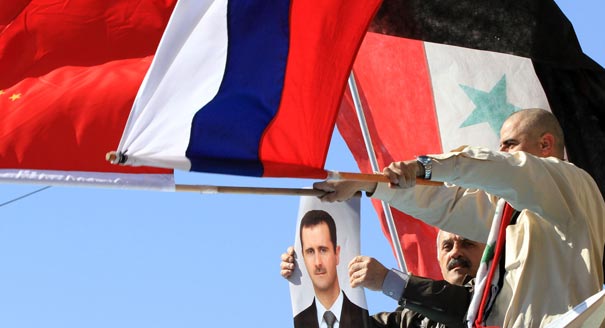
Speaking on CTV, Carnegie’s Matthew Rojansky discussed the Russia-Syria relationship and the domestic situation in Russia.

  • Russian Domestic Protests: Evaluating the recent large protest in Moscow during the national holiday, Rojansky said that unlike the protests in the December and March, which were widespread throughout the country, the current movement is centered in Moscow. “The negative there is that it is isolated, and that it doesn’t speak for the country as a whole,” he said. “The positive for the protesters is that they are in the media spotlight.” He concluded, “The fact that there has not been violence is good for protesters but it is also good for Putin. At a certain point, violence is going to tarnish Putin’s image and reputation and will bring more people out on the streets.”
     
  • Russia’s Relationship with Syria: Recently, U.S. Secretary of State Hillary Clinton suggested that Moscow might be sending attack helicopters to Syria. Rojansky commented on the possibility, saying “if it is true, that is a big if, and if this is an immediate delivery of attack helicopters, then that would be a real departure from Russia’s commitment to Syria.” He added, “it could be because simply one hand doesn’t know what the other hand is doing-that is, sometimes the Russian defense export industry is following through deals they think of as long-term arrangements irrespective of what the state of political play is.” He suggested that there is a third possible interpretation. “Another reason could be that the Russians are playing both sides of the game. We heard a couple of weeks ago that the Russians were prepared to talk about a post-Assad scenario, but obviously if they are supplying Assad with weapons he can use to effectively obliterate the rebels from the air, they are definitely playing for both sides,” he said.

This broadcast originally appeared in CTV.

About the Author

Matthew Rojansky

Former Deputy Director, Russia and Eurasia Program

Rojansky, formerly executive director of the Partnership for a Secure America, is an expert on U.S. and Russian national security and nuclear-weapon policies.

    Recent Work

  • Paper
    An Opportunity for Ambition: Ukraine’s OSCE Chairmanship

      Matthew Rojansky

  • In The Media
    Presiding Over the OSCE: Challenges and Opportunities

      Matthew Rojansky

Matthew Rojansky
Former Deputy Director, Russia and Eurasia Program
Matthew Rojansky
Political ReformForeign PolicyMiddle EastSyriaCaucasusRussia

Carnegie does not take institutional positions on public policy issues; the views represented herein are those of the author(s) and do not necessarily reflect the views of Carnegie, its staff, or its trustees.

More Work from Malcolm H. Kerr Carnegie Middle East Center

  • Commentary
    Diwan
    The Gulf Conflict and the South Caucasus

    In an interview, Sergei Melkonian discusses Armenia’s and Azerbaijan’s careful balancing act among the United States, Israel, and Iran.

      Armenak Tokmajyan

  • Commentary
    Diwan
    Syria Skirts the Conflict With Iran

    In an interview, Kheder Khaddour  explains that Damascus is trying to stabilize its borders, but avoiding war isn’t guaranteed. 

      Michael Young

  • people watching smoke rising at sunrise from rooftops
    Commentary
    Emissary
    Bombing Campaigns Do Not Bring About Democracy. Nor Does Regime Change Without a Plan.

    Just look at Iraq in 1991.

      Marwan Muasher

  • Commentary
    Diwan
    Axis of Resistance or Suicide?

    As Iran defends its interests in the region and its regime’s survival, it may push Hezbollah into the abyss.

      Michael Young

  • GCC foreign minister meeting in Kuwait City on June 2, 2025
    Article
    Can the Gulf Cooperation Council Transcend Its Divisions?

    Without structural reform, the organization, which is racked by internal rivalries, risks sliding into irrelevance.

      Hesham Alghannam

Get more news and analysis from
Malcolm H. Kerr Carnegie Middle East Center
Carnegie Middle East logo, white
  • Research
  • Diwan
  • About
  • Experts
  • Projects
  • Events
  • Contact
  • Careers
  • Privacy
  • For Media
Get more news and analysis from
Malcolm H. Kerr Carnegie Middle East Center
© 2026 Carnegie Endowment for International Peace. All rights reserved.