

Paper
Lora Saalman
{
  "authors": [
    "Lora Saalman"
  ],
  "type": "legacyinthemedia",
  "centerAffiliationAll": "dc",
  "centers": [
    "Carnegie Endowment for International Peace",
    "Carnegie China"
  ],
  "collections": [
    "Korean Peninsula"
  ],
  "englishNewsletterAll": "ctw",
  "nonEnglishNewsletterAll": "",
  "primaryCenter": "Carnegie China",
  "programAffiliation": "NPP",
  "programs": [
    "Nuclear Policy"
  ],
  "projects": [],
  "regions": [
    "East Asia",
    "North Korea"
  ],
  "topics": [
    "Nuclear Policy",
    "Arms Control",
    "Security"
  ]
}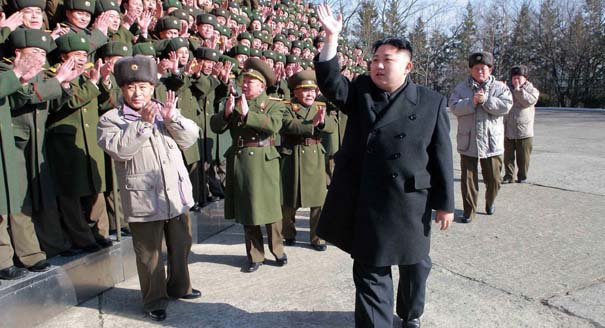
Source: Getty
North Korea has vowed to continue expanding and strengthening its 'self-defensive military power' to cope with sanction pressures.
Source: Voice of Russia

Lora Saalman: As you’ve mentioned I don’t think that it really surprises anyone, particularly given the overall environment in which North Korea exists. Now, of course when we look at the North Korean environment as it exists today, it is not just an issue of the international security environment, but also of the domestic situation. And I would say that many of the things that we see occurring we have to also think of the domestic audience within North Korea, it is not just foreign external audience.
So, the strong reaction also needs to be categorized and the fact that they have a new leader who is also very young, who is also trying to prove his mettle vis-à-vis the military community within his own country and also trying to demonstrate that North Korea can undertake a very strong reaction and stand up against the pressure from the outside world, particularly from the US.I think from the Chinese perspective what we are seeing here is also to a degree has its domestic and external motivations. I think from the Chinese perspective of course, they have been pushing all along for the importance of returning to the negotiating table, the importance of the six-party talks.
And so this has been one of their major talking points all along, when any other country have excoriated North Korea and said that it doesn’t have a commitment to denuclearization or to the multiparty process, China has always brought up this idea that if they return to the negotiating table or if they will be willing to give some way North Korea would return.
The fact that North Korea wants to walk away from everything would of course be a major blow, particularly to the kind of diplomacy that China has been engaged in and also to its role as a mediator within this entire North Korean nuclear issue.
Well, I think that actually when they were willing to reveal the fact that they had centrifuges to Siegfried Hecker, that was the scientist who went there, actually it depends on your perspective. I think that there was a veiled threat aspect to that, but as well there was a certain degree to which they were actually being transparent, which of course is what the international community is constantly pushing North Korea to be.
So, it is very hard to say one way or the other. It is a veiled threat and it is at the same time they actually engaging in behavior that the international community would like to see. If they have this program, then of course they may let everyone know and this is actually a form of mutual reassurance.
I do think however that we have to take them seriously on such threats. For example, when they talk about significant action or that they might engage in some form of significant action after the UN Security Council resolution has emerged – I do think that the likelihood of them for example conducting another nuclear test is extremely high.
But once again, I don’t know that this necessarily violates or is in discordance with their past behavior. We saw this in 2006 after a missile test, we saw it in 2009 after a missile test. And of course their current commitment, the UN Security Council resolution set forward all of those activities. So, I think that actually they’ve been extremely consistent all the way through. And so, if anything I would take them on the word if they say that they are going to do something or engage in some form of somewhat provocative behavior.
Lora Saalman: Well, I think one of the big steps forward and one of the things which will probably bolster the international community is the fact that both China and Russia have come forward in agreement with the UN Security Council in supporting this particular UN Security Council resolution. In the past there have been efforts by those two countries in particular to water things down or to soften the language, or to make sure that for example Chapter 7 is not involved, suggesting that there could be some form of military action.
And I think that in this particular case it does show that there is a consensus in the international community and particularly among these five members of the Security Council, that this is extremely serious.

Former Nonresident Associate, Nuclear Policy Program
Saalman was a nonresident associate in the Nuclear Policy Program at the Carnegie Endowment for International Peace. Her research focuses on China’s nuclear and strategic policies toward India, Russia, and arms control.
Recent Work
Lora Saalman
Lora Saalman
Carnegie does not take institutional positions on public policy issues; the views represented herein are those of the author(s) and do not necessarily reflect the views of Carnegie, its staff, or its trustees.
In an interview, Marc Lynch discusses his new book decrying the post-1990 U.S.-dominated order in the Middle East.

Michael Young

Just look at Iraq in 1991.

Marwan Muasher

Baku may allow radical nationalists to publicly discuss “reunification” with Azeri Iranians, but the president and key officials prefer not to comment publicly on the protests in Iran.

Bashir Kitachaev
In addressing Hezbollah’s disarmament, the Lebanese state must start by increasing its own leverage.
Michael Young
The country’s political and military establishment is still debating how to interpret the recent war’s outcome.

Nicole Grajewski