

Commentary
Sarah Chayes
{
  "authors": [
    "Sarah Chayes"
  ],
  "type": "legacyinthemedia",
  "centerAffiliationAll": "dc",
  "centers": [
    "Carnegie Endowment for International Peace"
  ],
  "collections": [],
  "englishNewsletterAll": "ctw",
  "nonEnglishNewsletterAll": "",
  "primaryCenter": "Carnegie Endowment for International Peace",
  "programAffiliation": "SAP",
  "programs": [
    "South Asia"
  ],
  "projects": [],
  "regions": [
    "South Asia",
    "Afghanistan"
  ],
  "topics": [
    "Political Reform",
    "Democracy",
    "Security",
    "Military",
    "Foreign Policy"
  ]
}
Source: Getty
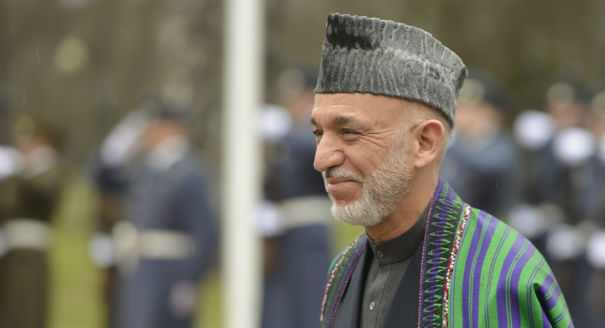
CIA payouts to Hamid Karzai have bolstered a corrupt government and undermined U.S. interests in the region.
Source: Los Angeles Times
In a time when the whetted and arbitrary deficit-reduction knife is cutting bone out of critical U.S. government programs, the image of shopping bags stuffed with CIA cash handed off on a monthly basis to Afghan President Hamid Karzai—who reigns over one of the most corrupt governments on the planet—has outraged many Americans.
The New York Times, which revealed the years of payoffs this week, noted that "there is little evidence the payments bought the influence the CIA sought."
In fact, regular cash handouts of this type may do the opposite. They may well have enabled Karzai's frequent and theatrical outbursts against U.S. officials and policies, not to mention his collusion with some of his country's most corrupt and abusive officials. Such payoffs signal to Karzai — or other leaders like him — that he enjoys the unwavering support of the CIA, no matter what he does or says, and embolden him to thumb his nose at the United States whenever he feels like it.Karzai's relationship with the CIA is believed to long predate the tense days in late 2001 when CIA officers joined him and his followers in the mountains north of Kandahar as the Taliban regime was falling. In a 2003 conversation, the most renowned commander of anti-Soviet resistance fighters in southern Afghanistan, where I lived at the time, told me that in the late 1980s Karzai introduced him to CIA officials so he could obtain some of the all-important Stinger missiles that helped the Afghan fighters neutralize Soviet helicopters. U.S. support of the anti-Soviet resistance was covert. Very few Afghans had direct contact with the CIA. Most received U.S. money or military equipment by way of Pakistani intermediaries. Karzai, according to this commander, was one of the early exceptions.
Given this long relationship with the CIA, Karzai may believe that the agency somehow represents the true voice of the U.S. government. Indeed, the competing and often contradictory exhortations and demands transmitted by ambassadors and special envoys who come and go, the successive commanders of international forces with their different approaches, the congressional delegations who troop through his office, even secretaries of State or Defense, must start to sound like a lot of cacophonous noise to the man on the receiving end. Amid the din, CIA money can ring a clear note.
The tendency to read CIA signals as conveying the "real" intent of the U.S. government is not limited to Afghan leaders. In his book The Arab Center, for example, former Jordanian foreign minister Marwan Muasher describes a tense episode in 2004 when Jordan was promoting a broad-based Arab initiative to break the deadlock in the Middle East peace process.
A meeting between President George W. Bush and King Abdullah II was hanging in the balance, with the king awaiting the result of fraught negotiations between Muasher and National Security Advisor Condoleezza Riceover the contents of a letter of intent from Bush to Abdullah. A full day of talks resulted in a mutually agreeable formulation.
But in the meantime, a CIA official had been speaking back channel with Jordan's intelligence chief, waiting on the West Coast with the king; the CIA official urged the delegation to fly home to Jordan, and it did. In the end, the king and his advisors concluded that it was the CIA, not the national security advisor, that really counted in the U.S. government, and the Middle East peace process remained stalled.
In Karzai's case, CIA payments, against a backdrop of jangling dissonance, may allow him to choose which messages to take seriously — usually the ones he likes. Or to play some U.S. actors off against others, as he recently did by subjecting Defense Secretary Chuck Hagel to public humiliation while courting Secretary of State John Kerry.
Many Afghans I know had assumed for years that the CIA was doling out cash to Karzai. Even so, the U.S. media expose has made waves, providing evidence for what had only been suspected.
"No wonder he talks so badly against the United States," one friend said, summarizing the reactions he'd heard. "The cash, on top of everything else America has done for him, just proves how desperately you need him. It means he can do anything."
This can hardly be the only time the CIA has covertly paid off key foreign leaders, with little if any coordination with other U.S. decision-makers and little understanding of the repercussions. Such activities amount to an independent foreign policy, lacking connection to any concerted plan, and too often conflict with the U.S. government's wider priorities. It is time, in this as in other domains, to inject some accountability and oversight into CIA operations.
Former Senior Fellow, Democracy, Conflict, and Governance Program
Sarah Chayes is internationally recognized for her innovative thinking on corruption and its implications. Her work explores how severe corruption can help prompt such crises as terrorism, revolutions and their violent aftermaths, and environmental degradation.
Recent Work
Sarah Chayes
Carnegie does not take institutional positions on public policy issues; the views represented herein are those of the author(s) and do not necessarily reflect the views of Carnegie, its staff, or its trustees.

In an interview, Ian Lustick and Eli Clifton discuss their new book on why a prominent ally has so much influence in America.

Michael Young

By failing to address Palestinian representation, the current process is bound to lead to just another temporary arrangement.

Nathan J. Brown

The armed forces champion a form of capitalism that is generating revenue, but its reliance on rent faces diminishing returns, leaving the country with massive sunk costs and deferred returns, deepening dependency on external borrowing.

Yezid Sayigh

Just look at Iraq in 1991.

Marwan Muasher

A coalition of states is seeking to avert a U.S. attack, and Israel is in the forefront of their mind.
Michael Young