

Commentary
Dmitri Trenin
{
  "authors": [
    "Dmitri Trenin"
  ],
  "type": "legacyinthemedia",
  "centerAffiliationAll": "",
  "centers": [
    "Carnegie Endowment for International Peace",
    "Malcolm H. Kerr Carnegie Middle East Center",
    "Carnegie Russia Eurasia Center"
  ],
  "collections": [
    "Arab Awakening"
  ],
  "englishNewsletterAll": "",
  "nonEnglishNewsletterAll": "",
  "primaryCenter": "Carnegie Russia Eurasia Center",
  "programAffiliation": "",
  "programs": [],
  "projects": [
    "Eurasia in Transition"
  ],
  "regions": [
    "Egypt",
    "Levant",
    "Maghreb",
    "Middle East",
    "North Africa",
    "Russia"
  ],
  "topics": [
    "Political Reform",
    "Foreign Policy"
  ]
}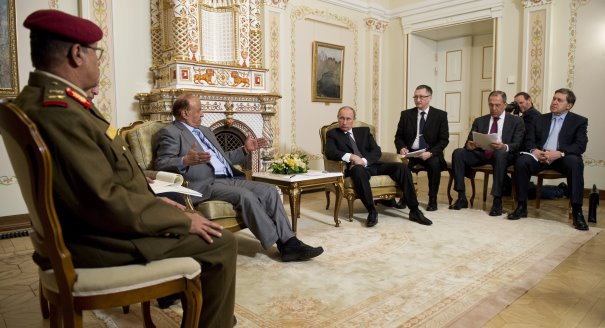
Source: Getty
Russia is clearly concerned with the rise of Islamist extremists in the Middle East and is looking for ways to prevent destabilization in the region. At the same time, it is seeking to improve ties with various Arab countries.
Source: World Politics Review
Last month, Russian President Vladimir Putin hosted Mohammed Morsi, a former Muslim Brotherhood leader and Egypt’s first post-Arab Spring president, even as Russia continued to back Bashar al-Assad’s regime in Damascus against an assorted opposition that includes the Syrian branch of the Brotherhood. This apparent contradiction illustrates the challenges Russia is facing in the post-Arab Spring Middle East.Like virtually everyone else, Moscow was surprised by the groundswell of change that began in the Arab world in early 2011. Experts advising the Russian government call this a tectonic shift and compare its impact to that of the two defining periods in the region’s 20th-century history: the fall of the Ottoman Empire and the secular revolutions of the 1950s and 1960s. The present “Arab Awakening,” they opine, may take years, even decades, to unfold and is likely to transform the entire shape and fabric of the region. Its future course and dynamics are hard to predict, but in the end it will give a boost to the processes of social and political modernization that so far have largely bypassed the Arab Middle East and North Africa. ...
Read the full text of this article in World Politics Review.
Former Director, Carnegie Moscow Center
Trenin was director of the Carnegie Moscow Center from 2008 to early 2022.
Recent Work
Dmitri Trenin
Dmitri Trenin
Carnegie does not take institutional positions on public policy issues; the views represented herein are those of the author(s) and do not necessarily reflect the views of Carnegie, its staff, or its trustees.
The Zaidi government’s objective to collect weapons is constrained by regional conflict, but it can take certain measures at home.
Ali Al-Mawlawi

Huawei pushed hard to enter the Egyptian data centers market, until the Americans made a better offer.

Angie Omar

The accord represents a pivotal moment in the region to avert a security vacuum in the Gulf.


Azeema Cheema, Mohanad Hage Ali

In an interview, Jason Burke discusses his sweeping account of the “revolutionists” who so shaped the 1970s and early 1980s.

Michael Young

By failing to address Palestinian representation, the current process is bound to lead to just another temporary arrangement.

Nathan J. Brown